
How investment projects progress from their initial stages through to being selected has always been an essential aspect of venture capital. Whereas the main philosophy of investing in good founders has stayed consistent, the approach towards finding and vetting potential startups has evolved drastically. In the current environment that is characterized by the speed at which things happen, the idea of deal flow venture capital is among the most crucial aspects in investment practices.
This guide explores what deal flow really means, why it influences investment outcomes, and how modern tools help investors identify good opportunities with greater clarity. Whether you’re an investor, founder, or someone studying the investment ecosystem, this guide is designed to give you a complete and structured understanding.
What Deal Flow Means in Venture Capital
At the simplest level, deal flow refers to the steady stream of startups that investors review for potential funding. When we talk about deal flow venture capital, we mean the entire path a startup takes from the moment it reaches an investor’s attention to the final decision on whether to fund it.
Good deal flow is not about collecting as many leads as possible. This pertains to making sure that every deal is appropriate, documented, reviewed, and monitored. Investment firms rely on continuous deal flow since it dictates the composition of their portfolio in the coming years. Without the introduction of new deals into the pipeline, there will be no way for investments to increase or diversify.
Deal flow forms the backbone of every venture fund’s operations. Each stage: sourcing, screening, evaluation, discussion, and decision, supports the overall effort to select startups that align with the fund’s long-term goals.
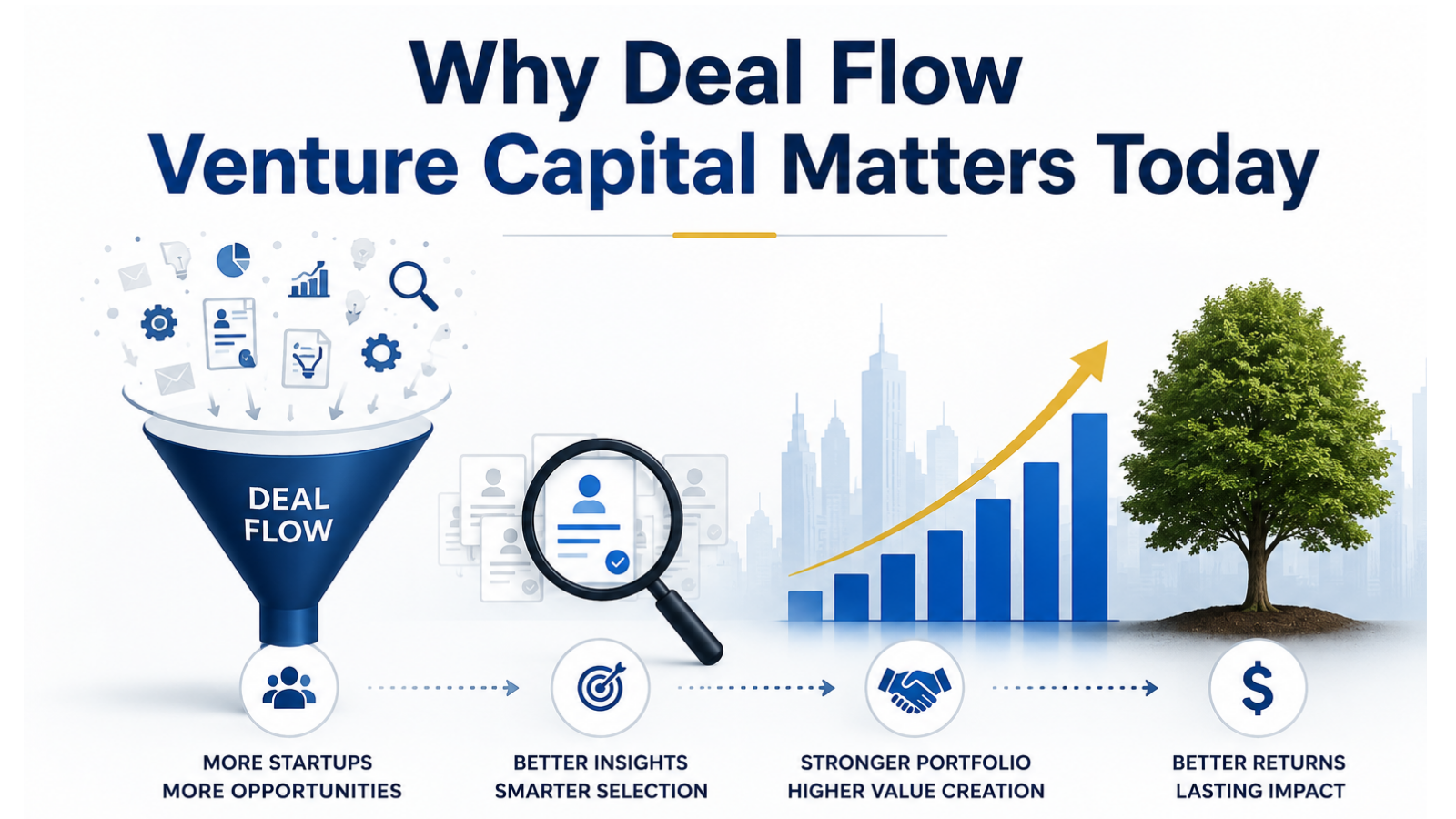
Why Deal Flow Venture Capital Matters Today
The venture ecosystem has expanded rapidly over the last decade. More founders, more startups, more ideas, and more competition have entered the landscape. As a result, investors must sift through larger volumes of information while making decisions that often need to be fast. This is precisely why deal flow venture capital has taken center stage.
A well-structured deal pipeline helps investors stay organized and confident. Without a reliable structure, decisions become inconsistent, slow, or unclear. Since every investment shapes the fund’s performance, strong deal flow gives investors the advantage of choice. They can compare different founders, assess different markets, and choose the strongest opportunities available at any moment.
A strong deal flow pipeline also reflects a fund’s reputation. Founders often prefer approaching firms with transparent decision-making, quick follow-ups, and well-structured evaluation methods. The better the experience a fund offers, the better the quality of startups entering its pipeline.
How Deal Flow Used to Work
Before investment platforms, dashboards, and automated tools became common, deal flow relied heavily on personal connections. Most venture capital relationships developed from industry conversations, conferences, startup events, and direct introductions. Many deals also arrived through cold emails or referrals from founders already in a fund’s portfolio.
This traditional approach worked to some extent, but it came with several challenges. Occasionally, there were cases where deals were not documented. Data was found in emails, spreadsheets, and personal memos. Methods of assessment varied depending on each individual partner. There were discrepancies in communicating with company founders.
In this older system, the success of deal flow venture capital depended largely on individual habits and personal networks. As venture capital expanded globally, this way of working became harder to maintain. Investors needed systems that brought structure to both sourcing and decision-making.
How Modern Tools Have Changed Deal Flow
Today’s investment landscape looks very different from the past. Technology has made it possible to organize the entire process of sourcing and evaluating startups. Simple dashboards, structured submission forms, organized data, and centralized communication tools have made deal flow venture capital more efficient than ever.
This shift has not replaced human judgment. Rather, the contemporary process is designed to minimize the labor required by analysts and partners before. It helps to manage the submissions process, keep a record of submissions, make comparisons between the startups, and have a consistent process for all opportunities. In addition, it facilitates teamwork among the investors and allows them to reference prior work.
The main change is that deal flow has transitioned from a loose collection of contacts and conversations into a structured pipeline. Instead of relying on memory or scattered spreadsheets, funds now manage deal flow with clarity and consistency.
The Five Core Stages of Deal Flow Venture Capital
Every strong deal pipeline follows a structured sequence. Understanding each step helps explain how investors move from discovery to decision. These stages also serve as checkpoints to ensure that every opportunity is reviewed fairly.
- Sourcing the Deal
This is where the pipeline begins. Sourcing refers to the moment a startup first appears in front of a venture firm. It might come through warm introductions, online submissions, industry research, incubators, accelerators, or even founder communities.
For a fund to maintain strong deal flow venture capital, sourcing must be continuous. The more channels a fund builds over time, the better the quality and diversity of its opportunities.
- Initial Screening
When the startup joins the system, there is a brief evaluation conducted to see if it meets the investment mandate of the fund. At this point, the investors consider the industry, stage, traction, founder experience, and relevance to the investment thesis.
The purpose of screening isn’t to finalize a decision. Instead, it helps investors filter out opportunities that clearly won’t fit. A well-designed screening process can save hundreds of hours for the investment team each year.
- Deep Evaluation
Successful startups proceed to the evaluation process. Here is where experts analyze the model of the business, its financial status, product readiness, consumer demand, market potential, scalability, and competition.
This phase may take the longest time. As it is the deciding factor, it is imperative that a comprehensive analysis be performed so that sound decisions can be made.
- Internal Review and Discussions
Once all the data is analyzed, the team then proceeds to discuss this internally. Every member of the investment team sees things from a different perspective based on his experience.
This stage helps identify blind spots and strengthens the overall decision-making process.
- Final Decision
This ends with the extension of a term sheet or the polite refusal of the offer. Funds that have an excellent communication strategy remain on good terms with founders regardless of the response.
It is important to note that this step influences the perception that founders have of the fund. And in turn, founder perception often influences future deal flow.
What Weakens Deal Flow in Venture Capital
Even strong funds face bottlenecks in their pipeline. A lack of good deal flow can be due to unclear process, disorganization, poor communication, or lack of sources.
If the startups are not measured correctly, they may be forgotten. If the assessment process takes too much time, the founders lose their enthusiasm. If there are different evaluation measures among different members of the team, then inconsistency will set in.
All of these issues affect the strength of deal flow venture capital. Investors who recognize these weaknesses can fix them before they affect long-term performance.
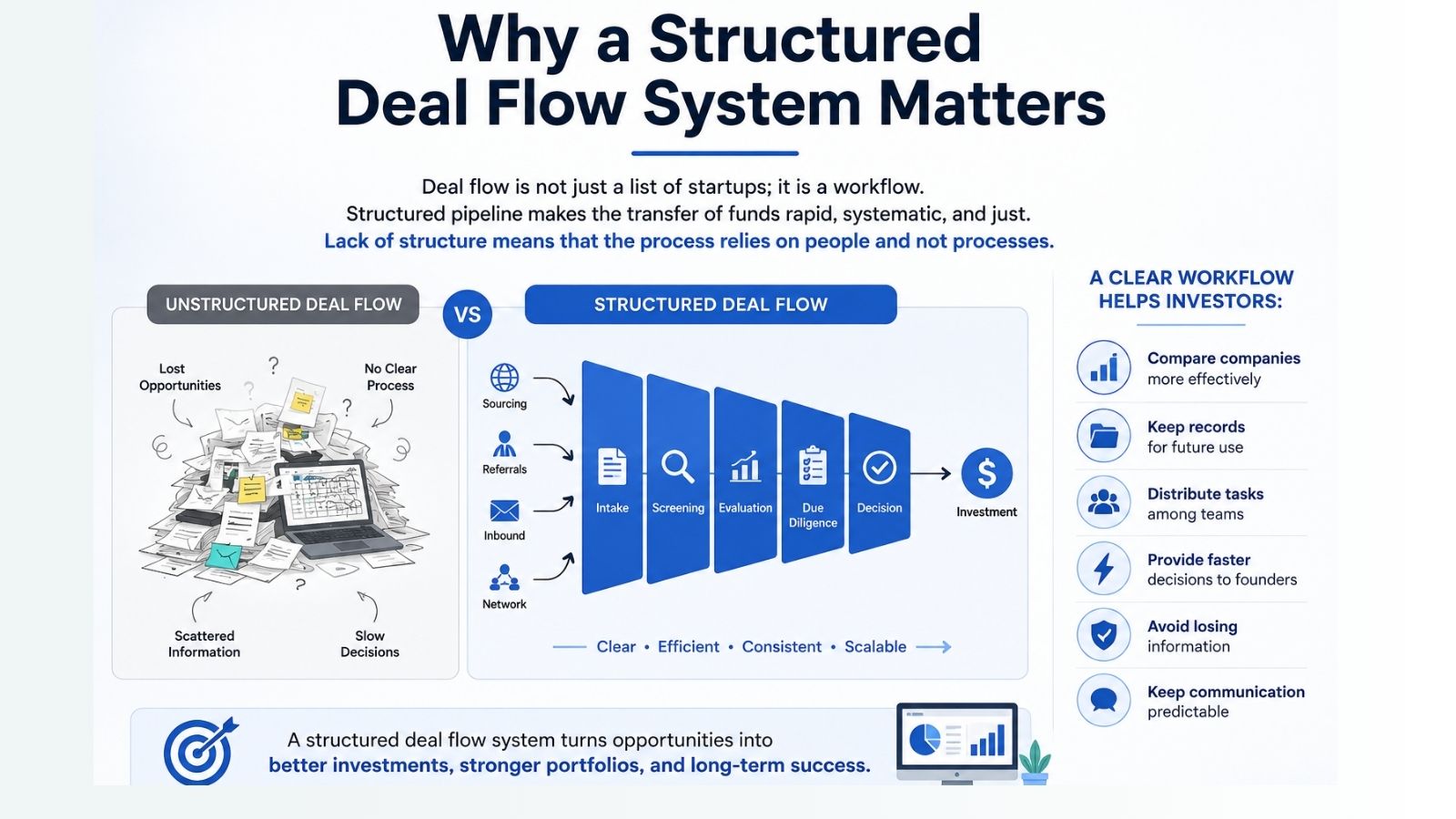
Why a Structured Deal Flow System Matters
Deal flow is not just a list of startups; it is a workflow. Structured pipeline makes the transfer of funds rapid, systematic, and just. Lack of structure means that the process relies on people and not processes.
- A clear workflow helps investors:
- Compare companies more effectively
- Keep records for future use
- Distribute tasks among teams
- Provide faster decisions to founders
- Avoid losing information
- Keep communication predictable
Structure allows the investor to be more confident when dealing. Structure also makes the process easier for the entrepreneur, thereby building the reputation of the fund over time.
How Smarter Screening Improves Investment Quality
Screening plays a significant role in shaping final outcomes. When investors screen efficiently, they avoid spending time on opportunities that obviously don’t fit their thesis. This helps them focus on the startups that truly deserve deeper evaluation.
Better screening also leads to better organization. A strong framework ensures:
- Faster response times
- Clearer criteria
- More consistent decision-making
- Fewer misunderstandings
- Stronger founder relationships
Since screening serves as the gatekeeper of the pipeline, improving this stage enhances the entire deal flow venture capital ecosystem.
How Data Strengthens Venture Capital Decisions
Modern investment teams rely heavily on data, not complicated analytics, but clear information that reveals patterns over time. The more structured a fund’s pipeline is, the more useful data it collects.
The data is useful for helping investors determine the industries that are emerging and who the good founders are. It enables people to make sound judgments and not rely completely on instinct when making choices.
Good data also helps teams revisit past deals. There may be times when a startup that had been turned down before comes back with better traction. With all documents well-organized, information from past ventures can be retrieved quickly and the potential revisited.
Why Communication Matters in Deal Flow
The way the fund communicates is one way startups gauge whether it’s worth their time or not. The founders appreciate being well-informed even if the venture capital ultimately decides not to invest in them. This transparency creates trust, and founders refer other startups to the fund because of that.
Clear communication helps avoid misunderstandings, makes timelines predictable, and builds a positive experience for everyone involved. Funds that communicate well usually see better long-term relationships with both founders and other investors.
How Venture Teams Benefit from Consistency
Investment decisions involve multiple people, analysts, associates, partners, advisors, and sometimes external experts. When each person evaluates startups differently, the overall process becomes unpredictable.
Consistency brings objectivity. It ensures that each deal receives a fair and equal review. It reduces unnecessary debates and helps teams move from screening to decision without confusion. This reliability becomes especially important when the volume of deal flow increases.
A consistent process strengthens the entire structure of deal flow venture capital.
How Funds Strengthen Deal Flow Over Time
A strong deal flow pipeline doesn’t appear overnight. It develops through continuous relationship-building, consistent sourcing, repeated evaluation, and ongoing improvements.
Deals become better thanks to the fact that funds remain involved in the community of entrepreneurs, having submission channels wide open, and building their reputation as fair players. Also, funds have good relationships with various accelerators, incubators, universities, and even other investors who introduce projects.
Regular reflection also contributes to stronger deal flow. As a team evaluates its processes at the end of each quarter, it finds areas to improve on and eliminate any problems that may have arisen in the process. These minor changes cumulatively lead to better processes and results.
Why Speed Matters in Today’s Venture Environment
Startups today move quickly, and investors must keep up. Slow decision-making can cause a fund to lose strong opportunities to faster competitors. When a fund responds quickly, it gains a reputation for efficiency, which attracts founders.
The faster every step takes place, the more space will be created for other deals. Speed affects the process for founders and investors alike and is an important component of deal flow VC.
How Deal Flow Supports Long-Term Portfolio Quality
Every investment affects the fund’s long-term performance. Strong deal flow leads to better investment decisions, and better decisions lead to a stronger portfolio. Over time, this compounding effect determines the fund’s overall success.
If there is an orderly pipeline system in place, then investors will be able to concentrate on what really matters. They will be able to analyze and choose good startups and markets.
Conclusion
Deal flow is the foundation of venture capital. It affects how investors find opportunities, filter them, evaluate them, and make a decision about approving them. An effective system means that all the opportunities get the right treatment and contribute to developing relations in the ecosystem.
In today’s environment, deal flow venture capital requires structure, clarity, and thoughtful processes that support both investors and founders. Whether you’re part of a large venture fund or an emerging team, building a strong deal flow system helps you make smarter decisions, stay organized, and create long-term value.
FAQs
- How does the quality of sourcing channels impact long-term investment outcomes?
Strong sourcing channels bring in relevant and well-prepared startup opportunities. When these channels mature, they improve the long-term strength of deal flow venture capital by ensuring investors always have access to founders who match their thesis.
- What role does internal communication play in strengthening deal flow?
Communication between analysts, associates, and partners is vital to avoid duplication of effort and minimize delays so that every startup will progress smoothly within the pipeline process. This internal clarity directly improves overall deal flow venture capital efficiency.
- Why do some venture teams struggle to maintain consistent evaluation criteria?
Evaluations may rely heavily on personal experience and individual judgment. In the absence of common standards, teams will generate inconsistent standards. Eventually, inconsistencies compromise the evaluation process and disrupt the flow of venture capital deals.
- How can founder experience be improved during the evaluation process?
Founders value punctuality, courtesy, and clear understanding of follow-through measures. If such transparency is exhibited by investors, then founders are more likely to suggest other startup ventures.
- What does an investor gain by tracking rejected deals over time?
Some startups return months or years later with stronger traction. Investors can rely on past decisions to help them make decisions quicker and see patterns that help make their decisions easier.
- How do funds benefit from reviewing their pipeline quarterly?
Quarterly review sessions will enable the team to identify any roadblocks, which will ensure that they make quick and easy decisions. This will ensure that the whole process is streamlined.
- Why is speed becoming a defining factor in modern deal flow venture capital?
The market moves quickly, and founders often prioritize investors who respond fast. When a fund builds a reputation for speed, it gains access to higher-quality opportunities, strengthening its deal flow venture capital pipeline.
- How does reliable data influence future investment decisions?
Data gathered from previous investments helps the investor to make sense out of various trends. For example, the markets that always perform well, what business model is scalable, and which founders have a track record of success among others.

I’m the Co-Founder of Startup Steroid, where I help founders navigate the challenges of building a startup. From connecting with the right investors and talent to guiding marketing, legal, and MVP development, I work alongside entrepreneurs to provide practical support and clarity, helping them grow their ideas into successful, sustainable businesses.