
There are cycles in financial markets, and volatility is one of their attributes. During some cycles, everything goes smoothly, but during others, there may be many drops, surges, and uncertainties. Investors have to take these factors into account when deciding how to act; therefore, they require sophisticated instruments that will help them to analyze changes and risks effectively. Here, the investment management system comes into play.
In recent years, many firms have begun integrating artificial intelligence into these platforms to help them perform more efficiently, especially when volatility is high. AI investment management systems are not merely online technologies used for the storage or presentation of information. These are technologies developed for assisting decision making processes through the analysis of huge amounts of data in real time, beyond what human capacity can achieve.
Understanding Market Volatility
Market volatility refers to how quickly and widely asset prices move over a given period. In case there are frequent price movements in the stock market, then it is called volatility. There may be several reasons for such volatility. These reasons include economic news, political occurrences, surprising news, earnings, wars, and changes in investor sentiments.
During volatile periods, information becomes harder to interpret. What seems like a trend may reverse rapidly. Information generated during the morning may become obsolete by the afternoon. This poses difficulties for advisers, analysts, and even individual investors who require sufficient time to make sense of the data.
The investment management system will be designed to make sense of the data available in the financial markets. Investors will be able to track their portfolios, manage their performance, and observe the flow of investments. In times of stability, everything will be easy to achieve. But during times when there is instability in the markets, further assistance will be needed by investors. This is where AI begins to play a central role.
What an Investment Management Platform Does
Before we explore how AI strengthens these systems, it is helpful to understand the core responsibilities of an investment management platform.
To begin with, at the most fundamental level, the investment management system collects data from multiple sources, market feeds, research studies, performance history, and economics and displays the same in a structured format. This allows for better position management, comparisons, risk assessment, and decision-making.
Another benefit of having a solid investment management platform is that it gives you the ability to create strategies, review your past choices, and predict future results based on current trends.
Yet, there are limitations in such systems. Their processing speeds are not limitless, and their effectiveness is dependent on human intervention. In stable economic climates, this is okay. But when it comes to volatile markets, data is changing very fast, which leaves no room for human interpretation.
It is precisely this discrepancy in abilities that has made artificial intelligence platforms for investing increasingly popular. These platforms increase the abilities of standard platforms and create new abilities in response to market changes.
Why AI Matters in Volatile Markets
AI matters because it can process information far more quickly than any human team. During sudden market shifts, AI investment management software is able to quickly analyze the newly available data and draw conclusions about what has changed. This process becomes extremely important during large price swings.
One more crucial benefit of using AI in investment management is its capability to recognize the signals that may be overlooked by people. Humans tend to pay attention to those indicators which seem obvious. At the same time, AI technology is capable of analyzing several thousand parameters, making comparisons between past price dynamics and today’s activity, thus discovering hidden connections.
AI is also useful because it does not rely on emotional decision-making. Investors may panic when there is volatility in the market or may be driven by emotion when there is bad news. AI-based investment management systems use information that is entirely fact-based.
Finally, AI enhances prediction. Any approach is unable to forecast market trends accurately; however, with the help of AI technologies, there is a possibility of estimating probabilities via trend analysis, scenario modeling, and past experience assessment. This way, people will be able to know about the potential risks and probabilities.
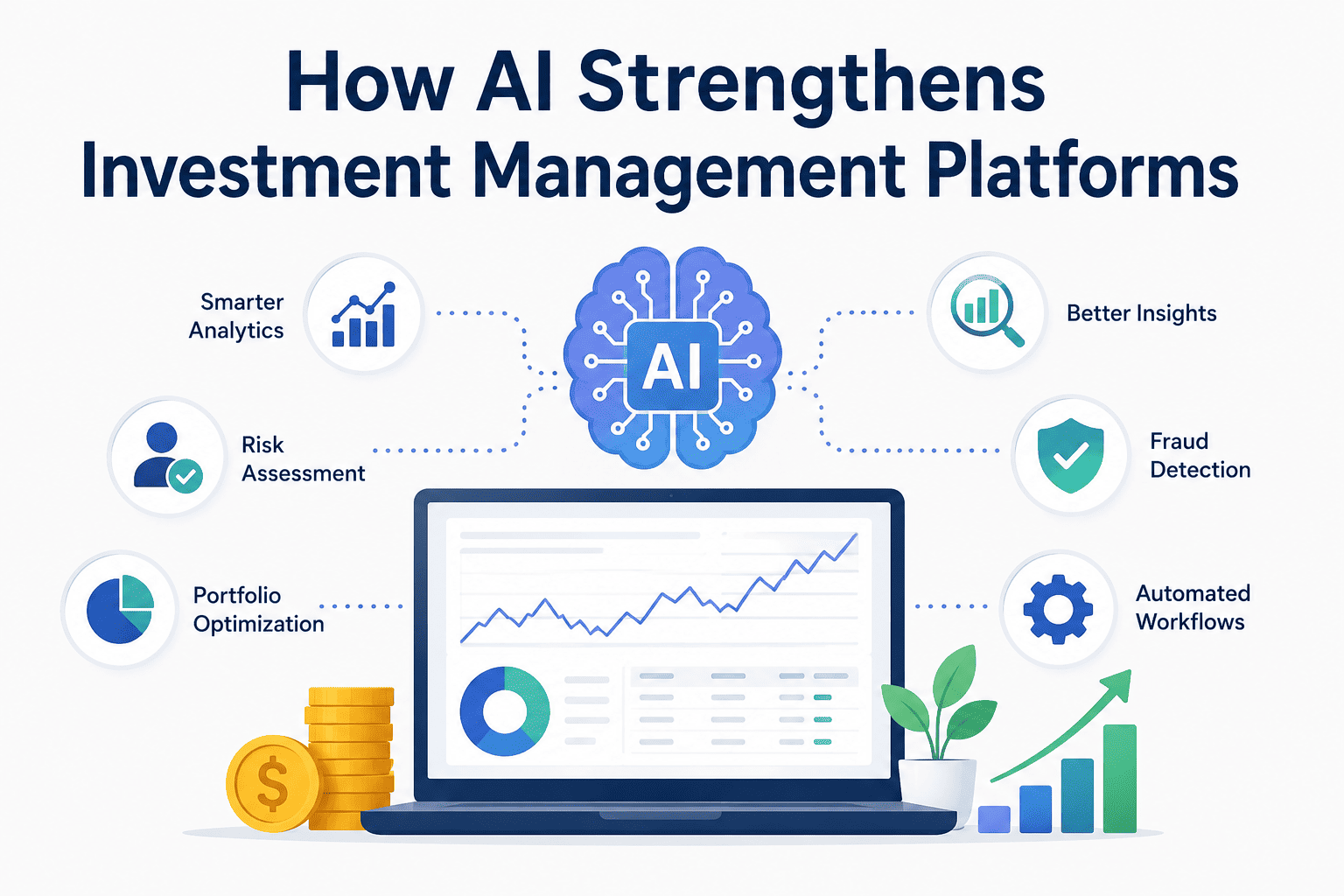
How AI Strengthens Investment Management Platforms
AI strengthens investment management platforms in several ways, each contributing to better decision-making during unpredictable market conditions.
- Faster Data Analysis
The power to scan through voluminous data within seconds makes it possible for AI to provide instant results. Any changes occurring in the market ensure that the investment management software is always up to date with the most recent scenario.
- Improved Risk Detection
The AI system evaluates signals that point out higher risks. The system can detect abnormal behavior of certain assets, alert stressed sectors, or issue warning signals on the basis of news from around the world. Such innovation allows the investor to adjust his strategy in advance and avoid more serious losses.
- Scenario Testing
A powerful feature of AI is its ability to simulate scenarios. It can examine how a portfolio might respond to interest rate changes, political announcements, or sudden market shocks. This helps investors understand different outcomes and prepare accordingly.
- Adaptive Strategy Support
AI can change its suggestions according to changing trends. In case the trends turn positive or negative, it will update the analysis instantly as and when required.
The “What”: What AI Brings to Investment Management Platforms
When examining the “what,” it becomes clear that AI adds several capabilities that traditional tools cannot provide as efficiently.
AI brings deeper data interpretation. The research is done on trends from a variety of markets, financial asset types, and locations. The interdependencies between certain variables can be revealed, which enables investors to gain insight into price behavior.
AI also contributes to consistency. With an investment management system supported by AI, there will be no fatigue or bias involved in its functioning. The system will analyze data at all times so that nothing significant will escape its notice.
Another significant benefit brought about by AI is the simplification of complex data. In volatile markets, there may be mixed or misleading signals. AI investment management systems are capable of filtering out irrelevant data and highlighting what really counts.
Scalability is another advantage that comes with the implementation of AI technology. The system can easily accommodate an increasing workload without affecting its performance.
The “Why”: Why AI Is Needed in Volatile Markets
The need for AI becomes most evident during high uncertainty. Volatility often causes rapid increases in the volume of data. Reports, prices, economic releases, and news come out constantly. It would be impossible for a human team to process such volumes of information fast enough.
The other reason that makes artificial intelligence necessary relates to the complicated nature of today’s markets. Modern times call for interconnected markets, meaning that something happening in one country may affect prices somewhere else instantly.
AI is also needed because investors require confidence when uncertainty rises. When markets experience drastic fluctuations, most investors begin to second-guess their approach. AI helps reassure them by delivering insights based on facts rather than emotions.
Lastly, AI is important due to the need for speed when dealing with volatility. The opportunities may come and disappear instantly. When there is AI involved in investment management platforms, people will be able to move swiftly.
The “How”: How AI Makes Strategies Stronger
To understand the practical impact of AI, it helps to look at how the technology strengthens actual investment practices.
- Refining Buy and Sell Decisions
AI analyses the actions in the market and recommends the ideal time to enter or exit. The AI system can pick up signals indicating the start of momentum or when something begins to lose its momentum.
- Supporting Diversification
The role played by AI is to help investors select the right set of assets that will be resilient amid volatility. The algorithm will consider how different assets correlate and recommend a portfolio that is likely to minimize risks.
- Tracking Behavior in Real Time
AI monitors changes as they happen. In case there is increased volatility on any asset, the investment management system will notify the investor instantly. Real-time information becomes important in ensuring that investments are safeguarded.
- Identifying Hidden Opportunities
During unstable periods, some assets may be undervalued because the market is reacting emotionally rather than rationally. AI investment management platforms help identify these overlooked possibilities.
User Experience Improvements
AI does not only strengthen the analytical side of an investment management platform. It also improves user experience.
The interface becomes more user-friendly thanks to AI’s contribution to data organization. Charts that used to crowd the screen now only include the necessary information. The user interface becomes more understandable for users of any experience level.
AI will also allow for better customization. For instance, investors can get information that relates directly to their needs in terms of their investment goals, risk-taking capacity, etc.
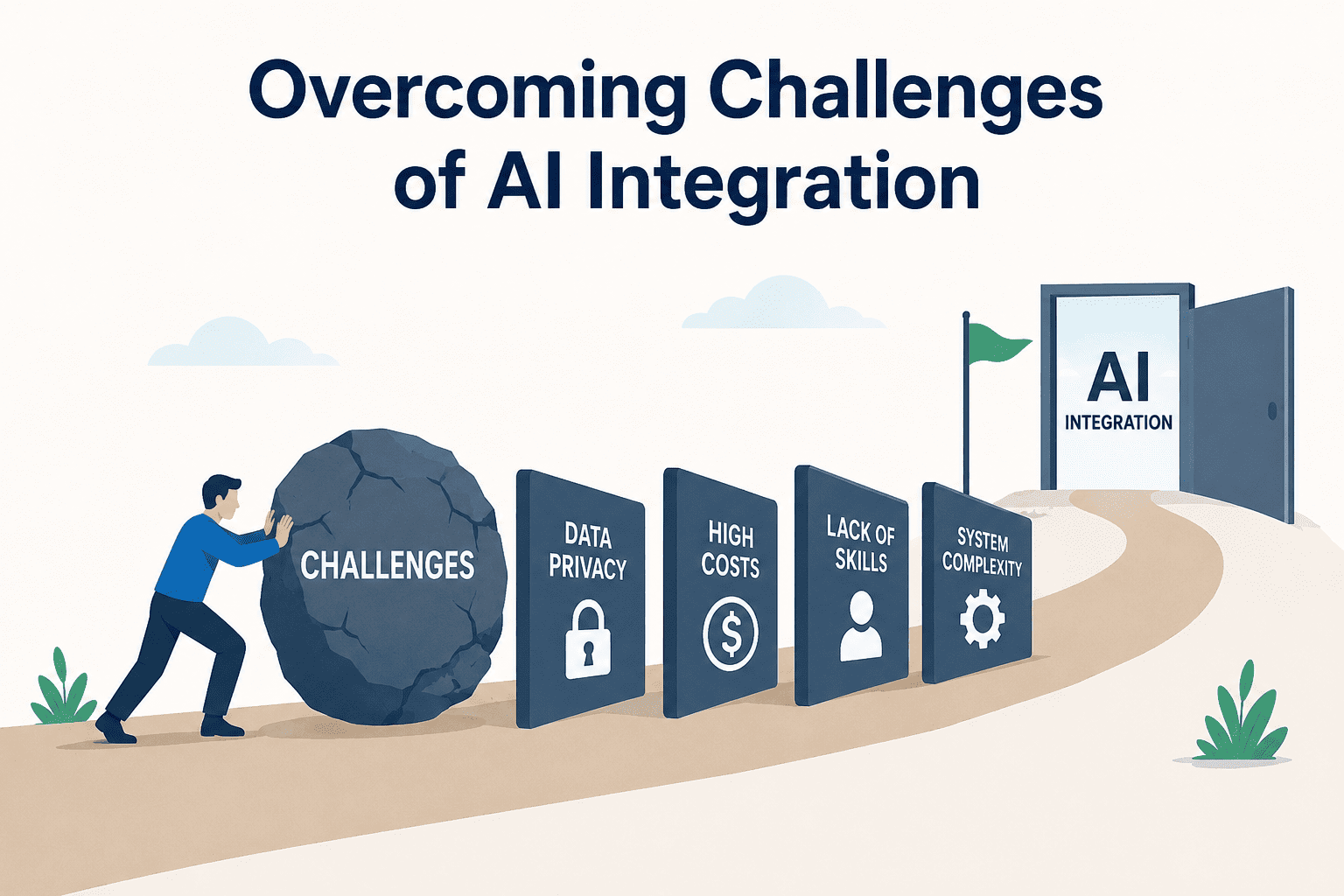
Overcoming Challenges of AI Integration
AI investment management platforms have a number of advantages, yet there are still some problems associated with their use. For example, the quality of data needed by these tools is highly important. Otherwise, the information obtained might be biased.
Another challenge is maintaining transparency. The investor desires to know how insights have been generated. Even as AI provides a way to make sense of information provided, platforms need to ensure that they communicate insights effectively.
Another issue is making sure that technology only complements humans rather than supplanting them entirely. It is most effective when working in conjunction with skilled experts.
Why Investors Trust AI More Today
Investor trust has grown because AI has repeatedly shown strong performance in interpreting complex data. During past market shocks, many investment management platforms equipped with AI demonstrated resilience by helping users make informed decisions.
Investors also trust AI because it removes guesswork. When markets behave unpredictably, having a system that relies on logic, patterns, and evidence helps calm uncertainty.
Finally, trust has increased because AI is now being used by major institutions around the world, demonstrating its credibility.
Future Potential of AI Investment Management Platforms
AI-based investment management systems are expected to become increasingly advanced. Possible advancements include improved capability for understanding international developments in terms of predicting how such changes can impact financial markets. These systems might also incorporate long-term forecasting algorithms to analyze larger economic trends.
Personalized investment portfolios have been recognized as another field with much potential. Advanced future systems would be able to adjust investment portfolios according to results achieved.
As technology evolves, the investment management platform itself will become more interactive, more adaptive, and more supportive of both new and experienced investors.
Conclusion
Volatile markets challenge even the most experienced investors. Price fluctuations occur rapidly, news events happen frequently, and one has to make decisions with little or no data at all. While an investment management system already brings some order into the process, adding AI capabilities makes it significantly more effective.
The AI investment management platform allows for fast analysis, better risk detection, scenario testing, and strategic adaptations. They ensure that the investor stays calm during turbulent times through factual information provided. The tool filters the noise to reveal true trends and create opportunities from them.
By combining human intuition and artificial intelligence’s ability to interpret data, it becomes possible to create a better investment climate. With ongoing market evolution, artificial intelligence is set to become increasingly important, ensuring that investors get all the support they need as part of the decision-making process. Over time, artificial intelligence will continue to complement human intuition, offering valuable assistance in the future.
FAQs
- How does an investment management platform help interpret fast-changing market data during volatile periods?
An investment management portal will aggregate the real-time feed, historical data, and market studies into an organized structure to allow investors to discern signal from noise; especially important considering that information becomes stale in hours.
- Why do AI investment management platforms perform better than traditional tools when markets are unstable?
Due to their capability of analyzing large amounts of data very fast, spotting trends that may have been overlooked otherwise, and changing risk profiles based on dynamic needs, AI-driven stock investment systems can quickly adapt to any changes in stock prices.
- Can AI reduce the chances of overreacting to short-term market fluctuations?
Yes. The use of artificial intelligence technology helps to understand the volatility by analyzing historical and macroeconomic trends, which prevent impulsive decisions made by investors. The application stresses statistically significant events rather than all market events.
- What role does data quality play in the effectiveness of an investment management platform?
The efficiency of the platform would depend on the quality of the information that can be obtained via the platform. Higher levels of diversity and accuracy of information would mean better comparisons, risk models, and portfolio analysis, especially in times of uncertainty within the marketplace.
- How do AI tools identify whether a sudden market move is a trend or just temporary noise?
With the use of machine learning algorithms which depend on historical tendencies, the AI technology makes comparison of volatility information in past incidences. This is achieved through the significance of the anomalies, correlations between the markets and sentiments.
- Do AI investment management platforms replace human judgment?
Of course not. It actually makes it better. The AI finds things that humans would not find as easily, but the decisions are always made by investors based on their experience and strategy.
- How can an investment management platform support long-term strategy creation even during turbulent market phases?
Through these systems, investors can test their strategies, analyze past decisions, and model various future possibilities. This ensures that investors do not stray from their plans owing to any uncertainties that arise in the short run.
- What unique advantages do firms gain by adopting AI early within their investment processes?
This gives them better analytics, better risk monitoring, and an advantage when volatility sets in. As more data is fed into the model, its effectiveness will become increasingly precise with time. This means that the decisions made will be more intelligent.

I’m the Co-Founder of Startup Steroid, where I help founders navigate the challenges of building a startup. From connecting with the right investors and talent to guiding marketing, legal, and MVP development, I work alongside entrepreneurs to provide practical support and clarity, helping them grow their ideas into successful, sustainable businesses.