
A private equity firm does not make success just by finding a good company. The success of a private equity firm comes from identifying the correct opportunity, understanding the associated risk, and formulating a value creation strategy after acquiring the business. Evaluation is extremely important in private equity due to its financial consequences.
In today’s competitive environment, investors have access to more opportunities than ever before. At the same time, they face increasing pressure to deliver strong returns while managing risk. This makes a thorough investment evaluation process essential.
The key component in any successful deal is always due diligence. The importance of due diligence lies in the fact that it allows an investor to confirm facts, scrutinize assumptions, identify hidden threats, and discover areas for future growth prior to any investments being made. By 2026, the due diligence process adopted by private equity players will be more comprehensive and include factors such as operational ability and technology readiness among others.
This guide discusses the nature of private equity investment analysis, the importance of conducting such analysis, and how firms conduct effective due diligence when evaluating investments.
What Is Private Equity Investment Evaluation?
Private equity investment evaluation involves the analysis of a company prior to deciding whether or not to invest in or buy out the company. The purpose is to assess whether the company fits into the investment portfolio of the firm and is able to offer good returns.
The process involves more than analyzing figures pertaining to revenues and profits. The investors must understand the nature of the business, its sources of growth, its market competitiveness, and the potential threats that the business might encounter in the future.
Investment evaluation provides a complete view of the opportunity. Investment analysis assists the investor in assessing whether the firm has sustainable competitive advantages, an effective management team, sound finances, and a viable way forward for further growth.
More importantly, investment analysis enables the investor to address three important questions:
- Is the company worth investing in?
- What risks could affect future returns?
- How can value be created after acquisition?
The answers to these questions shape every investment decision.
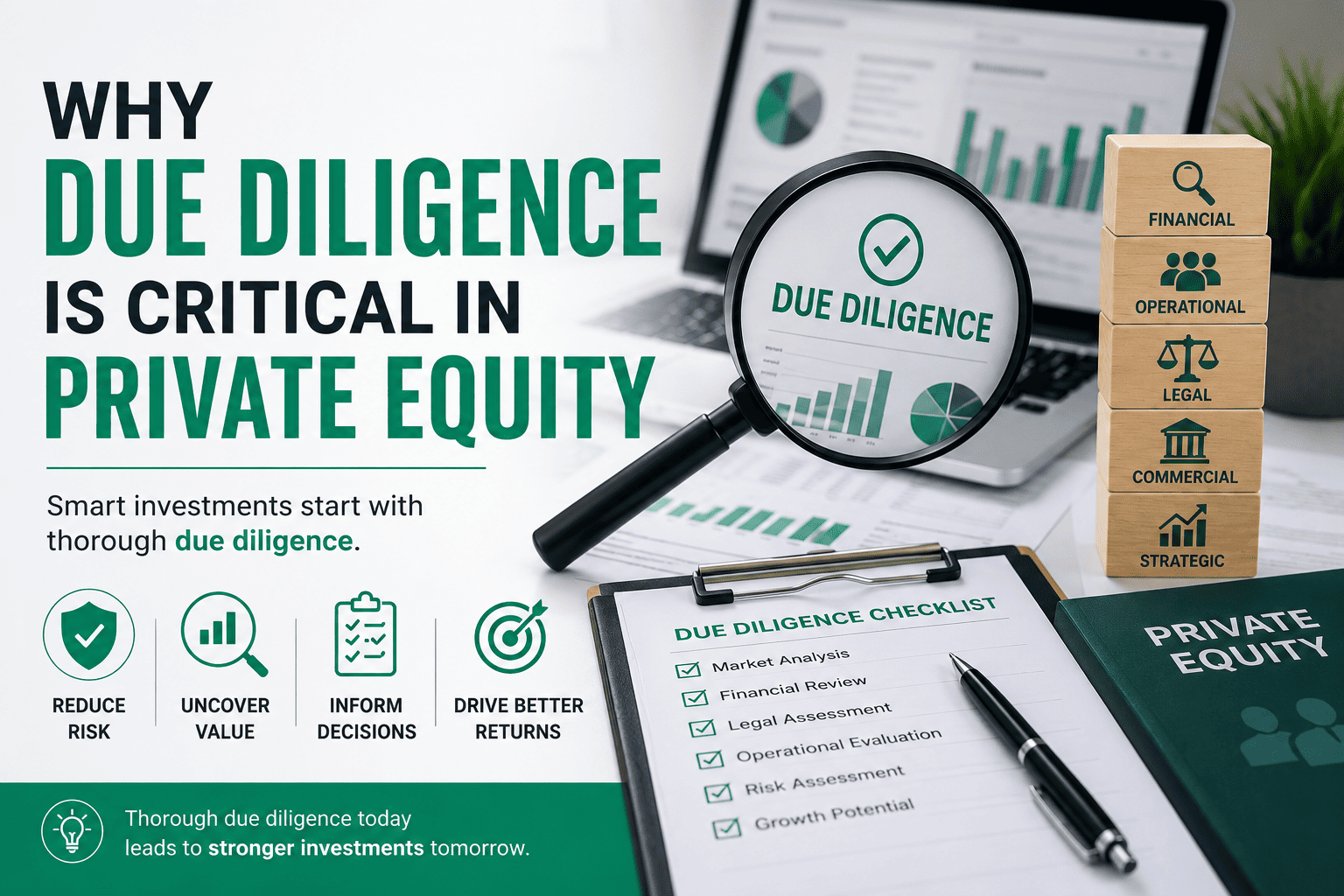
Why Due Diligence Is Critical in Private Equity
Since private equity transactions usually require large capital investments and have lengthy hold times, undoing a bad investment after the transaction becomes very costly.
This is why due diligence is one of the most important stages of the investment process.
Due diligence helps investors confirm any information given by sellers and management personnel. This step also enables investors to find any problems that were hidden at the earlier stage of discussion.
As an illustration, although an organization may claim significant revenue growth, closer scrutiny can unearth the fact that most of the growth has come from just a few clients. Moreover, while a business may seem profitable, there might be inefficiencies and other matters of concern within its operations that could pose problems in the future.
Conducting full due diligence eliminates all uncertainties and ensures that investors have the necessary information. In addition, it enables investors to know whether the given valuation is justified or not.
How Private Equity Due Diligence Has Evolved
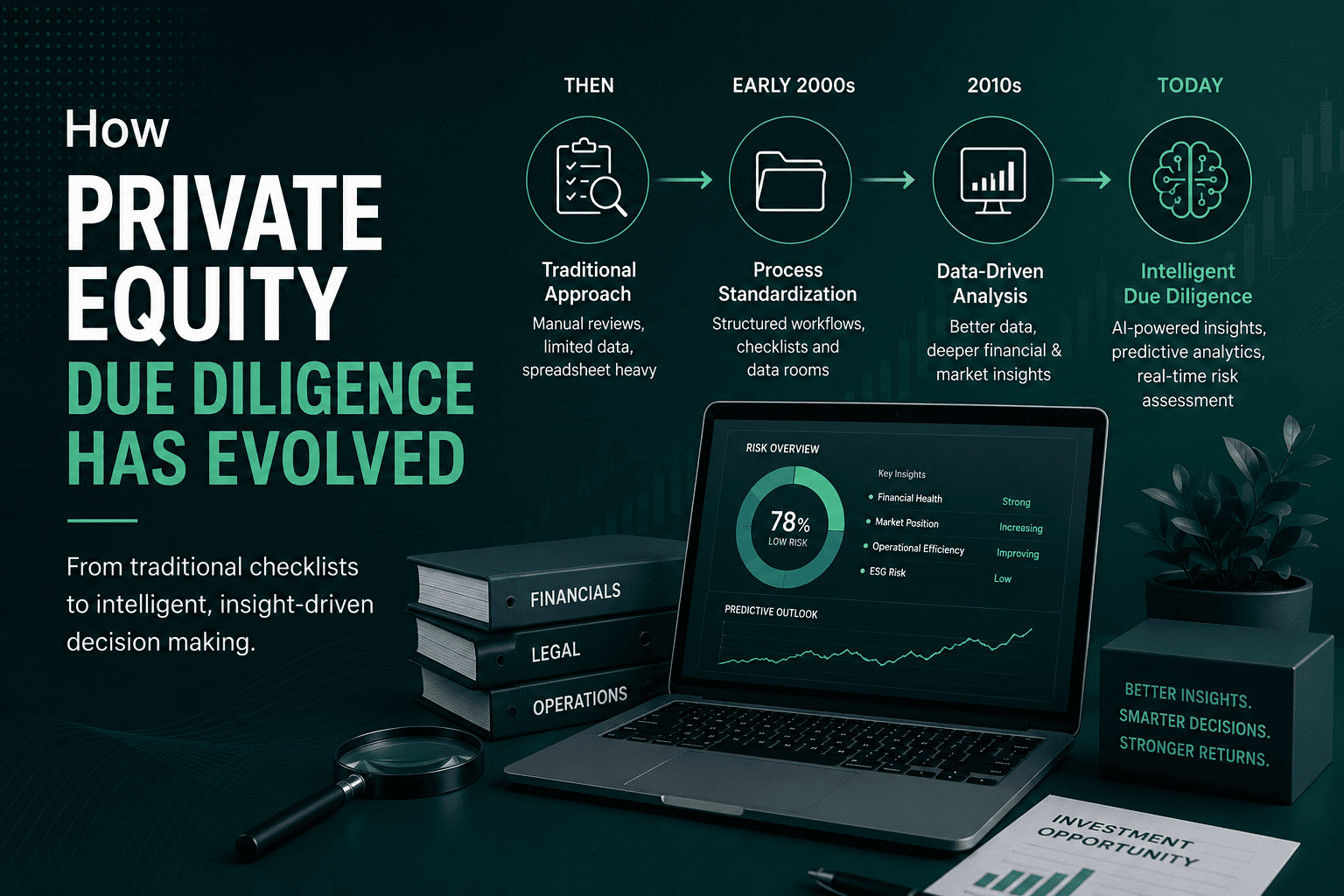
The due diligence process has changed significantly over the past decade.
Historically, many firms focused primarily on financial statements, market conditions, and legal matters. While those areas remain important, investors now recognize that long-term success depends on many additional factors.
By 2026, it is expected that private equity firms will conduct analysis on the performance of operations, cyber readiness, customer retention rate, employee engagement level, and digital literacy of the company. In this instance, the approach is no longer limited to just assessing risk but instead considers the full range of opportunities available.
Investors not only wish to know that the company currently thrives but that it will thrive in the future regardless of any market changes. It gives a much more comprehensive view of the investment opportunity.
Establishing an Investment Thesis
Every private equity transaction begins with an investment thesis.
An investment thesis is the rationale behind the investment. It helps to understand why the business considers this company an appealing prospect and describes the way value will be generated while holding the investment.
For instance, an investor can think that the company is going to enter into new markets, become more profitable by being more efficient in its operations, or gain market share through acquisitions.
The investment thesis serves as the foundation for the entire evaluation process. Throughout the due diligence process, the investors’ assumptions are checked against the thesis. In case the assumptions are proven incorrect, then there is a possibility of changing the investment strategy.
A strong investment thesis provides direction and helps investors remain focused on the factors that matter most.
Financial Due Diligence: Understanding the Numbers
Financial due diligence is often the first major step in evaluating a company.
The objective is to ensure the correctness of financial data and develop an understanding of how the firm performs economically. The process begins with the analysis of the financial history of the organization.
An increase in revenues is very significant; however, the quality of the increase is also analyzed by the investors. It is vital to ensure that the revenues earned are sustainable and diversified. The risk associated with a firm whose customers are few is higher than that of firms that have many customers.
Profitability is another key area of focus. Investors assess margins, operating expenses, and earning quality to determine whether profits accurately reflect ongoing business performance.
Cash flow is also another crucial aspect of evaluating a company. It could be that the business has very high profitability levels, but it has cash flow problems. Cash flow is an indication of stability within the business.
Financial due diligence also includes reviewing debt obligations, working capital requirements, and overall balance sheet strength. The goal is to develop a realistic understanding of the company’s financial condition before moving forward.
Commercial Due Diligence: Evaluating Market Potential
Even the strongest financial performance means little if a company’s market is shrinking. Commercial due diligence helps investors understand the external factors influencing future growth.
This process begins by analyzing the market itself. The investor takes into account the size of the market, market trends, consumer demand, and competitive environment. An expanding market provides more chances for growth compared to a mature market or a declining market.
Commercial due diligence also focuses on competition. Investors need to understand how the company differentiates itself and whether its competitive advantages are sustainable.
A business that consistently wins customers because of superior products, strong branding, or unique capabilities may be better positioned for long-term success.
Customer relationships are also equally significant. The investors analyze the retention rate of customers, their purchasing behavior, contracts, and their level of satisfaction.
By combining market analysis with customer insights, investors can determine whether projected growth assumptions are realistic.
Operational Due Diligence: Looking Beyond Financial Results
Financial success is a result of the business activities; however, it does not necessarily indicate the efficiency of its management process.
Operational due diligence involves evaluating how the business works on a daily basis. Potential investors analyze internal processes, structure, supply chain, production capability, etc.
Efficiencies must be identified, along with any potential bottlenecks or improvements that can be made. Operational analysis is critical in identifying value that may be created through improvements following the acquisition. Improvements in procurement, workflow, or inventory can make a business very profitable.
Supply chain analysis has become especially important in recent years. The disruptions in the global economy have emphasized the need for diversification and resilience. It is important for investors to know whether a company is exposed to risks of disruption, and if there are any other sourcing alternatives available.
Another key factor that investors consider is scalability. A business might be thriving currently, but the question remains whether the system has the capability to grow in the future or not.
Assessing the Management Team
Many private equity professionals consider management quality to be one of the strongest predictors of investment success.
A capable leadership team can execute strategic initiatives, navigate challenges, and drive long-term growth.
As part of their due diligence process, investors spend a lot of time analyzing the management team. This includes looking at management experience, expertise, vision, and abilities.
Management interviews can provide investors with insights about the decision-making process. Additionally, investors analyze the entire organizational structure. An organization which is highly dependent on one person faces great risks when that person exits the firm.
Strong organizations typically have leadership depth and clear succession plans. In most cases, private equity firms may opt for keeping the existing management in place because their knowledge is crucial for future success.
Legal Due Diligence: Identifying Potential Liabilities
Legal issues can significantly affect investment outcomes.
Legal due diligence enables the investor to become aware of the responsibilities, disputes, and compliance issues which may affect performance in the future. This includes the analysis of agreements, contracts, licenses, and permits.
Agreements made with customers and suppliers are essential as they have the potential to influence income and business. The other legal issues that need consideration include lawsuits and possible disputes.
Even minor legal matters could turn out to be sources of financial liability and distractions for the management.
Businesses in heavily regulated sectors need to have good compliance systems because otherwise, they could face sanctions and other problems. Legal due diligence enables investors to be fully aware of the legal issues related to their investments.
Tax Due Diligence and Transaction Structure
Tax considerations can have a meaningful impact on investment returns.
The main function of tax due diligence is the identification of both risks and opportunities before the transaction is finalized. The investors evaluate previous tax history, tax audit, and taxes owed.
In addition, they consider possible exposure for taxes that need to be paid on a state, federal, and even international level. Tax due diligence does more than simply detect liabilities.
Deal structuring can affect future taxation, cash flow, and returns. Proper structuring of the transaction can help increase the performance of investments made.
Technology Due Diligence in the Digital Economy
Technology plays an increasingly important role in business performance.
Regardless of whether the business is in manufacturing, healthcare, finance, or retail industries, technology may play an important role in influencing efficiency and customer experience, among other factors.
Due diligence in technology concerns evaluation of the elements related to technology at the company. Investors find out whether the technology used is adequate for their current purposes and further development.
The need for upgrading old systems can lead to higher costs following the acquisition, making growth plans difficult to implement. Technology assessments can reveal any difficulties that might be encountered while integrating technologies into one’s system.
Cybersecurity as an Investment Risk
Cybersecurity has become a major area of focus during due diligence.
Data breaches and cyberattacks can create substantial financial and reputational damage. These factors include an assessment of the company’s security measures, data security measures, incident response measures, and risk management strategies.
This helps assess the adequacy of the protective measures put in place to safeguard the company’s sensitive information. As cyber-attacks continue to grow more sophisticated, cybersecurity due diligence has become part and parcel of business investment appraisal.
Human Capital and Organizational Strength
People are often the company’s most valuable assets. Human capital due diligence helps investors understand workforce capabilities, leadership depth, and organizational culture.
The employee retention rate serves as an excellent metric for analyzing job satisfaction and organizational stability. An increase in employee turnover indicates a problem in the organization that will affect its future performance.
Furthermore, investors analyze compensation packages, training opportunities, and developmental initiatives in organizations. Successful organizations usually develop their employees and retain them for long periods.
Culture is another important consideration. A company’s culture influences productivity, collaboration, and adaptability. Understanding cultural strengths and weaknesses helps investors assess future growth potential.
ESG Considerations in Modern Private Equity
In addition to the traditional parameters, ESG considerations have become increasingly important in assessing companies.
Investors consider ESG performance as a metric of sustainability in all firms. With regard to environmental issues, the key focus is on compliance and resource use.
Social aspects encompass the welfare of employees, safety at work, and community involvement. The governance aspect encompasses board supervision, controls within the company, and proper conduct of business.
Highly rated firms with regard to ESG are more likely to enjoy a good reputation, increased operational effectiveness, and long-term value creation. Therefore, ESG analysis is increasingly common during due diligence.
Valuation and Investment Decision Making
Once the due diligence process is complete, investors use their findings to determine an appropriate valuation.
Valuation is more than just an equation. It considers the opportunities and threats that have been discovered in the course of doing the evaluation. Threats found during due diligence could mean rethinking the price or terms of the deal.
At the same time, finding new avenues for development might well justify the increased cost. There are a few ways by which the private equity firm valuates its investments.
These methods help investors determine whether the expected returns justify the proposed investment. Ultimately, valuation serves as the bridge between analysis and decision-making.
Common Red Flags Investors Look For
Throughout the evaluation process, investors remain alert for warning signs that could affect future performance.
Issues may include customer concentration, shrinking profit margins, high financial leverage, poor cash flow, inefficiencies, and turnover among senior management. Other potential issues are technical inadequacies, lack of compliance, and outstanding legal problems. Issues do not necessarily make an investment unattractive.
But it needs to be understood by the investor how serious the risk could be for their business venture. Early detection of problems is one of the most significant advantages of proper due diligence.
Conclusion
Private equity investment evaluation is a detailed process designed to help investors make informed decisions in an increasingly competitive market. Successful firms recognize that evaluating an opportunity requires far more than reviewing financial statements. It involves understanding the business from every angle, including its financial health, market position, operations, technology, leadership team, and long-term growth potential.
That is why due diligence continues to be an invaluable tool for private equity investments. Due diligence proves to be a vital process that validates certain assumptions, highlights risks, and provides opportunities. Investors will be able to proceed with confidence with less risk involved.
For 2026 and beyond, the success of the private equity business model will hinge on how consistent and disciplined companies are during their due diligence process, and their ability to discover and realize value from their investments.
FAQs
-
How does due diligence help investors identify value creation opportunities beyond risk assessment?
While due diligence typically involves risk assessment, it also enables an investor to identify ways in which the company can be made to run more efficiently, enter new markets, adopt improved pricing policies, or save money. Such ideas usually form the basis for the business strategy of a private equity firm following the acquisition.
-
Can a company with strong financial performance still fail a due diligence review?
Certainly. Just because there is good revenue and high profits doesn’t necessarily mean that the firm is an attractive investment. During due diligence, one can discover many problems such as heavy reliance on a few customers, old IT infrastructure, etc.
-
Why do private equity firms spend so much time evaluating management teams?
Leadership is very important in the implementation of any strategy that involves growth after an acquisition. Leadership becomes a major determinant of success to investors, as a business may perform well but fail to grow due to the failure of the leaders to handle change and growth.
-
How can customer concentration affect investment decisions?
When a majority share of the revenues is generated by just a few customers, the company will be exposed to risks in case of contract cancellations or variations in purchasing practices. In the due diligence process, the investor determines the extent of diversification among the customer base.
-
What role does cybersecurity play in modern due diligence?
The importance of cybersecurity cannot be underestimated when it comes to due diligence since cyber-attacks could result in financial loss, operational issues, and reputational damage. Nowadays, potential investors analyze their security systems to protect themselves before making any investment deals.
-
How does operational due diligence influence valuation?
Operational due diligence may reveal some inefficiencies or areas where processes can be improved that may affect the capability of the firm to produce money in the future. This will likely make the investor think twice about the proposed price for the acquisition.
-
Why is market position often more important than short-term growth rates?
A business that shows moderate growth but has a good competitive advantage could actually prove to be a better long-term investment than one that grows quickly but lacks differentiation. Due diligence will be used by investors to find out if the company’s growth is sustainable because of its competitive advantage.
-
What happens when due diligence findings contradict the original investment thesis?
If information comes up during due diligence that contradicts fundamental assumptions, investors may adjust their valuation, negotiate terms, require more safeguards, or choose to terminate negotiations for the project. The goal of due diligence is to base decisions on facts rather than first impressions.

I’m the Co-Founder of Startup Steroid, where I help founders navigate the challenges of building a startup. From connecting with the right investors and talent to guiding marketing, legal, and MVP development, I work alongside entrepreneurs to provide practical support and clarity, helping them grow their ideas into successful, sustainable businesses.