
Finding great startups has never been easy. Yet, in 2026, there will be a different dilemma for investors compared to the one they faced ten years ago. The problem is not the scarcity of opportunities but rather the abundance of pitches that they receive in terms of startup applications, referrals, and introductions.
Angel groups, venture capital firms, syndicates, family offices, and investment communities often review hundreds or even thousands of companies every year. Managing this volume requires more than spreadsheets and email threads. Investors need a structured system that helps them identify promising opportunities, evaluate them consistently, and make informed investment decisions.
This is where the startup deal flow pipeline plays a critical role.
The startup deal flow process is one that allows the investor to categorize potential deals starting from when the lead comes into their pipeline through to when the decision is finally made. With advances in technology, these processes are being made easier for investors today.
The goal is not to replace human judgment. Successful investing still depends on experience, industry knowledge, and relationships. Instead, technology helps investors manage increasing deal volume more efficiently so they can focus on evaluating the companies that matter most.
What Is a Startup Deal Flow Pipeline?
The startup deal flow pipeline refers to the process through which the investor evaluates the startups in the company.
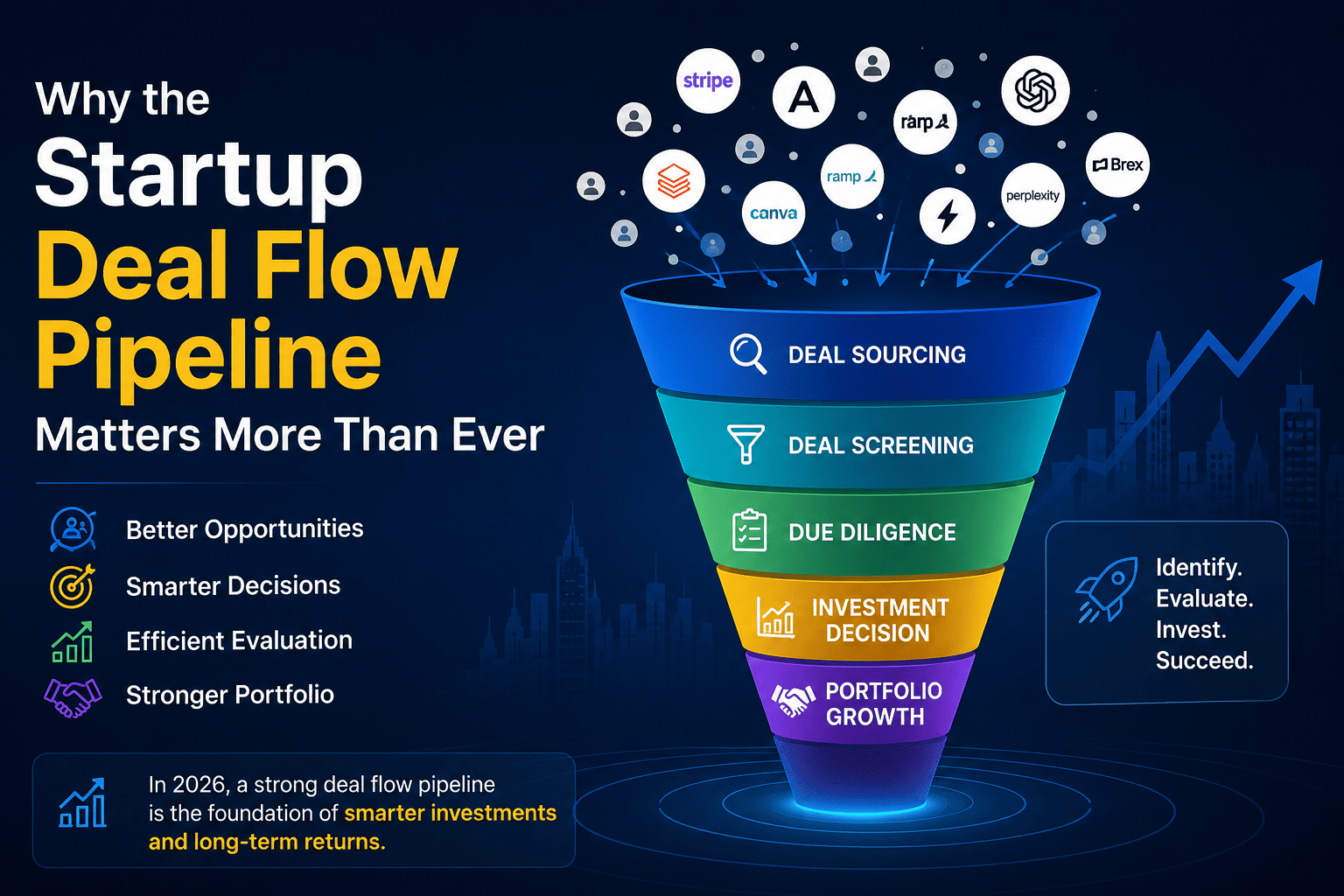
Each individual startup within a venture capital firm undergoes many processes before a final decision is made. These include sourcing, screening, due diligence, partner meeting, investment committee, and ultimately, approval.
The startup deal flow pipeline provides structure to this process.
Rather than keeping track of deals through various spreadsheets and communication media, investors can benefit from having a uniform system for keeping up with their deals.
A robust startup deal flow process will ensure that investors have an opportunity to review the deals that come their way, thereby avoiding any missed deals.
Why the Startup Deal Flow Pipeline Matters More Than Ever
The startup ecosystem continues to grow rapidly.
Access to investors is made easier by the help offered by accelerators, startup networks, the internet, demo days, and other forms of networking. Although this is helpful to founders, it does make it possible for investors to get far more opportunities than before.
For many investment organizations, volume has become one of the biggest challenges.
However, when there is no clear process for managing the pipeline of startups, things tend to get chaotic really fast. Potential deals are overlooked, follow-ups fail to happen, and decisions are inconsistent.
Having a pipeline in place provides structure in an otherwise chaotic space, due to the constant influx of data. Lastly, it ensures that investors remain consistent as they increase their investments.
How Deal Sourcing Has Changed
Deal sourcing is the process of finding potential investment opportunities.
Historically, investors relied heavily on personal networks and referrals. Founders were introduced through trusted connections, industry relationships, and local startup communities. These channels remain important today, but they are no longer the only sources of deal flow.
Many investors now receive opportunities through startup platforms, accelerator programs, incubators, online applications, industry events, and founder communities. As a result, sourcing has become more complex.
Investors need a way to collect opportunities from multiple channels while maintaining visibility across the entire startup deal flow pipeline. This is where technology is making a significant impact.
How Technology Improves Deal Sourcing
Investment platforms nowadays facilitate investors in combining information from various sources.
Rather than collecting data via email, spreadsheet, or application forms individually, one can combine all of that into one platform. It adds order and clarity to the process, making the monitoring of the investment opportunities that come their way possible.
Technology helps classify startups based on criteria like industry type, business model, stage of funding, location, and purpose of investing. This makes it easy to determine which startups fit into an organization’s investment philosophy.
As deal volume grows, these capabilities become increasingly valuable. Improving the sourcing process results in improved deal flow pipelines, resulting in greater investment opportunities.
The Importance of Screening
Once the opportunities are identified through the pipeline, investors need to know which startups merit further focus.
This stage is known as screening.
Screening enables investment firms to reduce the long list of prospects to an equally shorter list of firms that deserve further evaluation. Failing to use the process of screening means that investors may end up spending too much time looking at firms that do not fit their investment criteria.
At the same time, screening must be balanced carefully. Too stringent filters may result in overlooking potentially lucrative opportunities. The target is to design a system whereby good picks will be made without compromising efficiency. A structured startup deal flow pipeline makes this possible.

How Technology Supports Startup Screening
Screening often requires investors to review large amounts of information quickly. Pitch decks, business models, traction metrics, financial data, founder backgrounds, and market information all need to be considered.
Working manually with this data can take a lot of time.
It helps if there is technology involved, organizing information based on certain standards, allowing you to compare different startups. There is no need to rummage through numerous files and emails; rather, one can look up information from within the system.
It makes it easier for organizations to discover the right information in order to make sound judgments regarding the opportunities to pursue. There will be an improved pipeline in terms of startup deals without compromising on the quality of evaluation.
Improving Prioritization Across the Pipeline
One of the major problems that investors face is determining what to prioritize.
Not every startup deserves the same level of review.
While some opportunities might align well with an investor’s investment criteria, others might fall out of the desired sector or stage for consideration. In cases where there could be many organizations vying for funding every year, prioritization is key. Technology helps investors identify opportunities that align most closely with their investment criteria.
This does not mean making decisions automatically. What technology allows investors to do is to focus on opportunities that need more urgent attention.
Prioritization assists investors in managing their time effectively while making sure that there are enough chances for potential projects to be evaluated properly.
Strengthening Collaboration Among Investment Teams
Investment decisions are rarely made by one person.
Organizations will most likely incorporate various stakeholders in their analysis processes. Various analysts, associates, partners, advisors, and investment committees may be involved in generating insights prior to making the final decision.
The issue arises where data is spread out among Excel sheets and emails. Each team member may have access to various data sources, leading to inefficiency in the decision-making process. A solution to this problem would be a central database where all team members have access to all data simultaneously.
All individuals involved in the startup deal flow process have access to the same data sources. This results in enhanced communication and improved decision-making efficiency among other benefits.
The Role of Due Diligence
Due diligence remains one of the most important stages of investing.
Despite how good an investment might seem at first, it is important that due diligence be performed before any money is put into a new business venture.
These may include a thorough assessment of finance, markets, consumer appeal, competitive advantage, legality and managerial skills.
Technology cannot substitute for due diligence. However, it can make the process more organized. You can bring everything together, standardize the entire review process and keep a close record and track of progress.
This leads to a more consistent experience and helps make sure that important information is not lost. This makes the startup deal flow pipeline more predictable and easier to execute.
Supporting Better Investment Decisions
Every element of the investment process is finally oriented to one end: making informed investment decisions.
The quality of those decisions depends on the quality of information available.
When startup information is scattered across multiple systems, decision-making becomes more difficult. Important details can be missed, and discussions may rely on incomplete information.
The modern investment platforms help to organize the information so that the decision makers can have a complete picture of each opportunity. This allows investors to evaluate startups more effectively and compare opportunities with greater confidence.
Human judgment remains essential. Technology helps, but the decision-making is left up to the experienced investor due to his or her expertise and experience with the market.
Using Data to Improve Pipeline Performance
Most people tend to evaluate startups rather than the process of investing itself. It leads to inefficiency and low productivity. A well-managed startup deal flow pipeline provides visibility into key performance indicators.
The investment teams can measure how many opportunities come into the pipeline, how long deals spend in different stages, and where there are losses. This information enables the company to identify any choke points. An efficient process will eventually lead to a successful investment.
Creating a Better Experience for Founders
The startup deal flow pipeline affects founders as much as it affects investors.
Founders tend to get frustrated if there is no consistency in communication or decision-making.
It affects the relationships and leaves a bad image about the investment group. A structured pipeline helps improve the founder experience by creating greater consistency throughout the process.
Investors find it easier to manage communication and record it at the same time. This creates a more professional experience for founders while strengthening relationships between investors and entrepreneurs.
In a competitive investment environment, reputation matters. A good founder experience is one way for investors to ensure they attract better deals in the future.
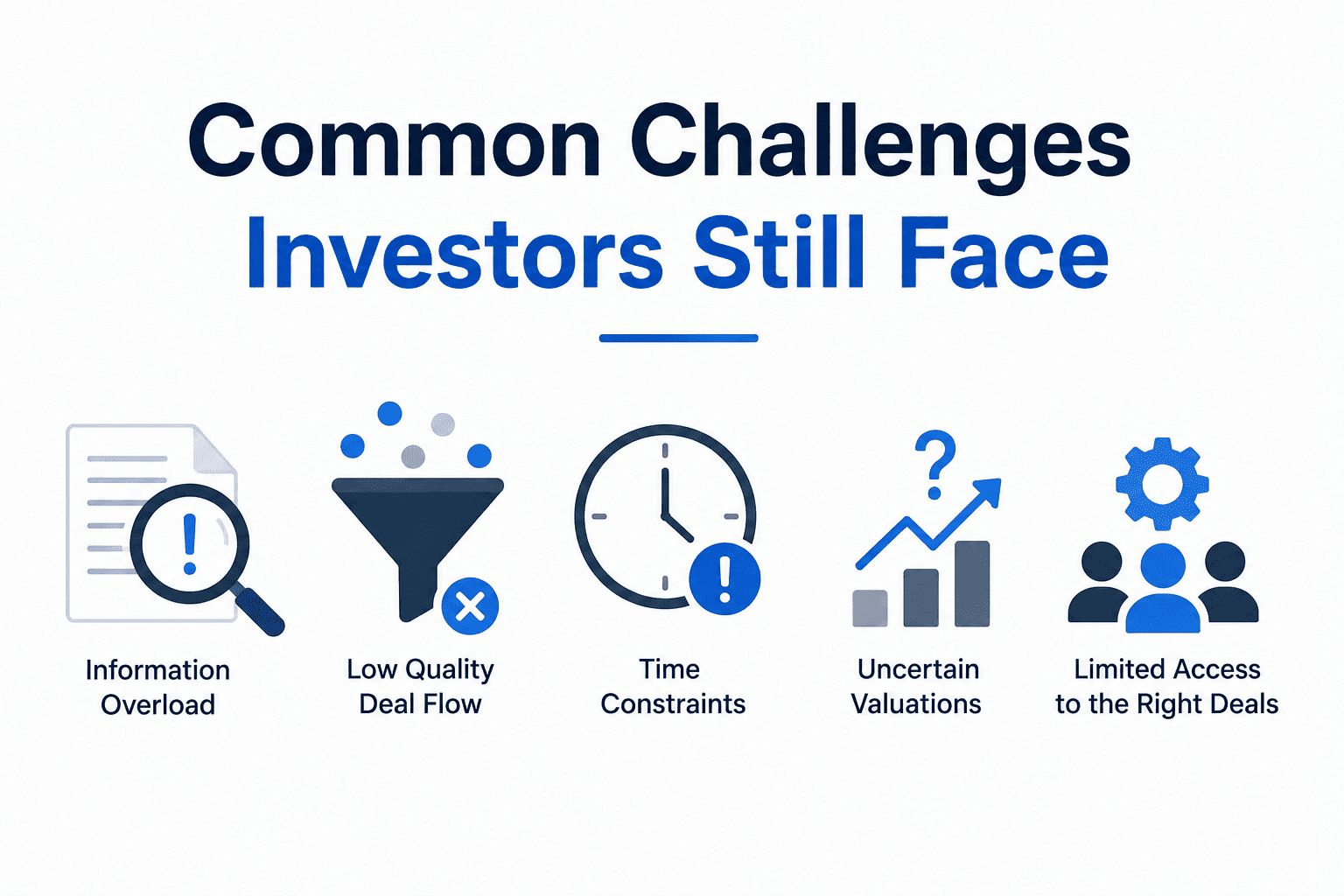
Common Challenges Investors Still Face
Despite advances in technology, investment organizations continue to face several challenges.
Growing deal volume remains a significant issue. However, as more companies emerge into the marketplace, the investors should develop means of evaluating them while maintaining quality.
Many organizations also struggle with inconsistent evaluation processes. Different standards may be applied by different evaluators, which makes it hard to compare the opportunities accurately.
Communication can be another problem among large investment groups.
Technology has been used to help solve these challenges, although success lies in integrating these tools with proper processes and teamwork. An entrepreneur’s deal flow pipeline works best when there is integration of man, process, and technology.
The Future of the Startup Deal Flow Pipeline
The startup deal flow pipeline will continue to evolve as the investment landscape becomes more competitive.
Investors will place greater emphasis on efficiency, collaboration, and visibility. They will attempt to find ways to handle greater quantities of deals while still upholding high standards for evaluating deals. Technology will keep being used to help investors organize their information and improve communication among themselves.
However, the human element in investing will also remain highly important. Relationships, expertise on the markets, evaluations of entrepreneurs, and sound reasoning will all be vital in deciding where to invest. The most successful organizations will be those who manage to balance effective processes with good judgment.
Conclusion
Investors, in 2026, must recognize that although opportunities abound, the constraints of time and resources limit their scope.
A strong startup deal flow pipeline helps investment organizations manage this complexity. This will bring about structure, enhance visibility, and also improve decision-making at every step of the investment cycle.
Advances in technology are making it possible for investors to become more efficient in sourcing, screening, collaboration, and due diligence. This increases the amount of time dedicated to analyzing opportunities and less to processing.
The future of investing is not about replacing human judgment. It is about giving investors the tools they need to work more efficiently and make better decisions.
For angel groups, venture capital firms, syndicates, and family offices, building a modern startup deal flow pipeline is becoming a critical part of long-term success. A well-managed pipeline does more than improve operations; it helps investors identify stronger opportunities, make smarter decisions, and build better portfolios over time.
FAQs
1. How can investors identify bottlenecks in a startup deal flow pipeline before they impact investment outcomes?
Stage conversion ratios, review cycle time, and deal loss ratios are some of the measures that can be monitored by investors. Keeping an eye on these measures within a startup deal flow pipeline will enable teams to optimize their deal flow process.
2. Why do some investment teams struggle with consistency even when they have a large startup deal flow pipeline?
Many opportunities do not necessarily translate into improved decision-making in investments. In the absence of uniform standards of assessment, each team member may have a differing view on the startup, resulting in varying results. The importance of a startup deal flow pipeline cannot be ignored.
3. What role does startup categorization play in improving investment efficiency?
Classifying startups in terms of their sector, stage, geographical location, business model, or funding requirements will enable venture capitalists to concentrate on startups which suit their investment strategy. The time required to analyze the suitability of such startups is greatly reduced.
4. Can a startup deal flow pipeline improve founder relationships even when an investment is declined?
Yes. An effectively managed deal flow process leads to improved organization in communication, update process, and decisions. Sometimes even when investors reject an investment, founders find that professionalism goes a long way.
5. How does centralized data management support investment committees?
With all information about the startups being kept within one database, all committee members have the same information to work on, eliminating the chances of miscommunication. The decision-making process becomes better informed due to this.
6. What indicators suggest that a startup deal flow pipeline is scaling successfully?
Indicators that show a startup deal flow pipeline is scaling include faster reviews, better quality deals making it to late-stage review phases, better teamwork among reviewers, and consistent investment decisions even as deal flow increases.
7. Why is prioritization becoming more important than sourcing for investors?
Many investors now have access to more startup opportunities than they can realistically evaluate. It is now not about finding deals but selecting those that require your urgent attention. Prioritizing will ensure that you manage resources effectively.
8. How can investors use historical pipeline data to improve future investment decisions?
The past informs one on trends like what type of sources give rise to the most successful businesses, why certain deals do not proceed past certain points, and how particular metrics of evaluation relate to successful investments.

I’m the Co-Founder of Startup Steroid, where I help founders navigate the challenges of building a startup. From connecting with the right investors and talent to guiding marketing, legal, and MVP development, I work alongside entrepreneurs to provide practical support and clarity, helping them grow their ideas into successful, sustainable businesses.