
Every cycle in venture capital brings a defining moment, one that forces firms to rethink how they source opportunities, evaluate founders, manage information, and ultimately decide where to place capital. As revealed by the analysis of the behavior of 275 investors, 2026 will become such a year. The characteristics of the previous decade, namely fast implementation, informal assessment, and unpredictable processes, will start losing their significance. Investors will face a new reality in which diligence and determination will be of equal importance.
This shift isn’t driven by theory but by market realities. Capital availability is tightening, founders are more selective about whom they partner with, and LPs expect clearer visibility into how decisions are made. As a result, many firms recognize that the traditional venture capital deal flow process is no longer equipped to match the speed, complexity, and scrutiny of today’s investment landscape.
The idea of a “reset” is not about minor adjustments. It’s about rebuilding the funnel, from sourcing to closing, so it becomes more organized, predictable, and strategically grounded. This blog explores what this reset looks like, why investors believe it’s essential, and how venture firms can adapt before the industry leaves outdated practices behind. What follows is a deeply explanatory look at the forces shaping the future of VC deal flow management, based on the trends investors expect to dominate 2026.
Why 2026 Marks a Turning Point in Investing
Across the investor interviews, one message stands out: 2026 represents a clear break from the past. For years, venture capital has been influenced by fast-moving markets, widespread founder optimism, and capital abundance. But now, the environment is changing.
Investors are reacting to the fact that the time horizons are increasing, the fundraising process is becoming more compressed, and the marketplace is favoring sustainable business models rather than speculative ones that could generate a lot of growth.
A second force shaping 2026 is founder behavior. Current entrepreneurs are more aware and careful in their dealings with investors. Entrepreneurs now demand transparency and follow-up. They prefer to deal with investors that demonstrate organizational skills and have a well-defined timeline for things.
The result is a mutual rebalancing of expectations. Both parties want clarity. Both want speed. Both want accuracy. And both are frustrated by outdated systems. That’s why the venture capital deal flow process is under scrutiny and why the industry is preparing for changes that affect the entire flow of investments.
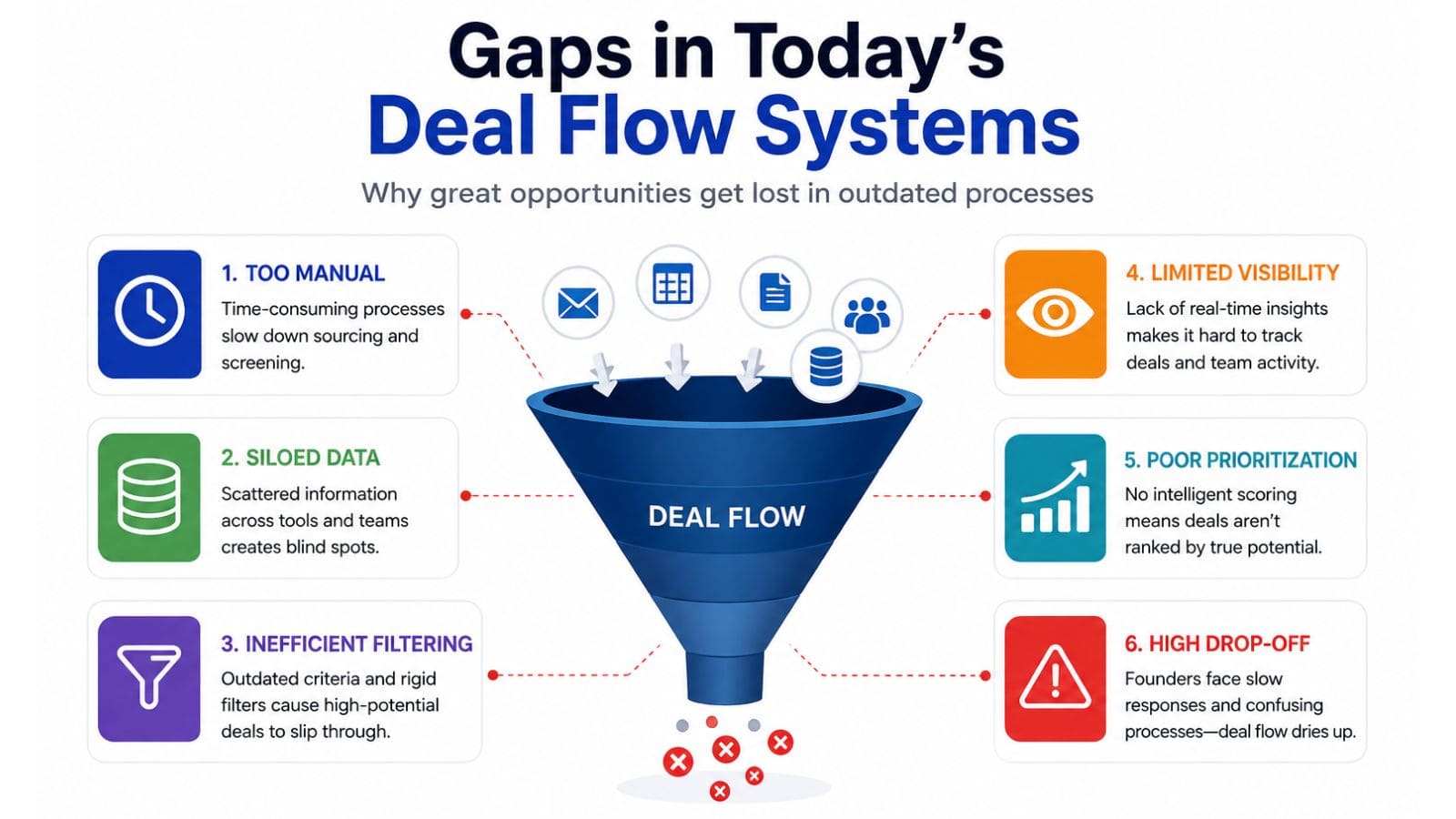
Gaps in Today’s Deal Flow Systems
While many firms believe they operate efficiently, investors repeatedly point out foundational weaknesses in the current setup.
One of the biggest issues is outdated infrastructure. Several sales teams are still resorting to Excel spreadsheets and emails for their transaction management process. Such practices contribute to data silos, inefficiency, and delays in communication, and complicate the process of accessing information that is both consistent and reliable.
Another concern is inconsistency. This results in a biased evaluation since analysts and partners tend to focus on different factors or capture different data. Investors have mentioned cases where deals that could potentially turn out to be very profitable have fallen through because the internal documentation was insufficient or lost somewhere.
Deal overload contributes to another gap. Funds receive more inquiries than ever before, especially at the early stage. Without a clear filtering mechanism, teams waste time reviewing deals that never align with their thesis.
Finally, investors note the lack of transparency, both internally and externally. LPs often want to understand how deals move through the funnel, while founders want visibility into where they stand. Without an organized structure, both groups are left uncertain.
These challenges illustrate why modern VC deal flow management is no longer optional, it’s becoming essential for firms that want to stay competitive.
What the “Reset” Really Represents
When investors talk about a reset, they’re referring to a wide-ranging rethinking of how deals move from introduction to investment decision. It’s not just about improving software or adding automation. It’s about building a clear, cohesive system where every stage supports the next.
At the core is the move toward verifiable insights. Investors seek ways to place less reliance on slides and more on actual proof of traction in terms of usage, monetization, pilots, and engagement. Data should be evidence-based.
Equally important is consistent internal structure. Firms want defined stages in the funnel, each with documented expectations and responsibilities. When everyone knows what happens at each step, there’s less confusion and fewer delays.
The reset also encompasses a cultural change in the direction of effective communication. Companies realize that good collaboration results in a better-quality transaction. The combination of analysts, associates, partners, and advisors having insight into the same information leads to better decision-making.
Ultimately, the reset is about building a stronger, more deliberate venture capital deal flow process that aligns with modern market realities.
Market Conditions Driving the Need for Change
Several external forces are pushing firms toward this new level of discipline.
The efficient use of capital resources is now of paramount importance. There is growing uneasiness among investors regarding excessively high burn rates, with investors being more attracted to companies with careful spending habits and sustained growth. For such identification, the assessment process needs to be more rigorous.
The fundraising environment for startups has also become more selective. The founders require more from investors than just money. Clear and concise information and a clear process will be expected. Without these elements, business owners will miss out on valuable opportunities to the competition.
LP expectations are higher as well. As the markets become less predictable, LPs look for ways to understand the decision-making process involved. This means documentation and thorough analysis.
All these factors reinforce the urgency behind strengthening VC deal flow management.
How the Sourcing Stage Will Change in 2026
Sourcing is the first filter of the funnel, and investors predict major changes in this stage.
The business will place less emphasis on the broader and more general nature of inbound deal flows. Rather, it is expected that there will be a more targeted approach to sourcing deals based on certain themes, industries, or problem domains.
Relationships will become a more reliable source of quality. Investors plan to deepen ties with industry operators, domain experts, and founders they’ve backed in the past. These channels produce deals that fit a firm’s thesis more consistently than cold outreach or mass applications.
Digital visibility will also play a growing role. Nowadays, investors follow startups’ development by monitoring product launches, community activity, or user reviews. In such a way, they are able to detect potentially valuable startups even before they embark upon the process of raising capital.
As sourcing becomes more intentional, firms reduce early-stage noise and improve the efficiency of their entire venture capital deal flow process.
What Early Screening Will Look Like in the New Era
The screening stage is where volume meets structure. Investors expect this part of the funnel to become more organized and much faster.
Initial calls will no longer rely on generic pitch deck discussions. Rather, they will concentrate on evaluating clear problem definition, founder preparedness, early customer cues, and ultimate defensibility. Investors feel that founders have to showcase not only concepts but early validation as well.
The use of standardized internal frameworks will become more important. Standardized frameworks are important in making sure all investments pass through an initial stage of assessment.
Speed at this stage is crucial. Investors are aware that founders like fast decisions, whether yes or no. Companies that have clear communication make good impressions on people.
The updated screening process will help enhance the overall pipeline process and improve future deals.
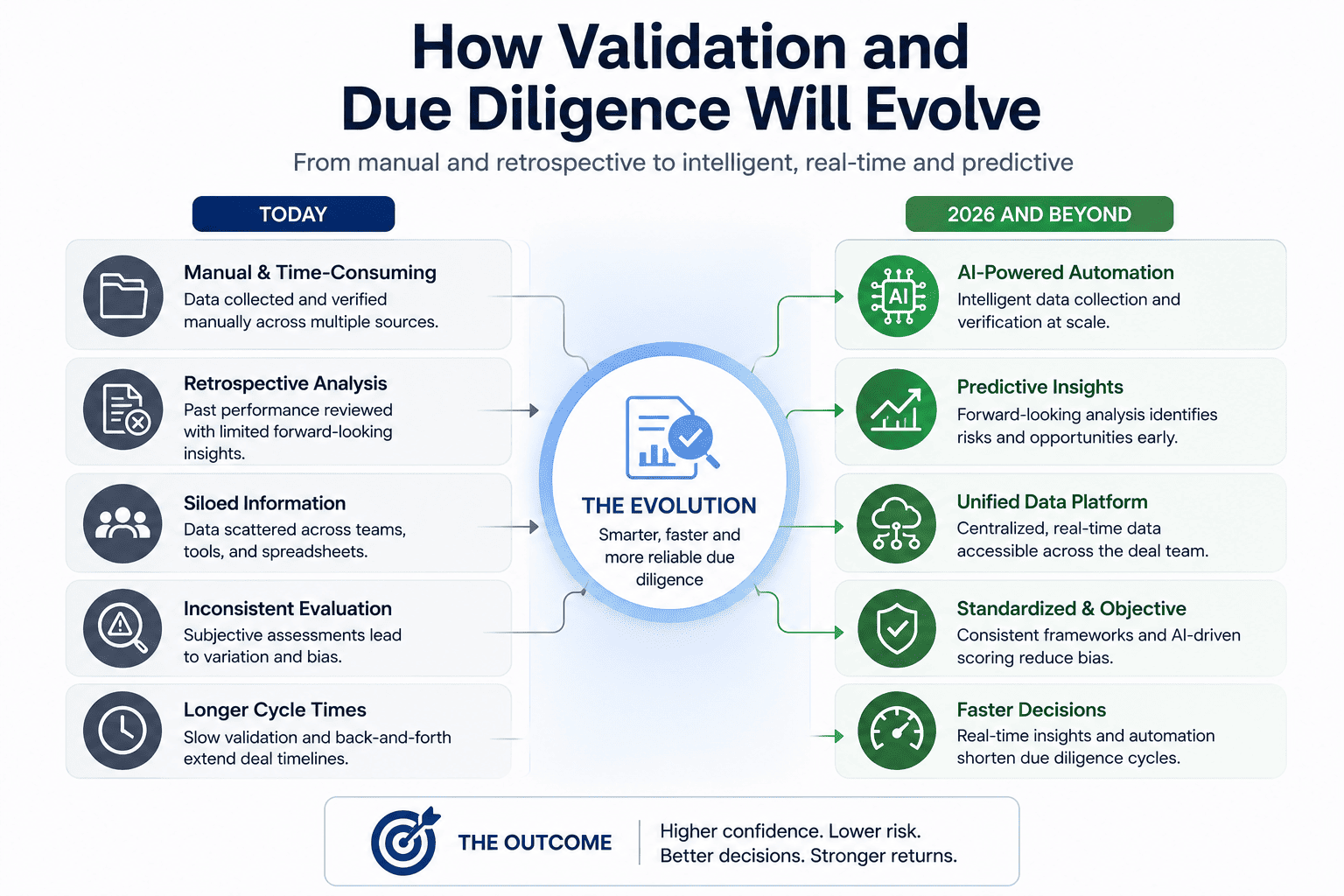
How Validation and Due Diligence Will Evolve
There will be greater complexity, nuance, and information surrounding validation and due diligence in 2026. Investors don’t want to rely on what the founders say but rather on metrics showing traction.
Customer validation will become crucial. It can be anything from user interviews, traction metrics, frequency of use, or pilots. The investors need to see if people care about the product, not just if they like it.
Benchmarking will become more common. Various industries have unique criteria for judging their power, and the investors will compare the companies with the benchmark companies in order not to exaggerate their power potential.
External expertise will also influence decisions. Investors increasingly involve advisors, operators, and subject-matter experts to validate assumptions, uncover risks, and strengthen the analysis.
This stage introduces a disciplined layer of rigor that anchors the entire VC deal flow management approach.
Investment Committees Will Demand More Structure
Investment committees are the final gatekeepers. Investors expect ICs to raise their expectations significantly.
Offers made to the ICs will be based on comprehensive documentation, including verified customer signals, financials, market data, and a strong narrative on value. Loose presentations or high-level summaries will no longer suffice.
ICs will also expect a consistent format. When each deal is presented through a similar structure, committee members can compare opportunities more fairly and more productively.
Firms may also strengthen the requirement for internal champions. Every offer will have an advocate that knows the opportunity inside out and can explain its significance clearly.
These changes will make the final stage of the venture capital deal flow process more transparent, deliberate, and predictable.
Speed and Clarity Will Shape How Deals Close
Once a firm reaches the closing stage, speed becomes a competitive advantage. Investors highlight that even strong relationships can fall apart if the process becomes slow or confusing.
Those who will win in 2026 are those that clearly outline their timeline, paperwork, and processes. An entrepreneur is inclined towards discipline and determination.
Activities that occur together can be expected in the future. Rather than doing legal verifications, references, and financial assessments one at a time, these tasks will all be completed at once in order to save time.
Communication on an ongoing basis, either internally or externally, can avoid confusion and lost opportunities.
Closing is where organized firms outshine disorganized ones. Investors believe the firms that modernize early will secure the best opportunities.
Automation’s Role in Supporting the Reset
Automation is not intended to replace investor judgment. Instead, it supports operational efficiency.
The most valuable contribution of automation is reducing manual work. Data entry, follow-up, and even organizing files will take up a considerable amount of time which can be used for finding opportunities or talking to founders.
Automation also creates a single source of truth. With all data residing in a single spot, there will be no ambiguity or redundancy.
The process will be much simpler and more accurate. Companies will have no difficulty finding information related to their LPs for any purpose without having to rummage through their past records.
The entire process is made more efficient by automation because all the data is organized in one place.
Collaboration Will Become Central to Better Decisions
Improved collaboration is one of the biggest cultural shifts expected in 2026.
A system will be put in place whereby team members will be able to check on their deals through changes, observations, and progress made.
Every deal will have an owner, who will be in charge of organizing the progress and timing of the deals.
Cross-functional insights will become more valuable. Investors will increasingly rely on specialists in sales, operations, product, and technology to evaluate deals more comprehensively.
Stronger collaboration leads to better decisions and a more resilient investment strategy.
Conclusion
The venture industry is heading toward a pivotal moment. The expectations of investors, founders, and LPs are shifting toward greater structure, more transparency, and stronger discipline. The venture capital deal flow process as we know it is being redesigned to meet the demands of a more complex, more selective, and more competitive landscape.
The reset of 2026 is not about replacing the intuition and experience that define great investing. All boils down to fostering these tendencies with valid data, well-structured systems, and proper execution. The companies that will implement this approach will move faster, efficiently, and decisively. Companies that won’t take this approach will lag behind their more sophisticated competitors.
As investors prepare for this new era, one message becomes clear: the future belongs to firms that understand the importance of intentional, organized, and thoughtful VC deal flow management. The reset is not only coming; it has already begun.
FAQs
- How are investor expectations influencing the redesign of the venture capital deal flow process for 2026?
The investors expect better documentation, provable traction, and internal steps. This is prompting the companies to adopt systematic processes that will bring in consistency across the entire funnel.
- Why are founders becoming a driving force behind changes in VC deal flow management?
Now, founders are expected to be clear communicators and follow predictable timetables. As a result of such evolution, firms will be compelled to reorganize themselves internally or risk seeing favorable transactions stolen from under their noses by firms with better organization.
- What role does “evidence over narrative” play in the next evolution of the venture capital deal flow process?
Evidence-based insight, like pilots, use cases, and customer testimonials, has become more valuable than sales talk. Investments are being made based on measurable signals, not so much on speculation or founder appeal.
- How will targeted sourcing change the quality of deal pipelines in 2026?
Rather than depending on a broad range of incoming deals, companies will seek to source thesis-driven deals through the use of their own network of operators as well as other industry contacts, in addition to constantly monitoring online information.
- Why is standardization becoming essential in VC deal flow management?
Standardized screening procedures and IC formats prevent any subjectivity in evaluation, which might have caused opportunities being left on the table before. Additionally, such systems provide for better comparisons among different offers and faster processing of information.
- How will cross-functional expertise influence the later stages of the venture capital deal flow process?
The specialists of the subject matter, including product and operations, would increasingly play a part in due diligence and validation because they provide knowledge about possible risks and improve analysis.
- What makes speed at the closing stage a competitive advantage in 2026?
The speed at which founder investigations are supposed to be done means that there should be no sequential but simultaneous investigation by the investors. Fast companies that maintain order will emerge victorious.
- How does automation change the way teams collaborate across the VC lifecycle?
This is because automation allows for the integration of data and the removal of all human effort involved in handling it. This creates a situation whereby all parties concerned have access to reliable data for making decisions.

I’m the Co-Founder of Startup Steroid, where I help founders navigate the challenges of building a startup. From connecting with the right investors and talent to guiding marketing, legal, and MVP development, I work alongside entrepreneurs to provide practical support and clarity, helping them grow their ideas into successful, sustainable businesses.