
Private equity firms analyze a continuous flow of investment opportunities that can emerge from investment banks, intermediaries, their own network, management teams, industry connections, and self-initiated searches. It takes more than just knowing how many deals have come in for effective pipeline management.
The metrics and KPIs of private equity deal flow give private equity firms insight into where their opportunities originate, how fast their opportunities progress through the investment cycle, where opportunities are slipping through the cracks, and what activities generate the best opportunities.
Well-constructed private equity deal flow measurement will enable the investment team to maximize its effectiveness, identify issues within the deal process, and develop a predictable deal flow.
This guide explains the most important private equity deal flow metrics, why they matter, how to calculate them, and how firms can use them to improve sourcing and investment decisions.
What Is Private Equity Deal Flow?
Private equity deal flow refers to the volume and quality of investment opportunities that reach a private equity firm for consideration.
The deal flow can comprise any number of transactions that make their way into the firm’s funneling process starting from the initial contact up until closing.
Deal flow can come from many channels. Investment banks and M&A advisors may provide opportunities through formal processes. Intermediaries could help connect with companies that fit the firm’s investment requirements. Proprietary sources could include reaching out to the company owners or management themselves. Existing portfolio companies, operating partners, investors, and network connections could all be potential sources of deals.
However, deal volume alone does not determine the strength of a firm’s pipeline. Receiving 1,000 opportunities is not necessarily better than receiving 200 if most of those 1,000 companies fall outside the firm’s investment strategy.
That is why private equity deal flow needs to be measured across both quantity and quality.
Why Do Private Equity Deal Flow Metrics Matter?
Private equity investing involves significant amounts of time, capital, research, and professional resources. Investment teams need to know whether those resources are being directed toward opportunities with genuine potential.
Deal flow metrics provide that visibility.
For example, a firm may receive a large number of opportunities but close very few transactions. This could indicate that the sourcing strategy is producing poor-fit companies, that screening criteria are too restrictive, or that opportunities are getting stuck during due diligence.
It is also possible that another company will get fewer deals, but a larger proportion of deals will move on to a serious evaluation stage after an initial review. This may suggest good sourcing or better fit between the sourcing channels and the investment strategy of the company.
Tracking private equity deal flow metrics makes these differences easier to identify.
Metrics also provide historical benchmarks. By comparing performance against earlier quarters or years, companies will be able to notice the differences in volume of deals, rate of conversion, sources of business and the speed of transactions.

The Difference Between Deal Flow Metrics and KPIs
Deal flow metrics are measurements used to understand activity and performance within the investment pipeline. KPIs are the measurements that are most closely connected to strategic objectives.
For example, the number of deals received is a useful metric. Nevertheless, this may not be one of the main KPIs if the goal of the company is to generate more qualified opportunities.
Therefore, a company may monitor total opportunities as an additional indicator, while qualified opportunities, conversion rate, and closed deals can be considered main KPIs.
The right combination depends on the firm’s strategy, investment stage, target industries, geography, fund size, and transaction model.
Deal Volume
Deal volume measures the number of investment opportunities entering the pipeline during a specific period.
It is one of the simplest private equity deal flow metrics, but it provides important context for other measurements.
The company could monitor its monthly, quarterly, and annual number of deals to detect variations in sourcing activity. For instance, if there is a notable reduction in the quarterly number of deals, then the firm would need to check whether there are any variations in referral, intermediary, or outbound sourcing.
Deal volume should not be viewed in isolation. A rise in opportunities is valuable only when the quality of those opportunities remains consistent.
Qualified Deal Volume
Qualified deal volume measures the number of opportunities that meet the firm’s initial investment criteria.
Qualification criteria might include revenue, EBITDA, industry, geography, ownership structure, growth rate, transaction size, or other investment requirements.
This metric is often more useful than total deal volume because it removes opportunities that are clearly outside the firm’s mandate.
A company that gets 500 deals in one quarter but only 50 deals that qualify could be having issues with its sourcing strategy. Alternatively, a company that receives 200 deals but 80 qualified prospects could be doing a better job with its sourcing process.
Deal Qualification Rate
The qualification rate is a measure of how many opportunities that come to the company qualify based on its criteria.
The calculation is straightforward:
Qualification Rate = Qualified Opportunities ÷ Total Opportunities × 100
For example, if a firm receives 400 opportunities and 80 qualify for further consideration, its qualification rate is 20%.
Having this statistic per source would really be helpful. When the qualification rate is 40 percent for opportunities that come from one intermediary and 8 percent from another, it would enable organizations to know where to invest their relationship building efforts.
Source of Deal Flow
Understanding where opportunities originate is essential for managing private equity deal flow effectively.
Common sources include investment banks, boutique advisory firms, independent sponsors, intermediaries, portfolio company referrals, management teams, existing relationships, conferences, industry networks, and direct outreach.
Firms should track not only how many opportunities each source produces but also what happens to those opportunities.
It is possible that the source generating 100 deals but only one good investment opportunity is actually worth less than the source generating 20 deals but five great prospects.
Source-level analysis allows investment teams to identify their most productive relationships and determine where additional sourcing efforts could generate better results.
Source-to-Meeting Conversion Rate
This metric measures how effectively a sourcing channel converts opportunities into management meetings or other meaningful interactions.
For example, suppose an intermediary introduces 50 companies, and the investment team meets with the management teams of 15. The source-to-meeting conversion rate is 30%.
This can help you determine which sources generate opportunities that should be taken further into consideration.
A high conversion rate may be a sign of a perfect fit between a potential investor and your investment criteria.
Meeting-to-Diligence Conversion Rate
Not every management meeting leads to detailed due diligence.
The meeting-to-diligence conversion rate refers to the percentage of the total opportunities that move from meetings to diligence.
A low rate could show that the company spends too much time evaluating those firms that do not meet its criteria.
A high rate may suggest that the firm’s sourcing and initial screening processes are producing better-fit opportunities.
This metric becomes more useful when analyzed by source, sector, investment size, and geography.
Diligence-to-Investment Committee Rate
Once a company enters due diligence, the next important question is whether the opportunity progresses to the investment committee.
This measure evaluates the number of deals that are under detailed review and make it to the investment committee for further analysis.
If the result is lower than expected, it may point to some issues with the screening process of the firm, its due diligence process, valuations, or investment case.
Moreover, it may show that investment professionals move deals along without identifying their flaws.
Investment Committee-to-Close Rate
The investment committee-to-close rate measures how many opportunities approved or seriously considered by the committee ultimately result in completed transactions.
Conversion of deals post investment committee approval may fail owing to various reasons such as valuation disputes, financing difficulties, legal challenges, diligence findings, and/or changing seller expectations.
Knowing the percentage of these deals that fail to materialize will be instrumental in gauging the reliability of the pipeline.
Overall Deal Conversion Rate
Overall deal conversion rate determines how successful the opportunities are converted into investment opportunities going through the pipeline.
The basic calculation is:
Deal Conversion Rate = Closed Investments ÷ Total Opportunities × 100
Therefore, where there are 500 opportunities in the pipeline and five deals have been made, the overall conversion ratio will be 1%.
Although this number can appear low, low conversion rates are normal in many competitive investment environments. It does not always have to be about maximizing conversions at each step. The key thing is having a pipeline that generates enough quality deals to meet the investment needs of the firm.
Time to First Review
Speed matters in competitive transactions.
Time to first review measures how long it takes for a new opportunity to receive an initial assessment after entering the pipeline.
If opportunities remain untouched for several days or weeks, attractive transactions may progress with competing buyers before the firm has a chance to engage.
The next important private equity deal flow KPI is the amount of time that an opportunity takes in each deal stage.
Time in Each Deal Stage
Another valuable private equity deal flow KPI is the amount of time an opportunity spends at each stage.
A typical pipeline may include sourcing, initial screening, preliminary review, management meeting, indication of interest, due diligence, investment committee review, and closing.
If there is always a long delay in the deal’s progress through a particular stage, then it is likely to be a bottleneck in the process.
For example, if opportunities move quickly from sourcing to management meetings but remain in diligence for several months without clear decisions, the firm may need to examine its diligence workflow or decision-making process.
Deal Aging
Deal aging shows how long individual opportunities have remained in the pipeline.
Older opportunities should not automatically be removed. Some deals take a lot of time to evaluate, especially in cases where companies have complicated ownership structures or there are other factors at play in the transaction process.
Nonetheless, the existence of many inactive deals makes the pipeline look much better than it is.
Regularly reviewing aging helps investment teams distinguish between active opportunities and deals that are unlikely to progress.
Pipeline Value
Pipeline value estimates the potential transaction value represented by active opportunities.
For example, a firm might have 20 active opportunities representing a combined potential enterprise value of $2 billion.
However, pipeline value should be treated carefully. Not all opportunities will end up closing, and some transactions may become bigger or smaller in scale during the negotiations process.
A more useful approach can be to segment pipeline value by stage and assign probability estimates based on historical conversion rates.
Weighted Pipeline Value
Weighted pipeline value adjusts potential transaction value based on the likelihood that opportunities will progress.
For instance, a nascent opportunity may have a lower probability compared to a deal that is under more advanced due diligence.
This will give a better estimate of the pipeline as opposed to summing up the value of the opportunities.
Historical conversion rates can help firms establish reasonable probability assumptions rather than relying solely on subjective judgments.
Average Deal Size
Average deal size indicates the average transaction size in the pipeline or closed investment portfolio of the company.
When comparing average deal sizes from various sources, the firm is able to determine which connections provide deals within its targeted investment range.
For example, some sources provide many smaller deals, while others bring larger companies.
This information can influence future sourcing priorities.
Cost per Qualified Opportunity
Sourcing requires some resources. Investment professionals have to invest time in researching companies, building contacts, reviewing prospects, attending industry meetings, and doing outreach.
Cost per qualified opportunity estimates the resources required to generate an opportunity that meets the firm’s criteria.
While it may be hard to measure this ratio accurately, even an approximation of the cost would allow companies to compare different sources for efficiency.
A channel that generates fewer leads, but more qualified leads is worth investing more than a channel generating large numbers but not qualifying those leads well.
Cost per Closed Deal
Cost per closed deal takes the analysis one step further.
It involves considering the costs involved in the generation and development of leads in relation to the completed deals.
If a sourcing channel consistently produces closed transactions, the firm can compare the resources invested in maintaining that channel with its outcomes.
This helps move sourcing decisions from assumptions toward measurable performance.
Intermediary Performance
Investment banks, brokers, and other intermediaries can play a major role in private equity deal flow.
Firms should evaluate intermediaries based on more than the number of opportunities they send.
Useful measurements include qualified opportunities, management meetings, diligence progression, investment committee presentations, transaction completions, average deal size, and time between introductions.
This way, eventually, it will become evident which relationship provides valuable opportunities and which creates additional unnecessary filtering work.
Proprietary Deal Flow Metrics
Proprietary sourcing refers to opportunities developed through direct relationships or outreach rather than widely marketed processes.
Measuring proprietary private equity deal flow can be more challenging because these opportunities may develop over a longer period.
Firms will know how many companies were discovered, contacts made, managerial connections formed, opportunities created, and transactions completed.
The length of the relationship-building cycle should also be considered. A relationship that takes months or years to produce an investment may still be highly valuable if it results in an attractive transaction with limited competition.
Deal Flow Quality Metrics
Quantity tells only part of the story.
Another way of assessing the quality of deal flow is through certain metrics like strategic fit, performance, growth, management, valuation, competitive advantage, and investment thesis.
Firms can establish a consistent scoring framework for initial screening, so investment professionals evaluate opportunities against similar criteria.
This will ensure uniformity and help spot trends in the process.
How to Build a Private Equity Deal Flow KPI Framework
A useful KPI framework begins with the firm’s investment objectives.
First, determine what the firm is trying to accomplish. This might include more proprietary sourcing, better intermediaries, more qualified leads, less screening time, or investing a certain amount of money per year.
Then, map the entire pipeline of investments. Find all significant steps from sourcing to closing.
For each step, decide what indicators of success or failure should be tracked.
The firm should then establish historical benchmarks. A conversion rate means little without context. Comparing current performance against prior periods gives a better indication of improvement within the pipeline.
Finally, review the KPIs on a regular basis. Monthly reporting can assist in identifying inefficiencies in the processes, whereas quarterly or annual reports will help identify broader sourcing trends.
How to Improve Private Equity Deal Flow Performance
The enhancement of the deal flow performance begins with recognizing areas where there is a shortage.
If there is too little deal flow, then perhaps the company should look at expanding its sources or improving its relationships with intermediaries and market players.
If deal volume is high, but qualification rates are poor, sourcing criteria and outreach strategies may need to become more targeted.
If qualified deals often get lost during due diligence, then it would be good to check if the essential screening questions are being raised early enough.
When good opportunities get to the investment committee and do not close, the company should look at valuations, financing, negotiations, or diligence problems.
The key is to improve the specific stage where performance is weakest rather than making broad changes to the entire sourcing process.
How Technology Supports Deal Flow Measurement
Tracking deal flow through private equity in spreadsheets, emails, and documents makes accurate measurement quite hard.
A centralized deal management system can provide a single view of opportunities, deal stages, contacts, communication history, documents, and pipeline activity.
This makes it easier to capture data consistently and generate reports across sourcing channels and investment stages.
Technology becomes very important when it works with a well-defined process. Technology cannot make up for lack of definition in qualification process and data collection process. It is important that companies define what they need to be able to configure their technology.
Common Mistakes When Measuring Deal Flow
One common mistake is focusing entirely on deal volume.
More opportunities do not necessarily mean better opportunities. Quality, fit, and progression matter just as much.
Another common problem is measuring too many KPIs. Having a dashboard full of dozens of indicators may make it hard to see what really counts.
Firms should prioritize metrics connected directly to their investment strategy.
Another pitfall may be inconsistent definitions of KPIs. If one investment specialist qualifies a company after a first examination, but another relies on a management meeting, then qualification rates won’t be comparable.
Consistent stage definitions are therefore essential.
What Are the Most Important Private Equity Deal Flow KPIs?
There is no universal list of KPIs that works for every firm. However, almost all companies can take advantage of the analysis of the number of deals, qualified number of deals, qualification rate, source channel performance, stage conversion rates, days in stages, deal aging, pipeline value, deal size, and closed deals.
The most important measurements should reflect the firm’s specific investment strategy.
A growth-oriented private equity firm will concentrate on qualified deals and pipeline value. A private equity firm oriented towards proprietary deals will give greater consideration to building relationships and sourcing deals. A very competitive buyout approach will emphasize speed of response and progress through initial screening.
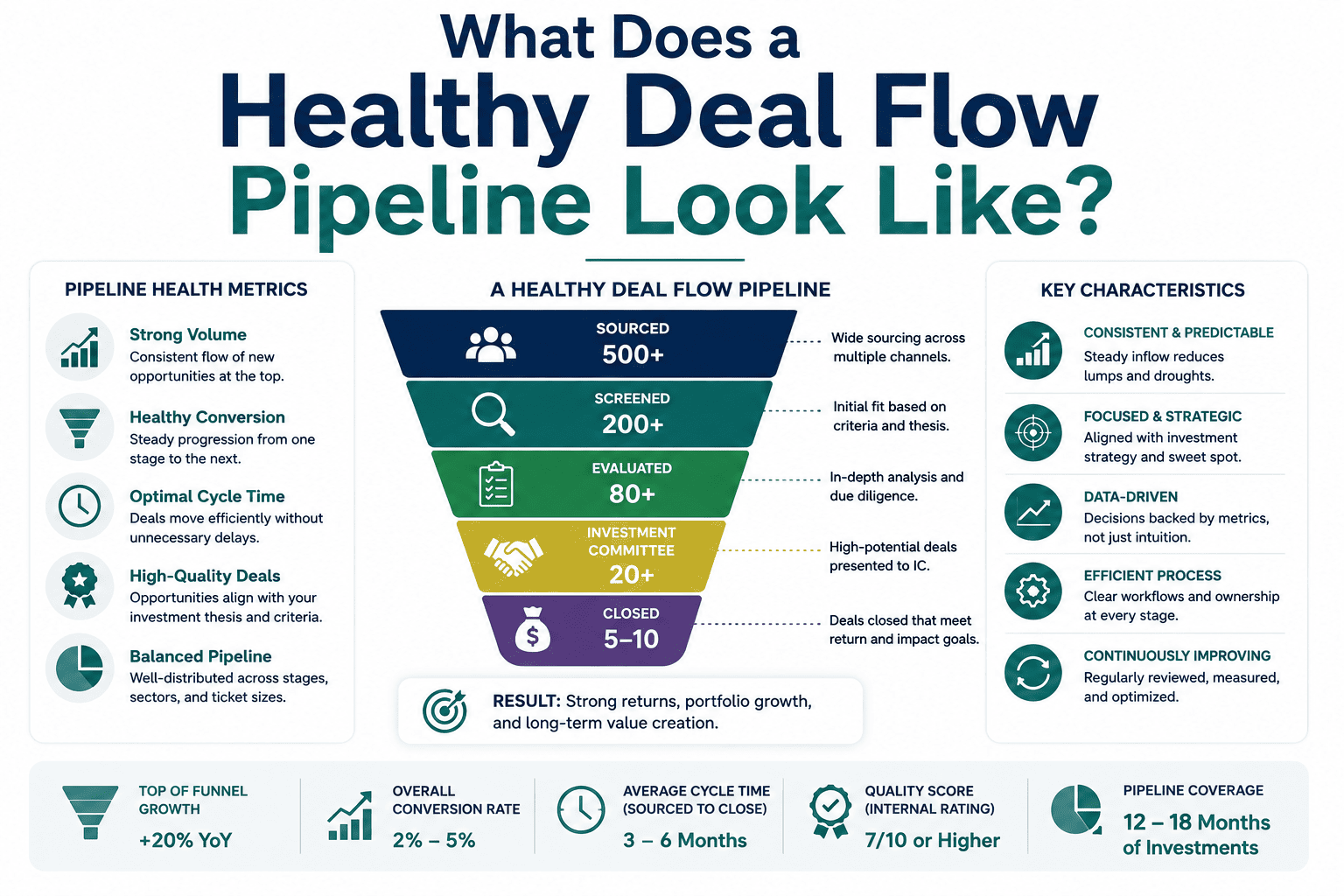
What Does a Healthy Deal Flow Pipeline Look Like?
A healthy pipeline is not simply a large pipeline.
It includes a good mix of new opportunities, qualified prospects, ongoing evaluations, advanced transactions, and soon-to-be-closed transactions.
The pipeline should also align with the firm’s investment criteria.
A good private equity deal flow pipeline will generate sufficient qualified opportunities to meet investment goals while enabling the team to concentrate on the best transactions.
There should also be clear advancement in the pipeline from stage to stage. Failure of the opportunities to move forward from one stage or to be rejected is an indication that there could be a problem in the process.
How Often Should Private Equity Firms Review Deal Flow KPIs?
Deal flow activity can be monitored continuously, but formal reviews should generally take place at regular intervals.
Reviews conducted weekly can highlight opportunities and actions. Reviews carried out monthly can look into sourcing efforts, conversions, and progress through the pipeline. Quarter-end reviews will allow for broader analysis of sourcing sources, investment results, and strategies.
The annual analysis can help identify long-term trends and establish new sourcing goals.
The key issue is consistency. With regular monitoring, change will be easier to spot.
Turning Deal Flow Data into Better Investment Decisions
The purpose of measuring private equity deal flow is not simply to create reports.
The real value comes from using the information to improve decisions.
When firms know which channels produce the strongest opportunities, they can allocate relationship-building resources more effectively. When they understand where opportunities are being lost, they can improve screening and diligence processes. When they track how long deals remain in each stage, they can address bottlenecks before they affect competitive positioning.
Over time, these insights can make the investment pipeline more predictable.
A disciplined approach to deal flow measurement also creates a feedback loop. Sourcing activity produces opportunities, pipeline data shows what happens to those opportunities, and the resulting insights help investment teams refine future sourcing strategies.
Conclusion
Effective private equity deal flow management requires a clear understanding of what enters the pipeline, where opportunities originate, how they progress, and why they ultimately succeed or fail.
Metrics such as deal volume, qualification rate, source performance, stage conversion, time to review, pipeline value, and closed-deal rates provide the foundation for that understanding.
The most successful measurement frameworks do not attempt to track everything. In its place, they emphasize the KPIs that have direct relevance to the investment and operational strategy of the organization.
By monitoring these metrics on a regular basis, private equity firms can find better sources of deals, eliminate inefficiencies, solve bottlenecks, and make informed decisions regarding what areas their investment team should be focusing on.
In essence, the reason for tracking deal flow for private equity is straightforward: create a more streamlined process from start to finish.
FAQs
1. How can private equity firms tell whether more deal flow is actually better?
More opportunities do not necessarily indicate stronger Private equity Deal Flow. Firms should compare total deal volume with qualification rates, source quality, stage conversions, and closed transactions to determine whether increased activity is producing better-fit opportunities.
2. What does a low qualification rate reveal about Private equity Deal Flow?
A low qualification rate can indicate that sourcing channels are producing too many opportunities outside the firm’s investment criteria. Reviewing qualification rates by source can help identify which relationships and channels are worth greater attention.
3. Why should deal flow metrics be tracked by sourcing channel?
Two sources can produce very different results even when one generates far more opportunities. Comparing qualified deals, meetings, diligence progression, and closed transactions by source helps firms identify which relationships contribute the most value to their Private equity Deal Flow.
4. How can deal aging expose weaknesses that conversion rates miss?
Deal aging indicates the duration of each opportunity within the pipeline. The abundance of inactive or aging opportunities may create an illusion of the healthiness of the pipeline and also reveal the problems in screening, diligence, or decision making process.
5. Can a private equity firm have a healthy pipeline with a low overall conversion rate?
Yes. A low conversion rate is not necessarily a problem because competitive investment processes naturally eliminate many opportunities. What matters is whether the remaining pipeline contains enough qualified opportunities to support the firm’s investment objectives.
6. Which Private equity Deal Flow metrics are most useful for evaluating intermediaries?
Companies need to move past the frequency of introductions. Some metrics that are useful include qualified leads, management meetings, diligence progress, investment committee presentations, closed deals, average deal size, and the intervals between introductions.
7. How can firms identify a bottleneck in their investment pipeline?
The comparison of time spent by deals at different stages will show where the deals always experience a slowdown. For instance, an unusual length of the diligence stage may signal that there is something wrong with the process of diligence and not with sourcing.
8. Why can a smaller deal source be more valuable than a high-volume source?
A source that delivers fewer opportunities may still outperform a high-volume source if its deals have stronger strategic fit, higher qualification rates, and better progression toward closing. Measuring quality alongside quantity gives a more accurate picture of Private equity Deal Flow performance.

I’m the Co-Founder of Startup Steroid, where I help founders navigate the challenges of building a startup. From connecting with the right investors and talent to guiding marketing, legal, and MVP development, I work alongside entrepreneurs to provide practical support and clarity, helping them grow their ideas into successful, sustainable businesses.