
Venture capital funds want nothing more than to gain access to the best startups before anyone else does. But discovering good companies is not the whole story. The tough thing is finding good entrepreneurs while rejecting thousands of opportunities that will not produce any return at all. This is where venture capital benchmarks for deal flow come into play.
Top-performing venture capital firms rarely succeed because they simply review more startups. On the other hand, they develop repeatable systems through which they are able to source better opportunities, make quick evaluations, sustain founder connections, and make intelligent decisions on investments. Their systems are measurable, structured, and continually improving.
These benchmarks can serve as an operational guide for startup VC firms, angel networks, family offices, and traditional funds interested in making their investments perform better. Instead of wondering whether their sourcing system works well, firms can benchmark themselves against industry norms.
This guide explains what deal flow venture capital benchmarks are, why they matter, which metrics successful VC firms monitor, and how leading investors consistently outperform competitors through disciplined processes instead of luck.
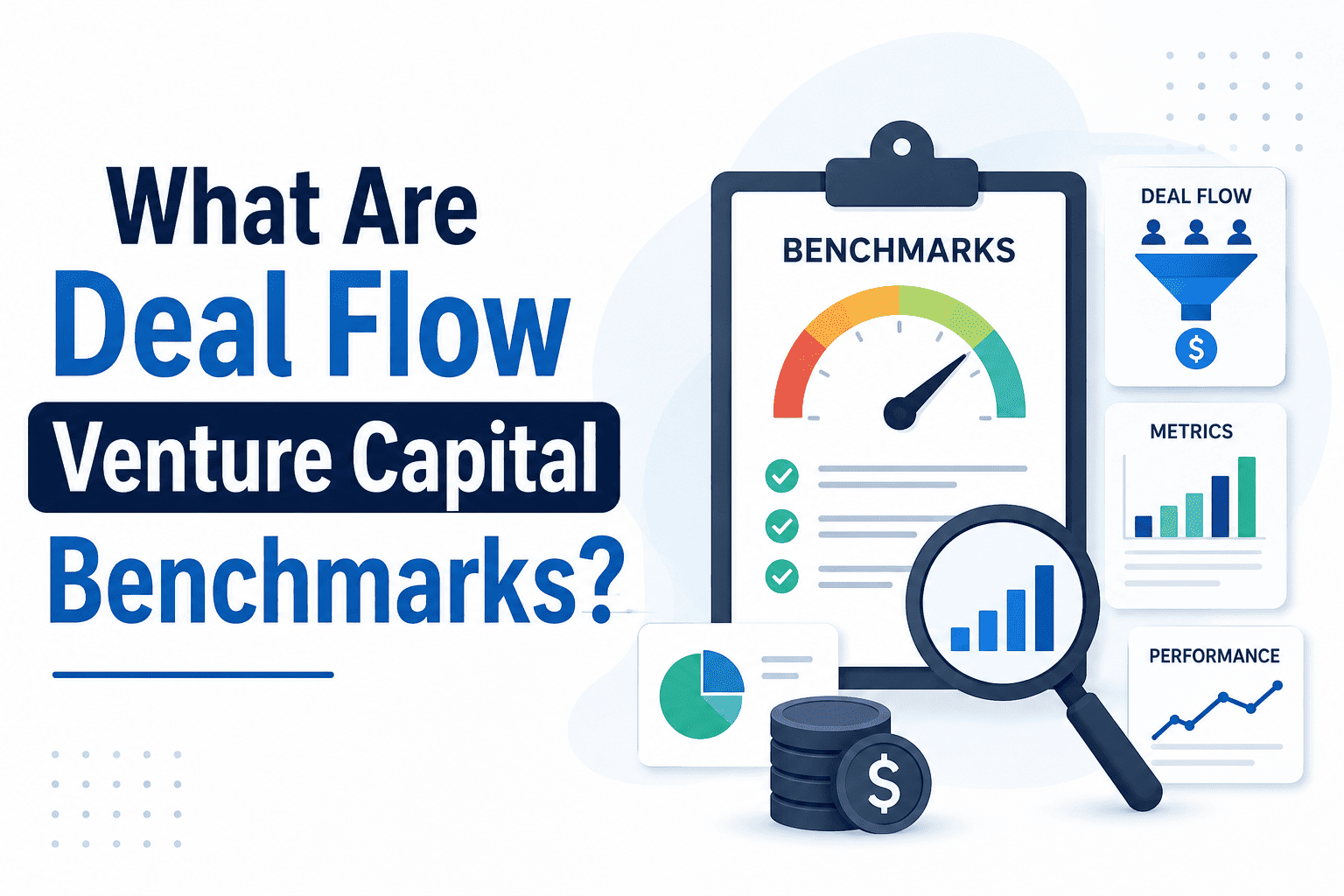
What Are Deal Flow Venture Capital Benchmarks?
Deal flow benchmarks are quantitative measures that allow VC companies to measure the performance of the investment pipeline.
They include all processes involved in investing in a business, ranging from finding new businesses, doing an initial screening of potential investments, conducting due diligence, making investment decisions, term negotiation, and post-investment support.
Instead of just going with gut feelings, good venture capital companies will use deal flow benchmarks to answer the following questions:
- How many startups enter the pipeline every month?
- What percentage advance to partner meetings?
- How long does due diligence typically take?
- Which sourcing channels produce the highest-quality founders?
- How many investments are completed annually?
By tracking these numbers consistently, firms gain visibility into where their investment process performs well and where improvements are needed.
Why Benchmarks Matter in Venture Capital
The venture capital business environment is highly competitive. Every year thousands of businesses look for investments, while venture funds are constantly emerging on the market.
Without clear benchmarks, firms often struggle with inconsistent decision-making, inefficient sourcing, and limited visibility into their investment pipeline.
Benchmarks help firms:
- Improve investment consistency
- Reduce operational bottlenecks
- Allocate partner time more effectively
- Identify high-performing sourcing channels
- Improve founder experiences
- Increase confidence in investment decisions
- Create repeatable investment processes
In the end, benchmarks help companies turn their assumptions into measurable performance metrics.
The Evolution of Deal Flow Management
Traditionally, deal flow management for venture capital firms was very much based on networking, referrals, and spreadsheets.
Although relationships remain essential, today’s investment landscape requires significantly greater organization.
Modern firms receive hundreds, or even thousands, of startup applications annually. Manually handling this amount of data gets harder with increasing amounts of money.
Currently, most advanced companies create structured investment pipelines involving standardized forms for intake, structured evaluation systems, structured stages of investing, centralized documentation process, and collaboration in review.
With the rise in competition, efficient deal flow venture capital management is not about getting more deals but managing them effectively.
Benchmark 1: Consistent High-Quality Deal Sourcing
Successful VC firms prioritize quality over quantity.
But if a startup gets 5,000 applications and only a handful to qualify for investment, then that doesn’t mean much.
Highly successful firms strategically use multiple methods of sourcing, including introductions by founders, accelerators, universities, conferences, syndication, inbound applicants, and portfolio companies.
They don’t just use one approach, but instead they look at the channels that are constantly producing startups with high chances of success.
For example, one accelerator may generate fewer companies than inbound applications but produce significantly stronger investment outcomes.
Instead of simply increasing application volume, firms optimize sourcing quality.
Benchmark 2: Clear Investment Thesis Alignment
Successful venture capital companies know that not every startup fits in their portfolio. They don’t look at every opportunity; they first see if a company fits their investment thesis. This early assessment allows teams to focus their efforts on startups that are aligned with the firm’s long-term goals and investment strategy.
In the first review, investors look at a few things to see if it’s a strategic fit. These usually include the industry of the startup, the stage of growth, the geographic market, the total market opportunity, the business model, competitive differentiation, founder experience, and the potential for future growth. By examining these elements early on, firms can rapidly determine which opportunities are worth additional consideration.
Having a clear thesis alignment at the start of the investment journey also minimizes unnecessary due diligence on companies that fall outside the firm’s focus. This, in turn, enables investment teams to devote more time to high-potential startups that match their expertise and portfolio objectives. This discipline improves operational efficiency and the overall venture capital deal flow process.
Benchmark 3: Fast Initial Screening
Top performers understand founders like timely communication. Because of the long delays, many promising start-ups have no choice but to accept competing offers. Successful firms schedule first reviews.
There is a preliminary assessment done by the analysts in a certain timeframe, instead of leaving applications untouched for weeks. This is great for both the founders and investors, because this makes the pipeline flow constantly without any backlog.
Benchmark 4: Consistent and Structured Startup Evaluation
A good venture capital firm is one that has a rigorous decision-making process. These companies have a standard process for evaluating any potential investment. The procedure is intended to help the venture capital firm make less subjective decisions about which startups to fund.
All opportunities are evaluated using the same set of criteria in order to come up with their total potential. The investment groups usually evaluate the founders’ understanding of the problem they are solving, the size of the market, and the position that the company occupies in its competitive environment. The other factors include customer traction, quality of revenue, product maturity, financials, and readiness for scaling.
By utilizing a standard framework to evaluate each opportunity, all startups can be judged impartially by the reviewer, whoever it may be. In addition, this standardizes the way that partners judge the opportunity as well, resulting in more productive conversation and sounder judgment. In the long run, this creates a more effective process.
Benchmark 5: Strong Founder Relationship Management
Successful firms recognize that founders are long-term partners rather than short-term transactions.
Even companies that may not have been immediately funded have potential to be good candidates for future funding.
Organizations maintain an efficient record of their communication history, minutes of meetings, follow-up schedule, and relationship history.
Entrepreneurs are always looking for transparency, accountability, and constructive feedback.
Effective relationship management helps in establishing a good reputation and generating referrals for future business.
Benchmark 6: Efficient Due Diligence
Due diligence is often the longest stage in venture investments.
The most successful businesses make due diligence simpler with standard document requests and pre-established checklists.
They avoid making repeated requests for information and instead compile the relevant financials, customer data, legal information, cap table, IP, and operations information through a streamlined process.
This reduces delays while improving investment confidence.
Efficient diligence also creates a better founder experience.
Benchmark 7: Structured and Data-Informed Partner Meetings
Venture capital firms that succeed ensure that all the meetings among partners follow the standard review process so as to create uniformity and efficiency in the process of reviewing the opportunities. This is done so that all the startups are evaluated based on the same criteria, and not just through casual meetings and partial information.
During these meetings, investment teams review a comprehensive summary of each company. It involves a review of the business model, target market, capability of the entrepreneur, performance, competitiveness, risk factors, and a general recommendation on whether to invest. Using similar criteria in every case ensures that discussions remain structured and that nothing is left out.
Moreover, having an organized structure in meetings also assists partners in evaluating many startups in a more effective manner. This is due to the fact that each potential startup is evaluated based on the same set of criteria. Thus, the comparison of companies becomes easier, and better-informed decisions can be made regarding investments.
Benchmark 8: Healthy Conversion Rates
An important deal flow venture capital benchmark involves conversion rates throughout the investment funnel.
Typical stages include:
- Application received
- Initial screening
- First partner review
- Due diligence
- Investment committee
- Term sheet
- Investment completed
Conversion ratios are measured for each stage in order to detect bottlenecks. If there are hundreds of start-ups that are put through the initial screening process, but just a few get through that stage, then it is necessary to modify the criteria.
Benchmark 9: Portfolio Diversification
Very successful firms do not focus on a single niche alone.
The monitoring includes how the portfolio is distributed across various industries, various stages of investment, companies’ maturity levels, and geographic regions.
Portfolio diversification allows investors to spread out their risks while providing multiple market opportunities.
A balanced portfolio indicates responsible sourcing rather than impulsive investments.
Benchmark 10: Continuous Pipeline Review
Venture capital organizations with high performance know that an investment pipeline needs to be monitored regularly. This means that they do not just monitor their investments at the time of planning for the quarter or the year; instead, they do it regularly. This helps them notice any trends or changes to make adjustments on time.
While conducting these reviews, the firm looks at whether there is any entry of a suitable startup through its pipeline and whether the potential investments match the investment thesis of the firm. Furthermore, they also identify the sourcing channels that help in bringing in the best performing companies.
Another important focus is identifying where opportunities are slowing down. If startups are spending too much time in a particular stage, it may indicate inefficiencies in screening, due diligence, or internal decision-making. In addition, companies also take into account the promptness of their response to entrepreneurs because a timely response can enhance relations and keep a promising startup from looking for alternative sources of funding.
Pipeline reviews would also be useful for the investor in order to determine any change in the marketplace. Through understanding the industries that have more potential deals, the company can modify their sourcing process. Continuous pipeline review will help venture capital firms make the right decisions and remain with an active pipeline.
Metrics High-Performing VC Firms Track
Top-performing venture capital firms look beyond investment returns when evaluating the effectiveness of their operations. While portfolio performance is the ultimate goal, successful firms understand that the strength of their investment process can be measured long before an exit occurs. Monitoring operational metrics helps teams identify inefficiencies, improve collaboration, and make more informed decisions throughout the investment lifecycle.
Rather than being obsessed with one particular measure, the top players monitor a few metrics indicating the condition of the pipeline. These include the quantity of startups that join the funnel on a monthly basis as well as the number of opportunities that fit the investment thesis of the firm out of all the candidates.
Time-based metrics are equally important. Many firms monitor how long it takes to complete an initial screening, conduct due diligence, and move a startup from its first introduction to an investment decision. Faster timelines can improve the founders’ experience while helping investors secure promising opportunities before competing firms.
A successful VC firm also carefully monitors the conversion rate through the investment process. Knowledge of how many companies move from one stage to another can reveal any possible bottlenecks and whether or not the evaluation system works. Moreover, the time founders take to respond is evaluated, along with the performance of referrals, the diversification of sectors in the portfolio, and the frequency of follow-on investments.
Examining all these metrics on a regular basis provides an insight to venture capital firms about their strengths and areas that require improvement. Gradually, through this process, venture capital firms will be able to streamline their investment strategy and boost their performance levels.
Common Mistakes That Limit Deal Flow Performance
Many firms struggle not because opportunities are unavailable but because internal processes reduce efficiency.
One common mistake is relying too heavily on personal networks. Although referrals are still valuable, overreliance on them means that we lack access to new founders.
Inconsistency in the evaluation standards used is another problem since each partner might have their own criteria.
Finally, there are some companies that do not record their interactions well, which results in scattered insights.
Slow response times can also damage reputation. Founders often choose investors who communicate clearly and move efficiently through the decision-making process.
Finally, many firms focus exclusively on increasing application volume without improving opportunity quality. Larger pipelines do not automatically produce better investments.
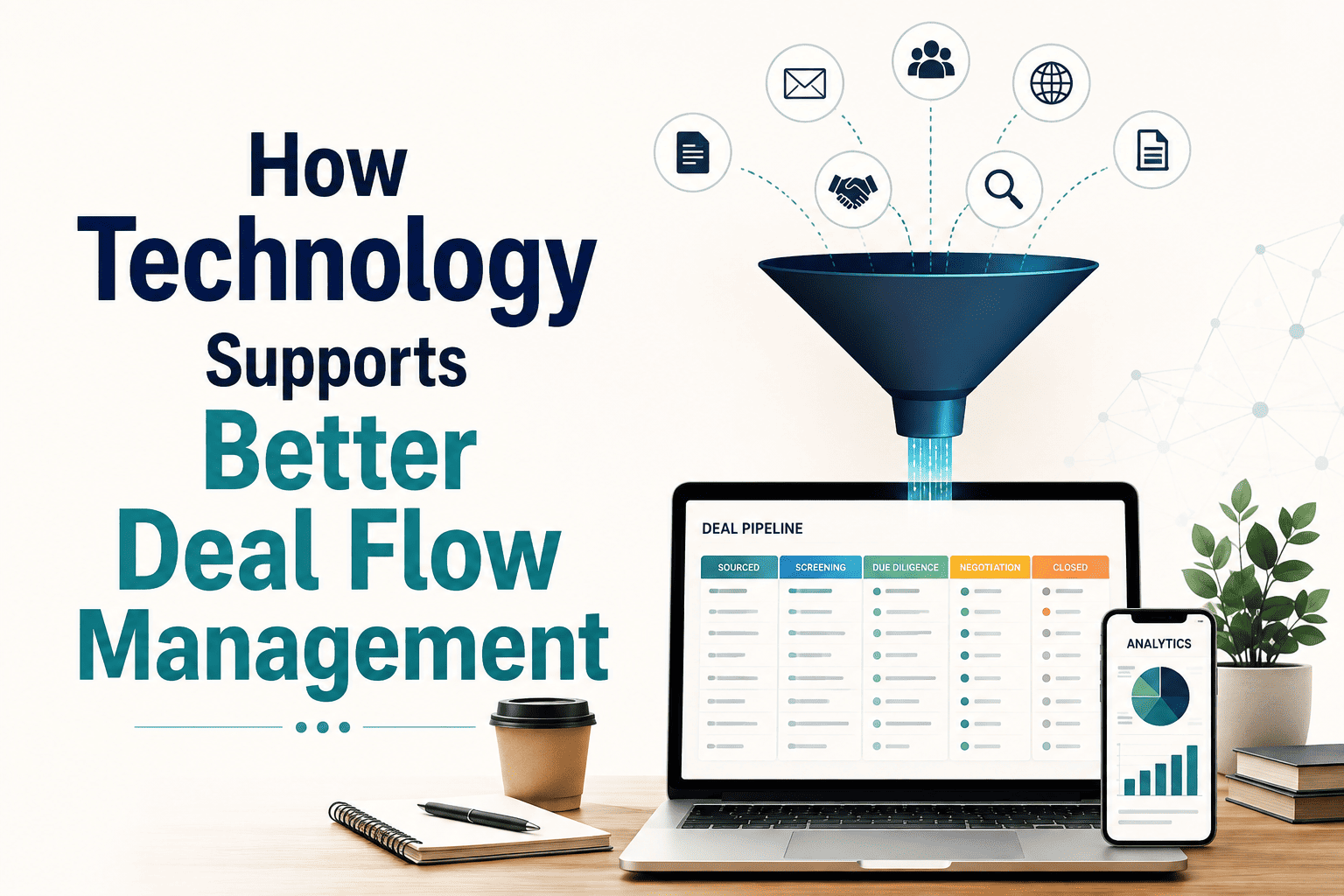
How Technology Supports Better Deal Flow Management
Venture capitalists today rely more on special platforms that help structure their investment process.
These systems help centralize startup applications, manage communications, organize documents, assign reviews, monitor pipeline stages, and generate performance reports.
While not replacing the expertise of investors, technology cuts down on paperwork, giving partners more time to evaluate and get to know founders.
Centralized systems also improve collaboration among analysts, associates, principals, and partners.
When information remains organized and accessible, investment decisions become more consistent.
Building Your Own Deal Flow Venture Capital Benchmark Framework
Every venture firm has different investment goals, but nearly every firm benefits from establishing measurable benchmarks.
Start by defining your investment thesis clearly. Next, document each stage of your investment pipeline. Identify performance metrics that are important for your company. Evaluate your sourcing channels regularly. Develop criteria for evaluating startups.
Measure response times. Monitor conversion rates. Evaluate the results on a monthly basis. The goal is not to copy the process of another company, but to create an infrastructure that will help your company invest wisely.
As your portfolio grows, your benchmark system should evolve alongside your organization.
Questions Every VC Firm Should Ask
When evaluating pipeline performance, investment teams should regularly ask themselves:
- Are we attracting the right founders?
- Which sourcing channel consistently delivers our strongest investments?
- How quickly do we review new opportunities?
- Where does our investment process slow down?
- Are partner meetings based on standardized information?
- Do founders receive consistent communication?
- Are our evaluation criteria aligned across the investment team?
- Can we clearly explain why each investment progressed or didn’t?
Answering these questions regularly strengthens investment discipline.
How Emerging VC Firms Can Compete with Larger Funds
Big venture firms get plenty of attention directed towards them. However, there are also strengths that small venture funds can bring to the table.
Smaller firms are able to move faster, create better relationships with founders, specialize in certain industries, and gain specific investment knowledge.
With the help of effective deal flow venture capital strategies, smaller funds can be competitive in spite of their limitations.
Consistency, transparency, and operational discipline often prove more important than the size of the firm.
Founders like having active investors who know their market and can communicate effectively.
The Future of Deal Flow Venture Capital
The world of venture capital is constantly changing as entrepreneurial activity grows in different sectors and geographical locations.
Founders today require fast response times and good communication skills.
Investors, in turn, must manage increasing application volumes while maintaining investment quality.
As competition intensifies, firms that continuously refine sourcing, evaluation, due diligence, and relationship management will be better positioned to identify exceptional companies before competitors do.
The firms that consistently succeed will not necessarily review the most startups; they will manage their deal flow venture capital process more effectively than others.
Conclusion
Strong venture capital performance begins long before a term sheet is signed. It starts with a disciplined, measurable, and repeatable approach to sourcing and managing investment opportunities.
High-performing VC firms distinguish themselves by establishing clear benchmarks, tracking meaningful metrics, standardizing evaluations, communicating consistently with founders, and reviewing pipeline performance on an ongoing basis. These practices reduce inefficiencies while improving the quality of investment decisions.
It does not matter whether your organization is creating its first fund or managing a current portfolio of ventures because with deal flow venture capital metrics, you will be able to create an approach that will help you build solid performance. Your decisions will be based on something other than intuition.
FAQs
1. How often should a venture capital firm review its deal flow benchmarks?
Benchmarking for deal flow needs to be done regularly and not just when conducting quarterly or yearly planning. Monthly benchmarking ensures that companies are able to spot any areas where there is inefficiency and can then improve their strategies going forward.
2. Can strong deal flow venture capital processes help smaller VC firms compete with established funds?
Yes. Smaller venture capital firms can offset their limited brand recognition by building disciplined deal flow venture capital processes. The ability to make quick decisions, the responsiveness of founders, concentrating on investments, and proper evaluation process help new companies compete with more established organizations.
3. Why aren’t increasing startup applications enough to improve investment performance?
Not every large pipeline necessarily leads to good investments. Good companies always seek to identify startups that fit into their investment criteria and constantly evaluate what channels of sourcing bring them the best deals, instead of simply having more applications.
4. What role does technology play in improving deal flow venture capital management?
Technology may prove very helpful in centralizing startup applications, documentation, pipeline phases, communications, and collaboration among the investment team. This technology does not take away from the expertise of investors but makes the decision-making process easier.
5. How can inconsistent evaluation standards affect long-term investment outcomes?
Investment decisions will be hard to compare because every individual will be analyzing different aspects of the companies. Having an evaluation process allows for consistency, better cooperation, and objective discussions regarding investments.
6. Which operational metrics reveal the health of a deal flow venture capital pipeline before investment returns are realized?
Examples of operational metrics that could show the state of the pipeline include startup pipeline volume, investment thesis fit, time taken for screening, time taken for due diligence, conversion rates, founder response, referrals, and diversification. Such metrics allow for improvements to be made to the process of investing long before exit opportunities or returns.

I’m the Co-Founder of Startup Steroid, where I help founders navigate the challenges of building a startup. From connecting with the right investors and talent to guiding marketing, legal, and MVP development, I work alongside entrepreneurs to provide practical support and clarity, helping them grow their ideas into successful, sustainable businesses.