It is an exciting experience to start a business, but the world of funding can be tricky to navigate. It is very important for entrepreneurs to know who the funders are, how much equity share to give away, and where to look for the funds. In this article, we shall discuss the basics of funding for startups so that you can plan strategically and get in touch with the right people for the job.
What Is Startup Funding?
Startup funding is the capital required to launch and grow a business. It helps founders create a product, build a team, and enter the market. Without funding, even the best ideas may not reach their full potential.
Funding can come in different forms: personal savings, loans, or external investors. The source of finance also affects the level of control that is maintained, growth prospects, and long-term plans. For example, seeking finance for a start-up from outside sources requires the owner to give away some equity in the business.
Knowing the basics of startup funding will enable a founder to make informed decisions.
Why Do Startups Need Investors?
Startups require funding from sources other than their own, as their own funds are generally insufficient for covering the costs of operation, development, and entry. Investors in start-ups receive not only capital but also advice, legitimacy, and access.
Investors for startups offer strategic advice, mentorship, and introductions to potential partners or clients. Such support can also assist in fast-tracking growth, eliminating risks, and improving decision-making processes. In addition, success in investments can also increase confidence in other groups like future investors, employees, and customers.
Startup investment enables entrepreneurs to focus on developing their venture instead of focusing on cash flow concerns. This investment helps provide entrepreneurs with the resources they need to reach milestones and develop products.
Types of Investors for Startups
Different types of investors offer distinct advantages and come with varying levels of involvement, expectations, and risk. Understanding the types of investors helps founders target the right source of funding.
Friends and Family
Friends and family often provide the first source of startup investment. Their funding is based on trust and personal relationships rather than formal evaluation.
While convenient, this type of funding carries personal risks. It is also important to formalize such agreements in order to avoid any misunderstandings in the future. Simple contracts or promissory notes can go a long way in achieving this goal while raising the necessary funds.
Angel Investors
Angel investors are individuals who invest in startups in return for equity or convertible debts.
Angel investors for startups not only offer capital to the startups but also provide mentorship to the startups. They offer valuable advice to the startups.
Venture Capital Firms
Venture capital (VC) firms pool funds from multiple investors to invest in high-growth startups. VC investment is usually larger than angel investment and involves structured due diligence.
Startup investment from VCs often requires giving up a significant portion of equity. In return, venture capital firms offer resources, strategic guidance, and access to extensive networks. They often play an active role in helping startups scale operations, hire key personnel, and expand into new markets.
Crowdfunding Platforms
Crowdfunding allows startups to raise money from a large number of small investors, typically online. Crowdfunding can involve rewards, pre-orders, or equity.
Equity crowdfunding is a growing trend, enabling startups to raise investment while validating market demand. Platforms allow potential investors to contribute small amounts in exchange for a stake in the company, providing both funding and early community engagement.
Corporate Investors
Some big corporations invest in startups to acquire innovation, technology, or entry into new markets. Corporate investors provide strategic assistance.
The investment in startups by corporate investors is effective when the product or service offered by the startup is complementary to the product or service offered by the investor. Such an investment can boost growth, enhance credibility in the market, and offer strategic advantages in the long term.
How Much Equity to Offer
The decision of how much equity to offer to the investor is one of the most crucial decisions that any founder of a startup has to make. Giving away too much equity results in loss of control, while giving away too little equity may not attract investors.
Calculating Equity
Equity is the ownership of the company. The amount of equity depends on the valuation of the company, the funding requirements, and the expectations of the investor. For example, a company with a valuation of $1 million and funding requirements of $200,000 may require 20% equity.
Equity negotiations also vary depending on the startup stage. At the seed stage, the equity is relatively higher compared to the later stages. In the later stages, the equity is relatively lower, but the investment is relatively higher.
Balancing Control and Growth
The founders need to strike a balance between having control over the company and providing equity that is attractive enough to the investor. The risk needs to be justified for the investor in the new venture, while the entrepreneur also needs to retain control over the company.
Vesting Schedules
Vesting schedules involve the allocation of equity over time. The founders and key employees receive equity over time, thus encouraging them to stay longer with the company. The investors also appreciate this because they do not lose the founders too soon after having granted them large equity stakes.
Where to Find Money for Your Startup
The best source of funding is determined by a series of strategies and preparations. There are various sources of funding, and each has its pros and cons.
Startup Accelerators and Incubators
Accelerators and incubators provide funding, mentorship, and resources in exchange for equity. Programs often include structured guidance to refine business models and prepare startups for further investment.
Participating in an accelerator increases credibility, exposure, and access to investors for startups. These services help founders avoid common pitfalls, develop investor-ready decks, and gain strategic guidance.
Angel Networks
With the use of angel networks, startups are in a position to share their ideas with a number of investors at once. This is because networking events, pitch days, and the use of the internet make it easier for a startup to share their ideas with a number of investors at once.
Building relationships through angel networks increases the likelihood of securing funding and establishing long-term partnerships. Angel investors of startups usually offer mentorship as well.
Venture Capital Firms
Venture capital firms invest in startups that exhibit traction. To get venture capital funding, a startup needs a good pitch, financials, and a growth strategy.
Founders should research firms aligned with their industry. Not all VCs invest in every sector, so targeting firms that focus on your niche increases the chances of obtaining startup investment.
Crowdfunding Platforms
Crowdfunding offers an alternative to traditional funding. Equity crowdfunding allows a broad audience to invest in exchange for company ownership.
Successful crowdfunding campaigns require clear communication of business potential, plans for fund usage, and attractive incentives for investors. Crowdfunding can also help create a community of supporters, which can also validate the product and raise funding.
Government Grants and Programs
There are many governments around the world that offer grants or programs for startups. The funding provided by these sources is also not in exchange for equity.
Exploring grants at the local, regional, and industry levels will provide the necessary funding without giving up ownership.
How Investors Evaluate Startups
Investors examine startups carefully before investing. Knowing what investors look for in a startup will help founders make a compelling pitch.
Market Opportunity
Investors for startups seek businesses with scalable markets. A large or increasing market implies that there is an opportunity for high returns. The founders need to demonstrate the size of the market, the trends in the market, and the competition in the market.
Team and Founder Expertise
Investors evaluate the founding team’s skills, experience, and ability to execute. Complementary teams with diverse expertise increase investor confidence in the startup’s growth potential.
Product or Service Validation
Having a validated product or service increases investor confidence. Pilot projects, initial sales, or early market feedback indicate market demand. Market validation is often essential for startups to raise funds.
Financial Projections and Growth Potential
Investors review business models, financial projections, and growth strategies. Realistic projections enable investors to estimate the potential for returns and the magnitude of growth.
Negotiating Terms with Investors
Once investors express interest, negotiating terms defines the partnership, ownership, and expectations for both parties.
Valuation Negotiations
This step helps in deciding how much equity is to be given away. The founders also have to give valuations that are realistic based on research and financial figures. Overvaluation can cause founders to lose investors, while undervaluation can cause founders to give away too much of their shares unnecessarily.
Investor Rights and Preferences
The investors can ask for many things in return for the investment in the company. This helps the founders retain control of the company while making the offer attractive to the investor.
Legal Agreements
Term sheets and shareholder agreements are formal contracts that safeguard both founders and investors.
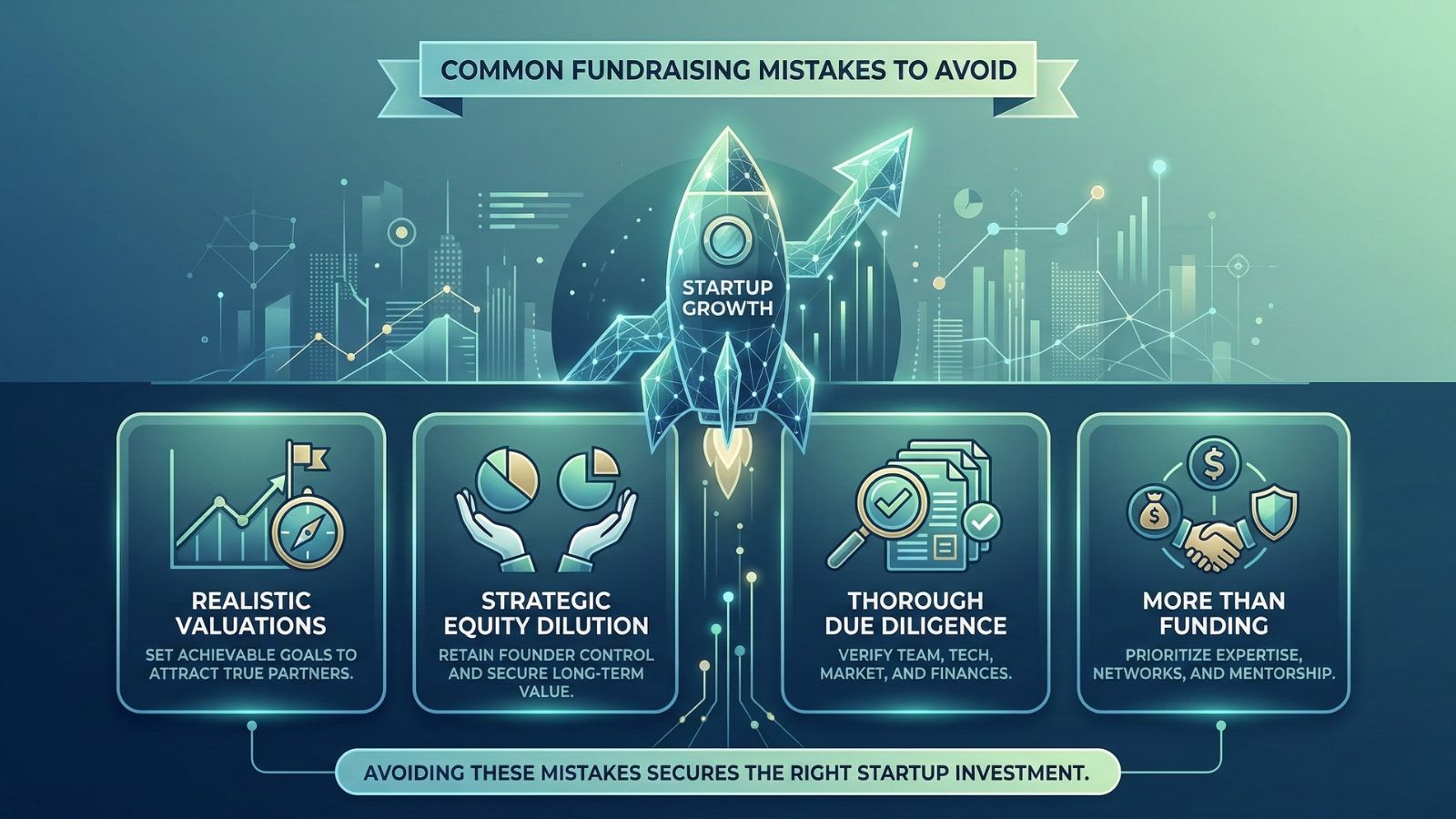
Common Mistakes to Avoid
Raising funds for a startup involves a lot of complexities, and if proper care is not taken, it may lead to negative repercussions in the long run.
- Overvaluing the startup: Overvaluing a startup may lead to problems in the funding rounds.
- Giving away too much equity: Giving away too much equity may lead to negative repercussions.
- Neglecting due diligence: It is important to understand what the investors expect and what the legal requirements are.
- Focusing only on money: Investors for startups can bring strategic value and guidance.
Avoiding these mistakes ensures founders secure the right startup investment for growth.
Preparing for Funding Rounds
Startups receive funding in installments, which match specific milestones in their growth process. Each round is backed by different investors, who have varying investment objectives.
Seed Stage
Seed funding is for product development, talent acquisition, and market testing. The investors for startups are friends, family, and angel investors.
Series A and Beyond
Later-stage funding focuses on scaling up, growth, and profitability. Venture capitalists and institutional investors are involved. Traction, metrics, and teams are important.
Building Relationships with Investors
Funding is a long-term partnership, not a one-time transaction. Good communication, regular updates, and clear milestones are key to building good relationships with investors, especially startups.
Attending networking events, conferences, and mentorship programs are a good way to network with potential investors. Referrals from people within your circle are more effective than seeking investors from unknown people.
Good relationships are a way to get access to future startup funding.
Tips for Securing Startup Investment
- Prepare a strong pitch: Clearly communicate your product, market, and growth potential.
- Research investors: Target those aligned with your sector and stage.
- Show traction: Demonstrate product validation, early adoption, or progress toward goals.
- Prepare financials: Investors expect realistic forecasts and plans for fund usage.
- Network strategically: Relationships often create funding opportunities more effectively than applications.
- Be transparent: Honest communication builds trust with investors for startups.
- Protect ownership: Ensure equity allocation balances funding needs and long-term control.
Conclusion
Startup funding is more than acquiring money. Understanding who invests, how much equity to offer, and where to find funding is essential for founders. Investors for startups provide capital, guidance, networks, and credibility.
Finding the proper investment for a startup can lead to growth, verification of a business, and access to resources that can help expand operations. Careful planning, pitch preparation, and equity management can help founders make informed decisions and retain control while attracting the proper investors.
By following these principles, the founders can approach funding in a strategic manner to build the foundation for their long-term success.
FAQs
- What factors truly influence how much equity a founder should give up early on?
The founders have to take into account the valuation, control, and expectations of the investors in determining the amount of equity that is to be provided.
- How do investors assess whether a startup’s market is worth entering?
The investors will look at the market size and demand to ensure that they will get a good return from the business.
- Why do some startups struggle to attract investors even with a strong product?
A good product is only half the equation; investors also consider the team, financials, model, and scalability potential of the startup.
- What makes certain investors a better fit for early-stage founders?
Investors who offer mentorship, strategic guidance, network support, and industry expertise tend to be more supportive for founders compared to those who simply offer capital.
- How do funding stages differ in what investors expect from founders?
Each stage requires different proof points, seed investors require concept validation, whereas later-stage investors require traction and revenue growth.
- What should founders look for in investor rights before accepting funding?
It is important to look at voting rights, board seats, liquidation preferences, and decision-making powers to ensure a balance is maintained.
- How can founders prepare financially before approaching investors?
Clear forecasts, sustainable revenue models, and well-structured use-of-funds plans show investors that the founder understands business economics.
- Why is relationship-building an essential part of long-term fundraising success?
Relationship-building will help build trust, facilitate better communication, and sometimes provide easier access to future rounds of investment.

I’m the Co-Founder of Startup Steroid, where I help founders navigate the challenges of building a startup. From connecting with the right investors and talent to guiding marketing, legal, and MVP development, I work alongside entrepreneurs to provide practical support and clarity, helping them grow their ideas into successful, sustainable businesses.