
In the world of venture capital, the pace at which opportunities are identified and assessed may mean the difference between success and failure. With a number of startups to deal with, keeping track of all of them, as well as ensuring that no opportunity slips through the cracks, can be a daunting task even with the most efficient of systems. While many venture capital teams used to rely on customer relationship management systems, this was not a tool created with venture capital in mind, but the emergence of deal flow software venture capital teams are embracing has changed the face of the way they track investment opportunities.
This blog explores what deal flow software is, why it outperforms CRMs, and how a deal flow management tool can improve investment decision-making.
Understanding Deal Flow in Venture Capital
At its core, deal flow refers to the number and quality of investment opportunities that reach a venture capital firm over a period of time. It is the lifeblood of venture investing. Firms with strong deal flow can evaluate multiple opportunities, pick the most promising ventures, and diversify their portfolio effectively.
While it is true that deal flow is all about the number of opportunities, it is also equally true that it is all about the quality of these opportunities as well. Venture capital firms are looking for start-ups that have growth potential and are in line with market trends. If these opportunities are not tracked in any manner, then it is possible for these opportunities to be missed.
This is where a deal flow management tool can prove to be incredibly valuable, as it is specifically designed for the needs of venture capital organizations and can provide a way to manage, track, and analyze opportunities in a structured manner.
Why CRMs Fall Short for Venture Capital
Venture capital organizations often start using a CRM system as a way to manage their opportunities. CRMs work well for sales pipelines and managing customer relationships, but they are limited when it comes to venture investing.
CRMs are often too generic for venture capital needs. They emphasize contact management and sales tracking instead of evaluating startups. Features like scoring potential investments, funding stages, and market intelligence are not native to CRMs.
Secondly, CRMs may be cumbersome when it comes to manual inputs for some of the processes that may be automated in other systems. For instance, CRMs may be cumbersome when it comes to tasks such as sending follow-up emails to startup founders or tracking document submissions or meeting results. Generating detailed insights about the investment pipeline or comparing startup performance across industries is often difficult.
Integration is another limitation. CRMs may not be able to easily interface with software used for financial modeling, market research, or valuation analysis. This can cause problems as the venture capital firm increases in size. This is one reason why specialized software is necessary.
What Makes Deal Flow Software Venture Capital Teams Choose
Deal flow software venture capital firms use is purpose-built to manage the complete lifecycle of investments. Unlike CRMs, it provides features specifically designed for venture capital needs.
A deal flow management tool allows firms to organize opportunities clearly and efficiently. Startups can be tracked through the entire process of evaluation, including the final decision to invest. The teams can also score and rank the startups based on the desired parameters, which can be set as per requirement, to prioritize the best startups.
Collaboration is another significant feature that can be beneficial for the teams. The teams can add comments, share documents, and even set tasks through the platform. All the information is stored in one place, including the founder’s information, pitch books, and financials.
In addition, this tool may also have the ability to display a dashboard showing the status of the investment pipeline. This provides a very clear picture of which startups are moving along, which ones need follow-up, and where the process is being stalled.
Why Firms Are Moving from CRMs to Deal Flow Software
Venture capital firms are adopting deal flow software because it overcomes the challenges that CRMs pose and offers benefits:
- Improved Tracking – Investment opportunities have multiple stages and complex criteria. The deal flow management tool records this information in detail and enables a systematic approach for monitoring all startups so that none are missed.
- Time Efficiency – The automated features help minimize the workload on the individuals, and they can concentrate on evaluating the startups.
- Informed Decision-Making – The scoring and ranking of the opportunities that the venture capital teams utilize through the deal flow software enable the firms to make informed decisions.
- Consistency Across Teams – Having the data in one place allows all team members access to the same information. This improves accountability and ensures smooth collaboration.
- Scalability – As firms manage larger portfolios, deal flow software scales with their needs. CRMs often struggle to handle increasing numbers of startups without losing organization or oversight.
How Deal Flow Software Enhances Investment Tracking
Investment tracking is a critical component of venture capital. Deal flow software makes this process more precise and organized.
- Centralized Data Access – Access to all startup data, including financial data and founder information, is in one place. This eliminates the need to search through emails and spreadsheets.
- Real-Time Updates – Startups are dynamic organizations, and the deal flow software facilitates real-time updates with respect to funding rounds, the startup team, and the market.
- Customizable Pipelines – The startup firm can create its own pipeline based on the way it conducts its investments. The opportunities can be segmented based on the stage, funding round, and industry type.
- Performance Analytics – These websites give access to various metrics that help measure conversion rates, sector performance, and founder engagement. This information can help refine strategies and improve the investment process as a whole.
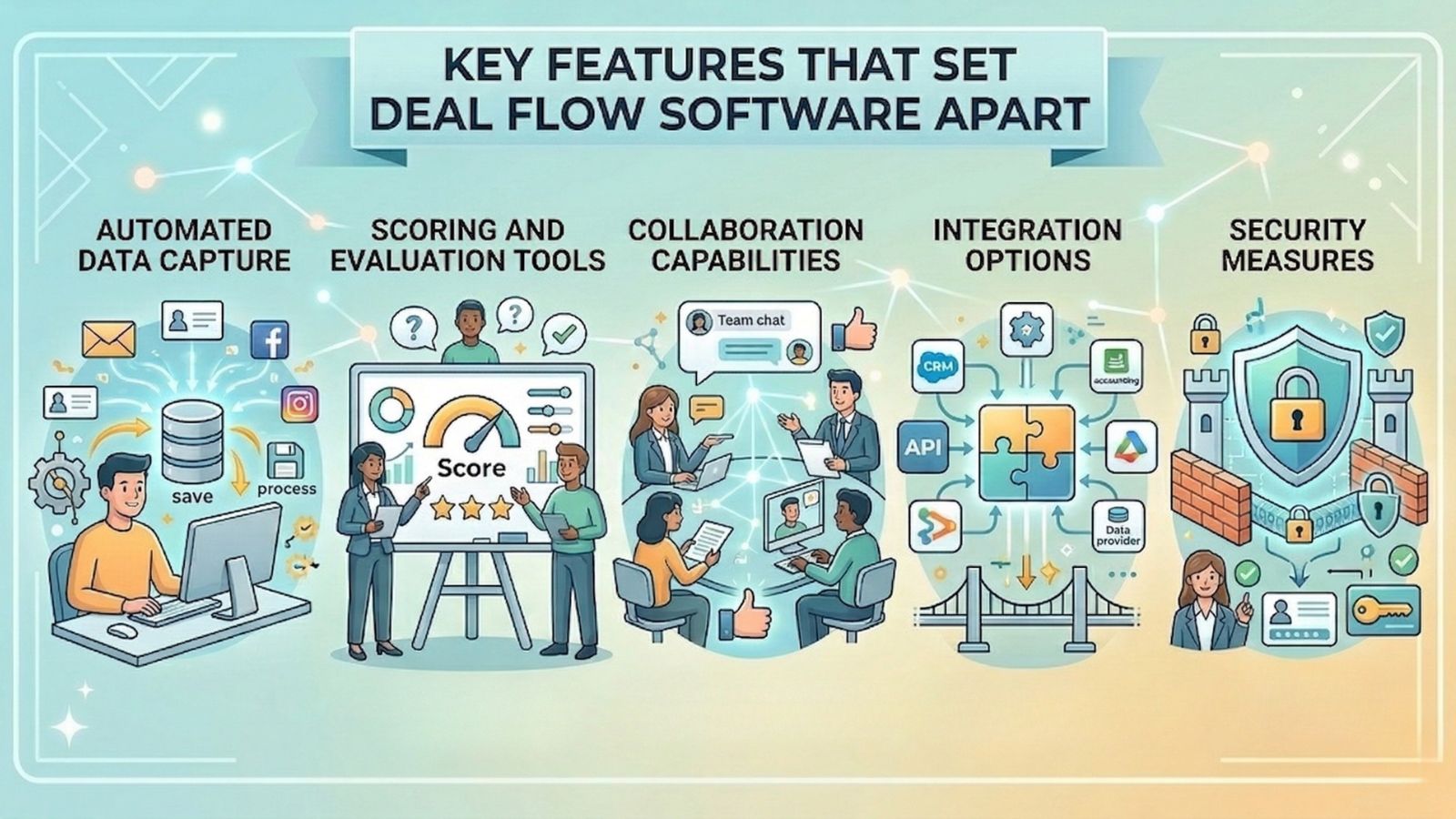
Key Features That Set Deal Flow Software Apart
While making a choice for deal flow management tools, some of the features are of utmost importance:
- Automated Data Capture – Sometimes the data is available in the email, forms, and other public domains, which can be easily captured and hence the chance of human errors can be avoided.
- Scoring and Evaluation Tools – This feature allows the flexibility to create a scoring system in order to rate the startups based on various parameters.
- Collaboration Capabilities – Commenting, tagging, and task assignment are useful collaboration tools.
- Integration Options – The ability to connect with financial modeling, valuation, or market research tools ensures seamless workflows.
- Security Measures – Robust security measures are required for the security of the investment information.
Though CRMs provide these tools, they are limited and need significant customization. Dedicated deal flow tools provide all these tools out of the box.
Real-World Impact of Deal Flow Management Tools
For instance, if we take a case of a venture capital firm that operates hundreds of early-stage startups, previously, such a firm used to use a CRM and spreadsheets to manage their data. However, it was a tedious task, and follow-ups were also missed in the earlier days. Moreover, it took a long time to make business decisions, and some business opportunities were also missed in the earlier days.
After implementing a deal flow management tool, the firm experienced significant improvements. Manual data entry was reduced by over 40%, follow-ups became systematic, and scoring mechanisms highlighted the most promising startups. Collaboration improved because team members could comment and share notes in real time. Overall, the firm could move faster, track opportunities more efficiently, and make more informed decisions.
This is an example of how a deal flow software, which venture capital teams invest in, may alter their ability to manage their investments from negative to positive.
Implementing Deal Flow Software Successfully
Implementing a deal flow management tool is just as important as choosing the right tool for your organization.
- Assess Current Processes – Determine how deal flow is tracked and managed today. Know what works well and what does not work well.
- Define Requirements – List the features your firm needs, such as scoring models, reporting, integrations, or mobile access.
- Choose the Right Platform – Not all deal flow software is the same. Select a tool that is appropriate for the firm’s workflow, portfolio size, and focus.
- Train the Team – Here, the required education level of the team regarding the usage of the tool for data input, startup evaluation, and analytics tools needs to be provided.
- Migrate Data Carefully – Migrate the existing data from the CRM systems and the spreadsheets.
- Review and Optimize – This step includes the review of the usage of the tool and optimizing the process to leverage the tool in the best possible manner.
By following the systematic approach, the software will help to improve productivity rather than adding more complexities.
Maximizing the Value of Deal Flow Software
In order to make the best out of the deal flow management software, it is recommended to follow the best practices as mentioned in the following sections:
- Standardized Evaluation – It is recommended to use the standardized evaluation parameters in order to rate the startups and make objective decisions.
- Maintain Accurate Data – It is recommended to maintain accurate data in order to avoid decision-making based on wrong and inaccurate data.
- Leverage Analytics – The application of analytics can be used to gain a better understanding and improve the strategies employed in investing.
- Encourage Collaboration – The entire team must be encouraged to make the most out of the platform they have been provided with. Communication is the key to success and can be achieved through centralized communication.
- Automate Repetitive Tasks – Features like automated reminders, follow-ups, and report generation save time and reduce errors.
When these practices are in place, a deal flow management tool becomes a central hub for investment decision-making.
The Future of Deal Flow Management in Venture Capital
However, the venture capital industry remains a changing field, as venture capital firms deal with more complex portfolios, complex investments, and global opportunities. The deal flow software venture capital teams are utilizing today will likely become even more advanced, offering features such as predictive insights, more in-depth analytics, and potential integrations with new forms of market intelligence tools.
While CRMs may still serve as supplementary tools, they cannot match the efficiency, specificity, and strategic value of a dedicated deal flow management tool. Businesses that use these systems and optimize them are in a position to respond quickly, invest wisely, and maintain their competitive advantage.
Conclusion
Venture capital thrives on speed, accuracy, and insight. Managing high volumes of potential investments requires more than basic contact tracking. While CRMs may offer familiarity, it is impossible for CRMs to meet the demands of venture capital investments.
Venture capital deal flow software is a method of managing venture capital deal flow that is utilized by the venture capital industry. This approach has the potential to automate routine tasks, score/rank startups, and even work together on opportunities to help focus on the evaluation of opportunities.
In today’s competitive landscape, venture capital firms must master the art of deal flow with the proper software, and it is no longer a choice, but a necessity for success.
FAQs
- How can venture capital teams identify hidden pipeline bottlenecks before they affect investment decisions?
Venture capital teams often realize bottlenecks only after delays occur. A deal flow software venture capital firms use provides real-time visibility into each stage, allowing teams to detect where deals slow down, whether during initial screening, due diligence, or partner review, so they can fix issues before they impact outcomes.
- What role does centralized data play in improving the accuracy of investment evaluations?
Centralized data removes the risk of miscommunication and scattered documents. When all founder notes, financial files, and meeting summaries live in one platform, evaluations become more accurate because teams base decisions on complete, updated information rather than piecing together insights from multiple tools.
- How do venture capital firms maintain evaluation consistency across different team members?
However, consistency is difficult to attain when partners are using their own evaluation criteria. A structured scoring system is also provided in a deal flow management tool that helps to ensure that all partners are evaluating all startups on a fair and equal basis.
- Can specialized deal flow tools support long-term portfolio insights beyond initial investment tracking?
Yes. Most of these websites provide information on the startups even after investing, which helps in tracking the progress and revenue announcements made by the startups. This information helps in making informed decisions on further investments, which can be useful in creating the investment theses.
- How does automation help smaller VC teams compete with larger firms?
Smaller teams often lack the manpower to manage high volumes of startups. Automation features, such as auto-capturing founder data, sending follow-up reminders, or updating deal stages, give these teams the ability to work at a scale comparable to larger firms without increasing workload.
- Why do some firms combine traditional CRMs with deal flow software venture capital platforms instead of replacing CRMs entirely?
Some companies also maintain CRMs as part of their relationship management process; however, they also use deal flow platforms for the evaluation and tracking process. While the former is being used for investor relations, the latter is being used by the venture capital teams. In that way, both these tools are being used for the best functionality.
- How does adopting a deal flow management tool influence a firm’s ability to attract better startup leads?
Startups also prefer to work with companies that are quick to respond and are well-organized. A well-managed and efficient evaluation process is a mark of professionalism. When founders are impressed with a company’s professionalism, they are more likely to recommend it to other high-quality startups.
- What challenges do firms face when transitioning from spreadsheets to dedicated deal flow tools, and how can they avoid them?
The biggest challenges include inconsistent data migration, lack of internal alignment, and team reluctance to change. Firms can avoid these issues by standardizing data before import, training all team members properly, and rolling out the deal flow management tool in phases rather than all at once.

I’m the Co-Founder of Startup Steroid, where I help founders navigate the challenges of building a startup. From connecting with the right investors and talent to guiding marketing, legal, and MVP development, I work alongside entrepreneurs to provide practical support and clarity, helping them grow their ideas into successful, sustainable businesses.