Early-stage investing has always been fast-moving, but the competitive environment today requires more structure, clarity, and coordination than perhaps ever before. Angel investors increasingly consider a high volume of opportunities operating in multiple sectors and different geographies; keeping track of them is the real challenge. This is why many investors have now started working with the help of angel investor deal flow software, which reshapes the way decisions are made at the earliest stages of startup funding.
As investor networks expand and founders seek capital from a broader pool of backers, having a reliable deal flow management process has become increasingly essential. This change isn’t merely about ease of use; it’s about laying the groundwork for a better, more informed assessment and/or collaborative environment.
How can angel investors create a more organized approach to sourcing new opportunities?
The conventional method for gathering information for early-stage investment comprises different sources, word-of-mouth, pitches, approaches, and startup sites. Historically, investors have depended solely on using spreadsheets, email folders, and note-taking, which has not left any stones unturned.
With this software, incoming deals are organized in one place. Investors can review, tag, and categorize each opportunity at once. A structured process ensures every startup receives equal attention and no promising deal gets overlooked.
The streamlined organization allows investors to spend a lot less time tracking down documents scattered everywhere and more time really focused on the merits of each startup.
How can standardized workflows help investors maintain consistent evaluation across deals?
Early-stage investment decisions depend heavily on consistent evaluation. Moreover, without such a system, various investors may have diverse criteria in place or may fail to consider vital information. This not only slows down decision-making but could also cause confusion, especially among numerous investors involved in one investment.
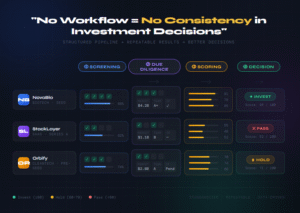
A strong process solves this by establishing a standardized workflow. Every startup goes through the same steps; from initial review to deeper assessment and final decision. The software encourages such consistency by facilitating every member of the team to adhere to this criteria.
This model results in decisions that are more considered, balanced, and consistent.
How can investor networks strengthen collaboration during early-stage deal evaluations?
Angel investing is no longer an isolated activity. Many take part in investment clubs, or they may be in groups where cooperation is vital, as shared notes and viewpoints, as well as assessing opportunities together, yield better results. Only, of course, if communication is clear.
Angel investor deal flow software improves this collaboration by bringing all discussions into one shared environment. Instead of long email threads or multiple versions of a pitch deck, investors can comment, score, and review opportunities directly within the platform. This strengthens the deal flow management process by reducing friction and making it easier to build consensus.
New members of a network also benefit, since they can quickly understand past evaluations and align with the group’s approach.
How does centralizing information make due diligence more efficient for investors?
Due diligence ranks as one of the most extensive processes for early-stage investors. Investors must also be able to obtain basic documents, backgrounds of the founders, industry analysis, and legal documents. When documents are costly or hard to obtain because their storage spaces are inconsistent, doing due diligence becomes difficult.
Essentially, when an entrepreneur makes use of angel investor deal flow software, it can allow them to leverage one central location to view all information associated with the investment. This would, therefore, enhance the effectiveness of the deal management process. This would make the investment management process efficient as it would allow them to view everything in one location.
Faster due diligence means investors can move quickly on strong opportunities and avoid delays that may cause them to miss out.
How can investors gain better visibility into their entire deal pipeline?
Angel investors rarely review one startup at a time. They might be considering dozens of companies simultaneously, each at a different stage. It can be difficult to keep track of what needs attention and what can wait.
Angel investor deal flow software solves this with clear pipeline visibility. Investors can instantly see which opportunities are new, which are under review, and which are close to a decision. So if you run your deal flow management tightly, nothing ever gets stuck or lost, as every step always had a subsequently known.
Such an approach allows investors to better plan their time and keep a clean and organized pipeline.
How can investors use insights to strengthen long-term decision-making in early-stage deals?
Although experience and judgment remain critical for the investor in bootstrapping, understanding the patterns can also help refine the strategy. Eventually, deal flow tools available for angel investors will help detect patterns such as which startups progress the most, which industries are the most popular, and what are the most frequent factors associated with the successful startups.
A reliable deal flow management process allows investors to reflect on their pipeline data, make adjustments, and strengthen future strategies. These findings can help with continuous improvement and aid investors in developing a better and better-informed style of investment.
Conclusion
The world of early-stage investing is evolving quickly, and the tools investors use must evolve with it. Angel investor deal flow software is now increasingly playing a central role for modern-day investors for the identification, assessment, and commitment towards new deals and opportunities. These software systems can help boost the effectiveness of the deal flow management process for the investors, facilitating increased efficiencies in terms of organization, collaboration, and understanding.
It simply does not replace investor intuition or experience. It actually provides a backdrop from which such strengths will be much better applied. Early decisions will always have some degree of uncertainty; just better systems will give an investor fronting every decision with greater confidence and a clearer view of every opportunity.

I’m the Co-Founder of Startup Steroid, where I help founders navigate the challenges of building a startup. From connecting with the right investors and talent to guiding marketing, legal, and MVP development, I work alongside entrepreneurs to provide practical support and clarity, helping them grow their ideas into successful, sustainable businesses.