Angel investing is not only about finding good startups and putting money into them. Angel investors have to analyze business models, review management teams, conduct due diligence, make comparisons, and keep track of companies well after making the investment. Balancing all these tasks becomes harder when there are many deals and participants in the decision-making process.
For angel groups, individual investors, accelerators, and small venture capital firms, disconnected spreadsheets, email conversations, and scattered documents can slow down the entire process. Opportunities may remain unreviewed; important feedback can get lost, and investment committees may struggle to make decisions with complete information.
The angel investing software acts as the means through which all these processes can be combined into one single environment. Through these processes, an angel investor is able to create an efficient investment process.
In 2026, choosing a platform is not simply about finding software with the most features. In other words, this is a process that involves the use of technology for reaching certain goals, fixing operational gaps, and making informed decisions.
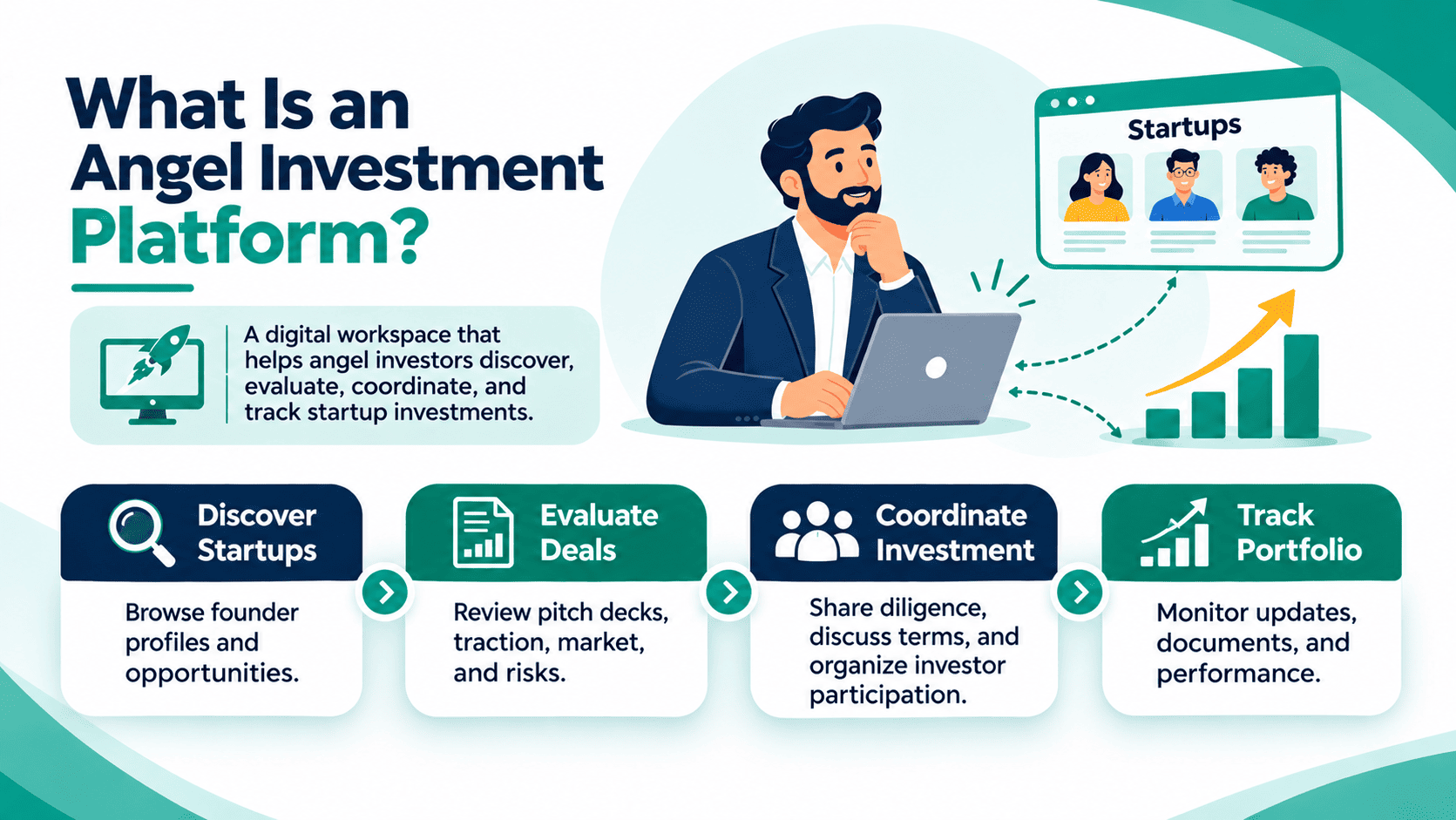
What Is an Angel Investment Platform?
An angel investment platform is one type of technological product, which is used for supporting investors in managing their investment projects with startups and early stage investments. There may be some differences in features of an angel investment platform provided by various vendors.
Rather than keeping different files in different software, like spreadsheets and email, investors can utilize a single platform for managing information and keeping track of their work. Team members will be able to see how far they have gotten and what actions are still pending.
For instance, in the case where an angel group is receiving requests for funding from different sectors, there is a need for a standard process for assessing the founders, assigning review teams, collecting their input, and selecting firms that will move forward.
Not all platforms provide the same functions, as some may only offer deal flow and collaboration functionality, while others may also offer investment vehicles and fund management. Knowledge of these differences will allow investors to select the solution suitable for their business model.
Why Do Investors Need Better Investment Management in 2026?
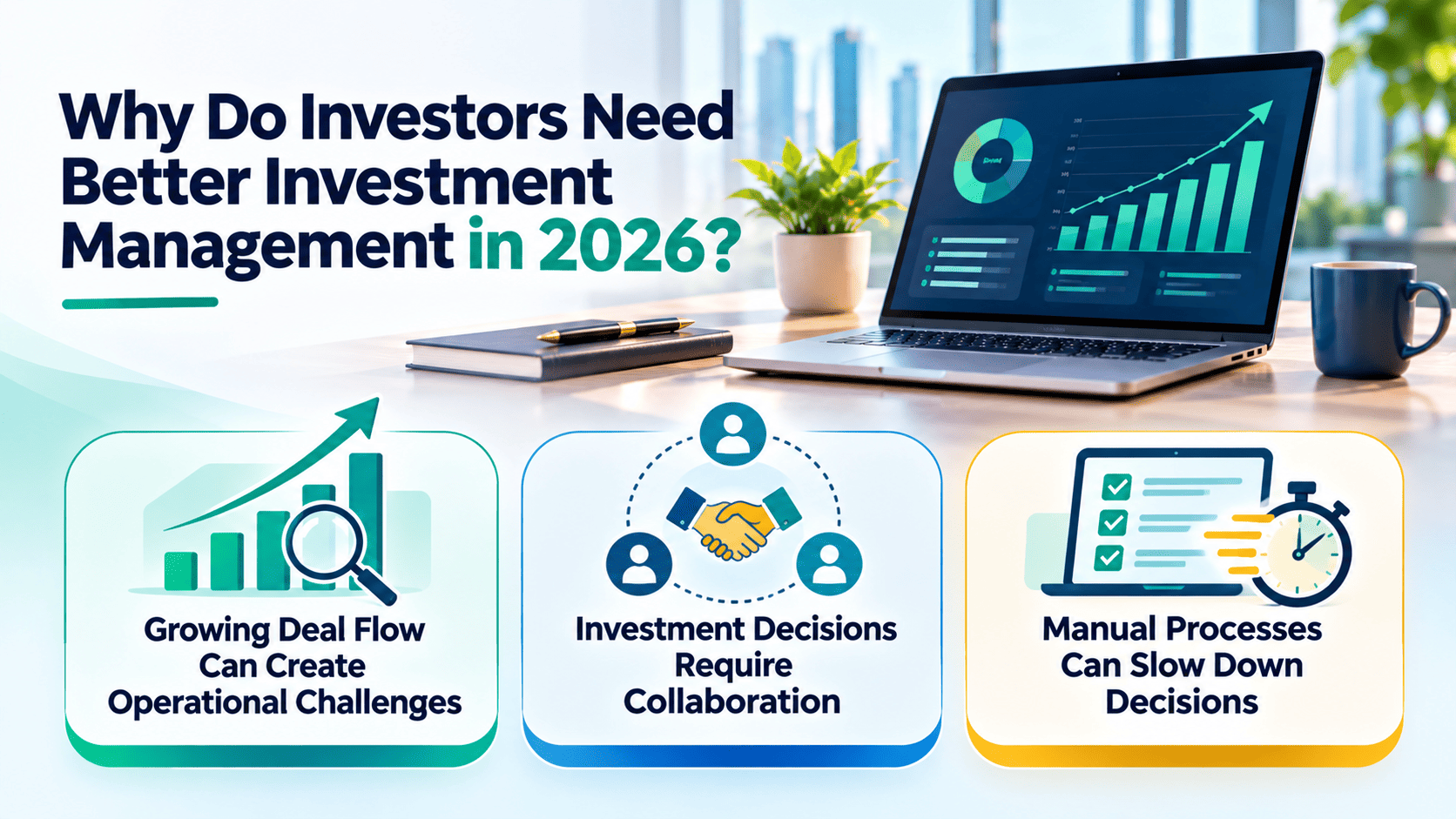
Growing Deal Flow Can Create Operational Challenges
The investments come from entrepreneurs’ applications, referrals, professional contacts, incubator programs, and business functions. Although there are more investment opportunities from more investment, this means that there will be more work done in the evaluation of such deals.
Without a structured process, investors may struggle to distinguish promising deals from incomplete submissions or opportunities that no longer fit their investment criteria. Follow-ups can be delayed, and multiple reviewers may unknowingly duplicate the same work.
The angel investment portal will help categorize the investments into various stages of development, thus helping you manage your portfolio and prioritize reviews of deals that need your attention.
Investment Decisions Require Collaboration
Angel groups bring together people with different professional backgrounds and areas of expertise. One member may understand healthcare regulations, while another specializes in enterprise software, financial services, or consumer businesses.
When feedback remains scattered across private conversations, the group cannot always benefit from the knowledge its members have already contributed. A common platform ensures that evaluation comments, important papers, and deal talks are made available to the right people.
This ensures that a more coordinated decision-making approach is developed. Members will be able to use their knowledge without having to call meetings or ask for information repeatedly.
Manual Processes Can Slow Down Decisions
An investment opportunity may pass through initial screening, founder meetings, due diligence, committee review, and final approval. Each stage requires clear responsibilities and timely action.
When such actions rely on personal reminders, there can be holdups. The reviewers may miss their deadlines, the founders may delay receiving their updates, and committee members may get inadequate information before discussing the topic.
A centralized system helps teams assign responsibilities, track outstanding tasks, and identify opportunities that have remained inactive. This visibility allows investment managers to address delays before they affect the entire pipeline.
Essential Features to Look for in an Angel Investment Platform
The proper platform will ensure that the investment process from the moment the first contact to the founder, till portfolio management, is well covered by the platform. Investors should not choose a platform depending on the number of features in it but on its capability to meet their needs.
Deal Sourcing and Startup Application Management
Deal sourcing determines which opportunities enter the investment pipeline. An effective platform should make it easier to collect applications, maintain founder profiles, organize pitch decks, and record how each opportunity was introduced.
Custom application forms are particularly useful because investment groups have different priorities. A healthcare-oriented team will seek data on regulatory compliance and clinical proof, whereas a software venture capitalist will be interested in recurring revenue, client retention, and client acquisition costs.
Uniformity in application processes decreases the need to seek simple data constantly. It also helps investors screen the startups consistently.
Deal Flow and Pipeline Management
Collecting opportunities is only the first step. Investors also need to understand what happens to each startup after it enters the system.
Pipelining provides the ability for team members to follow up on stages such as application received, initial screening, founder meetings, due diligence, committee review, and decision. Opportunities may have owners, statuses, and clearly defined next actions associated with them.
This creates a way of differentiating between a big pipeline and an efficient pipeline. It becomes easy to see which opportunities are in process, which ones need more information, and which ones should be discarded.
Startup Screening and Due Diligence
Early-stage investing involves uncertainty, and every startup presents a different combination of opportunities and risks. These include considerations relating to the founding team, market opportunity, competitiveness, financial performance, customer traction, and business model.
A system for angel investments will facilitate the process by providing customizable forms for rating, scoring, assigning reviewers, and conducting due diligence. Members will then be able to document their findings and justify whether the business is to be passed or rejected.
The software should support professional judgment rather than replace it. Scores and checklists provide structure, but investors must still assess the context behind the numbers and investigate concerns before committing capital.
Investor Collaboration and Decision Management
Usually, the decision-making process related to investments includes several people and even a special investment committee. In the absence of a common document, the feedback can be found only within emails or personal records.
Collaboration tools can bring deal discussions, evaluation comments, meeting records, and recommendations together. Decision management features may also help document approvals, outstanding conditions, and the reasons an opportunity was accepted, rejected, or deferred.
These records support accountability and preserve institutional knowledge. They also help new members understand previous discussions without requiring the entire evaluation process to be repeated.
Investor Relationship Management
The value of an investor network increases when the members know the capabilities, interests, and professional networks of each other. Just having a contact list does not indicate who can evaluate a particular startup, refer a client, or give industry advice.
Relationship management capabilities help investment organizations maintain useful information about member interests, sector experience, and previous participation. This makes it easier to involve the right people at the right stage of an opportunity.
When used appropriately, these capabilities help groups make better use of their existing networks while reducing dependence on individual memory.
Portfolio Management and Reporting
The investment process does not end when a deal closes. Investors may have to track the performance of companies, get financial updates, follow up on milestones, and communicate with founders for many years.
The portfolio management functionality could help in managing updates, financials, ownership information, tasks, and investments. The reporting functionality could help track the activity of the portfolio, allocations, company status, and updates.
The degree to which these features are available depends on the service provider. Investors should ensure that the platform is capable of supporting their reporting needs, and check whether they need any extra fund administration or accounting solutions.
Security, Integrations, and Automation
Investment companies process confidential information such as founder documents, financial information, and investment terms. Security is thus an important selection criterion.
Investors should review authentication controls, role-based permissions, encryption, activity logs, data retention policies, and procedures for removing access when a member leaves. Providers should also explain how they protect confidential information and support data exports.
The ability to integrate and automate processes is just as critical for those companies that currently use e-mail, calendars, document storage, digital signing, or accounting applications. Automation can save time on performing redundant actions, and integration will help avoid duplicating data entry.
How an Angel Investment Platform Improves Investment Decisions
A platform creates meaningful value when it connects information with a clear investment process. Simply transferring existing spreadsheets into new software will not resolve problems caused by unclear responsibilities or inconsistent evaluation criteria.
For one, a centralized system makes the retrieval of relevant information simpler. Reviewers have the chance to check previous information on feedback, documentation, and unanswered queries before rating an investment opportunity. This prevents information lapses, as well as duplication of effort.
Second, a standardized process enables investors to implement standard evaluation criteria. Even though each deal is unique, having a common platform makes it easier for investors to analyze different opportunities.
Reporting also gives an understanding of the investment pipeline. One can identify areas where there are bottlenecks in the process, the areas that require follow-ups, and whether the information sources are providing appropriate opportunities.
Finally, documented decisions help organizations learn from their experience. With the benefit of looking back at past evaluations in conjunction with future company performance, investors will be able to revisit their assumptions and improve their method of screening. It is important that the past performance not be taken as a guarantee of future success.
How to Choose the Right Angel Investment Platform in 2026
Define Your Investment Model and Requirements
It all depends upon the size of the organization, its investment strategy, and organizational setup. A single investor would prefer something simple to manage his deals and portfolio, while an angel group would need something that facilitates collaboration among members, deal screening, committee processes, and event management.
Due diligence, investments, and reporting can become increasingly important in small venture capital firms. The processes of applications for programs, mentoring processes, and the link between involvement in programs and introductions to potential investors may turn out to be critical to accelerators and incubators.
Begin by analyzing the present process of operation of your organization and the tasks which cause the most difficulties. This will help you differentiate between those tasks which are really important from those which bring little benefit.
Compare Functionality, Usability, and Pricing
Feature lists alone rarely reveal how well a platform supports day-to-day investment activity. Ask providers to demonstrate a complete workflow, from receiving a startup application to recording an investment decision and monitoring the company afterward.
Think about how easy it is for members to view opportunities, provide feedback, access documentation, and know what is expected of them. An unfriendly system might discourage participation, leaving some important documentation not documented at all.
Price should also be evaluated. Comparisons ought to be based on subscription charges, cost of deployment, number of users, compatibility, and additional modules. If SPV management, fund administration, compliance, and taxation support are required, make sure that these are included in the package or are separately available.
Assess Scalability and Data Portability
Operational requirements can change as a result of increased membership or transaction volumes or increased complexity of portfolio operations. It is important that the chosen software can grow in line with reasonable expectations without the need for replacement immediately.
Before signing a contract, ask how information can be exported if you change providers. Confirm whether records, attachments, and relevant histories remain accessible and understand the provider’s data retention and deletion policies.
Common Mistakes to Avoid When Selecting a Platform
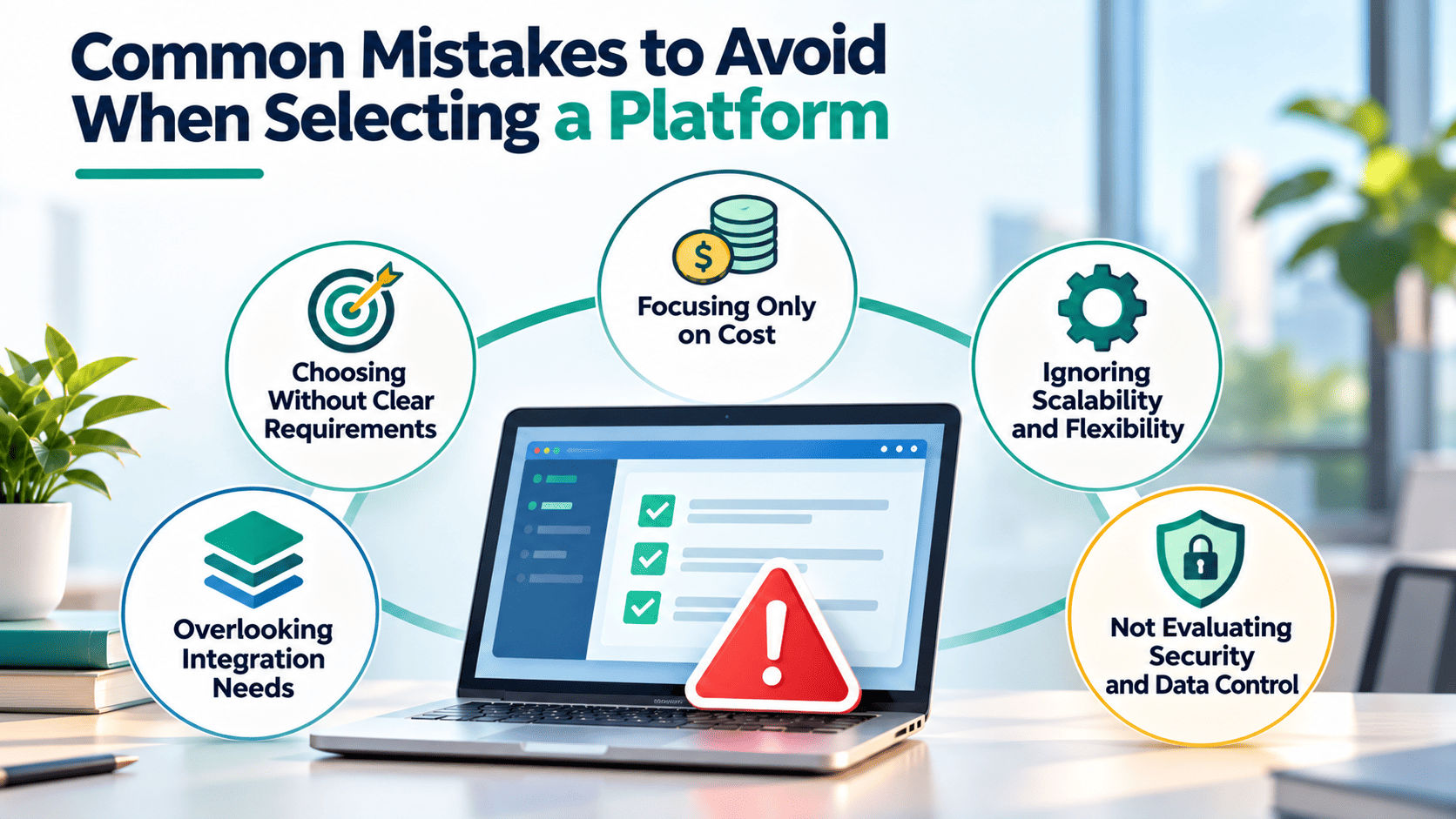
The first one would be picking a platform that has the most features available. Just because it has all these features doesn’t necessarily mean it will work for your firm.
Another mistake is implementing software without agreeing on screening criteria, pipeline stages, and decision-making responsibilities. Technology can support a consistent process, but it cannot independently resolve disagreements about how investment decisions should be made.
In addition to the above, organizations need to ensure that training, data quality, and user adoption issues are not overlooked. This can affect reporting despite good performance by the software.
Lastly, it should be noted that deal management software will not guarantee legal compliance, fund administration, or tax services. It is important to verify the exact functionality offered.
How to Implement an Angel Investment Platform Successfully
Successful implementation begins with documenting the current investment process. Determine the process through which agreements enter the pipeline, the individuals who will be responsible for reviewing them, the information needed at each step in the process, and the method through which decision-making takes place.
Next, create workflows and permissions according to the responsibilities of the users. Purify your existing data in anticipation of migration, which includes removing duplicate and unnecessary data, organizing the documents, and standardizing important data.
Roll out the platform gradually, train the employees on how to use it, and inform them of tasks that need to be logged into the platform. A pilot using a few users will point out any confusion or lack of functions before rollout.
Upon completion of implementation, measure success against set objectives. Look at user adoption, deal record completion, overdue follow-up activities, and time spent in various pipeline stages. Use such information to improve your workflow process and eliminate any administrative overhead.
What Is Next for Angel Investment Platforms?
Applications for investments are becoming increasingly focused on simplifying processes, improving reporting, and providing quick access to relevant data. In the eyes of investors, improvements in these areas should address existing problems rather than add complications.
Certain systems will have advanced capabilities in document management, reporting, and automation of tasks. Others will have the ability to use AI technology to analyze and extract information from documents. This can be very helpful in an initial review, but the investor is supposed to verify the information and make investment decisions responsibly.
The long-term priority remains the same: build an investment process that combines reliable information, clear responsibilities, effective collaboration, and sound judgment. Organizations with consistent records and well-defined workflows will be better prepared to evaluate new capabilities as their needs evolve.
Conclusion
Constructing an intelligent investment process is not just about discovering potential ventures. There is a necessity for a system that can source ventures, screen firms, coordinate actions, manage relationships, and analyze portfolio performance.
The platform for angel investing will enable all these functions and increase transparency, but the value of such a platform depends on the extent to which it aligns with the company’s investing strategy.
In 2026, investors should prioritize practical functionality, collaboration, security, reporting, usability, and scalability when comparing solutions. They should also assess implementation requirements, total costs, and the precise scope of any additional administrative services.
Indeed, having the right platform will allow the investors to focus on evaluating their opportunities, sharing the experience, and helping their businesses grow, rather than trying to manage a lot of scattered information.
FAQs
How can investors tell whether their deal pipeline is productive or simply growing?
Instead of having many applications without evaluation, an effective pipeline will have opportunities that are qualified after going through all the various levels of assessment. There is a need for investors to monitor the results of their screenings, how deals are doing, late follow-ups, and conversion ratios.
Can an angel investment platform help identify gaps in an investment group’s decision-making process?
Yes. The angel investment portal will be able to capture all evaluation information, reviews, decision history, and pipeline information. Inconsistencies in their decision-making process will be identified by analyzing why the deals have been stuck or how different deals have been handled.
What should investors consider before moving from spreadsheets to an angel investment platform?
Prior to embarking on any change process, investors should evaluate the number of deals they process, the level of collaboration needed, security of documents, and reporting features. Additionally, the investors have to develop a consistent workflow process for their pipelines, clean the current data and identify permission needs.
How can angel groups make better use of their members’ expertise when evaluating startups?
Angel groups may keep track of their member’s industry experience, investment interests, and professional experience. Matching reviewers according to the industry of the start-up, business model of the company, or specific risks involved is essential in ensuring that the angel group obtains information relevant to the project.
Which investment metrics should angel groups monitor beyond the number of deals reviewed?
The indicators that can be used include the percentage of applications that reach the due diligence phase, time taken at each phase in the pipeline, reviewer engagement, late follow-ups, and opportunity to investment conversion among other things. These metrics will enable the group to measure their efficiency in the investment process and identify any bottlenecks.
How can investors maintain consistent due diligence without treating every startup identically?
An evaluation framework can be created by investors that will include aspects such as the team of founders, the market opportunity, financial status, competitive risk and the business model where different sections will be customized according to the industry of the startup and its stage of development. This process can be done easily on an angel investing platform using checklists and evaluation sheets.
What happens when an investment group outgrows the capabilities of its current platform?
It must be assessed whether the software that the team already uses can support an additional number of users, approval processes, portfolio reporting, and different investment vehicles. It is necessary to assess the possibilities for switching to another provider without losing information about historical transactions and ongoing investments.
How should investors evaluate the value of an angel investment platform after implementation?
Investors should compare performance against the goals established before implementation. Improvements in record completeness, follow-up times, reviewer participation, pipeline visibility, and administrative workload can indicate whether the platform is delivering operational value. The assessment should also consider user adoption and whether the system supports more consistent, well-documented investment decisions.

I’m the Co-Founder of Startup Steroid, where I help founders navigate the challenges of building a startup. From connecting with the right investors and talent to guiding marketing, legal, and MVP development, I work alongside entrepreneurs to provide practical support and clarity, helping them grow their ideas into successful, sustainable businesses.