
Investment teams rarely have a shortage of deals to consider. The harder problem is knowing which ones deserve attention.
A typical investment pipeline can contain hundreds of startups at different stages, with different business models, markets, funding requirements, and levels of traction. Some come via referrals from known people. Others come via the application process, accelerator programs, conferences, current portfolio companies, or direct contact. Each one comes with its own unique body of information that makes the comparison tough.
The result is a familiar challenge: too many opportunities, too little time, and no simple way to determine what should move to the top of the list.
This is where deal flow analytics becomes valuable. By looking at the information contained within an investment pipeline, it becomes clear where deals are coming from, their progression, whether they align with the strategy, and whether any potential deals that may have been missed in the process.
The goal is not to reduce investing to a collection of numbers. Investment decisions will always require experience, judgment, conversations, and due diligence. Instead, analytics can give those decisions a stronger foundation by making the pipeline easier to understand.
What Is Deal Flow Analytics?
Deal flow analytics refers to the collection and analysis of information on deals at each point during the deal process.
This may involve such information as the origin of the deal, the industry and stage of development of the company, funding needs, evaluations, meetings, diligence status, rejections, and ultimate investments.
When this information is viewed individually, it may seem like routine pipeline data. When it is analyzed collectively, however, it can reveal patterns that are difficult to see from individual deals.
An investment team might discover that one sourcing channel generates twice as many opportunities as another but produces far fewer qualified companies. Another team might find that opportunities referred by portfolio founders consistently move further through the pipeline.
These insights help teams understand not only how much deal flow they have, but also what that deal flow actually looks like.
Why Does Deal Flow Analytics Matter?
Investment teams operate under a constant attention constraint. There may be dozens of new opportunities every week, but only a limited number of people available to review them.
Without a structured process, teams can easily spend disproportionate amounts of time on deals that happen to arrive at the right moment, come from a familiar source, or make a strong first impression.
That creates an important distinction between deal volume and deal quality.
A large pipeline does not necessarily mean a strong pipeline. If most opportunities fall outside the investment thesis, the team may simply be creating more work for itself.
Deal flow analytics can assist in distinguishing between action and value. Deal flow analytics can help in identifying the number of deals in the pipeline, the number that meet the criteria, the number advancing, and the number ending up as investments.
This gives investment teams a clearer basis for deciding where their time should go.
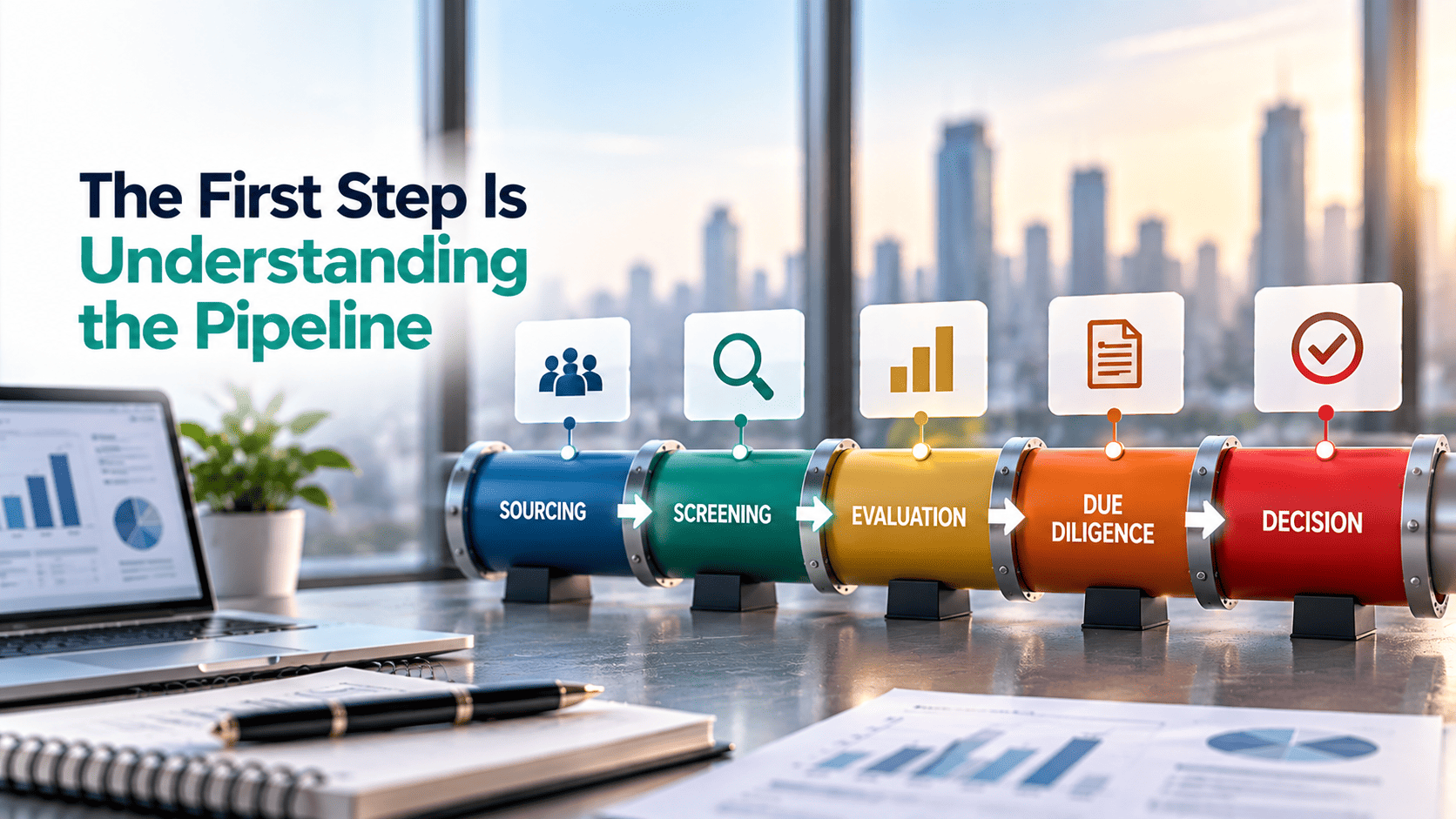
The First Step Is Understanding the Pipeline
Before ranking opportunities, teams need to understand what is actually entering their pipeline.
This means looking beyond the total number of deals and examining the composition of those opportunities.
Are most companies at the stage the firm invests in? Are opportunities concentrated in a few industries? Are they coming primarily from referrals or inbound applications? How many match the firm’s geographic focus? How many have the level of traction expected at their stage?
These questions provide context that a simple deal count cannot.
For example, an investment team might see a 30% increase in quarterly deal volume and assume its sourcing strategy is working. However, if the percentage of qualified opportunities has fallen at the same time, the additional volume may not represent an improvement.
Understanding these differences is one of the first ways deal flow analytics can make pipeline discussions more meaningful.
What Data Should Investment Teams Track?
Good analysis depends on good information. That does not mean investment teams need to capture every possible detail about every company.
The most useful information is data that supports a decision or reveals something about the investment process.
Teams should generally track information such as deal source, industry, investment stage, geography, funding requirement, evaluation criteria, pipeline stage, meeting history, diligence status, decision outcome, and reason for rejection.
The specific fields will depend on the investment strategy.
An early-stage investor may care heavily about founder experience, market size, early traction, and product differentiation. A later-stage investor may place more weight on revenue growth, margins, retention, customer concentration, and financial performance.
The important point is consistency. If different team members record information differently, comparisons become less reliable.
How Can Teams Evaluate Investment Opportunities?
Evaluation begins with defining what makes an opportunity attractive to the investment team.
A clear investment thesis should guide the evaluation framework. If the firm invests in early-stage B2B software companies in a particular market, for example, companies outside that focus should not receive the same initial priority as companies that clearly fit.
Having established the general fit, it is then possible to analyze aspects such as the founding team, market opportunity, customer traction, competitiveness, business model, finances, valuation, and return on investment.
Each factor can be given an appropriate level of importance.
This allows for a standardized way of analyzing each investment opportunity while still giving flexibility for professional judgment by the investor.
Analysis of deal flow becomes particularly critical at this point, since it shows how each opportunity stacks up against the others using the same metrics.
Rather than depending only on their memory, groups will be able to refer to the deals done in the past and identify what traits successful deals shared in common.
How Should Opportunities Be Ranked?
Ranking becomes important when a pipeline contains more qualified opportunities than the team can immediately review.
A ranking system can assign relative priority based on factors that matter to the investment strategy.
For instance, an opportunity with high thesis fit, strong market potential, traction, and a seasoned founding team may be prioritized over a firm with poor fit but a very good presentation.
A ranking system should not be treated as an automatic investment decision. It is better viewed as a way to answer a more practical question: Which opportunities deserve deeper attention right now?
That distinction matters.
The purpose of ranking is to help investment professionals manage attention, not to remove the human element from investing.
From Ranking to Prioritization
Ranking and prioritization are related, but they are not identical.
A firm may score very well on paper yet still need more information in order to advance. Another firm may score just a bit lower but have a unique quality that merits discussion right away.
Prioritization allows the team to consider these circumstances.
High-priority opportunities might move quickly into partner review or diligence. More information needed for opportunities may stay in the middle ground, while opportunities which are obviously out of scope for the thesis may be rejected.
This creates a pipeline where attention is allocated intentionally rather than simply based on arrival time.
With deal flow analytics, teams can also check whether their actual behavior matches their stated priorities. If high-priority deals are consistently waiting as long as low-priority opportunities, something in the process may need to change.
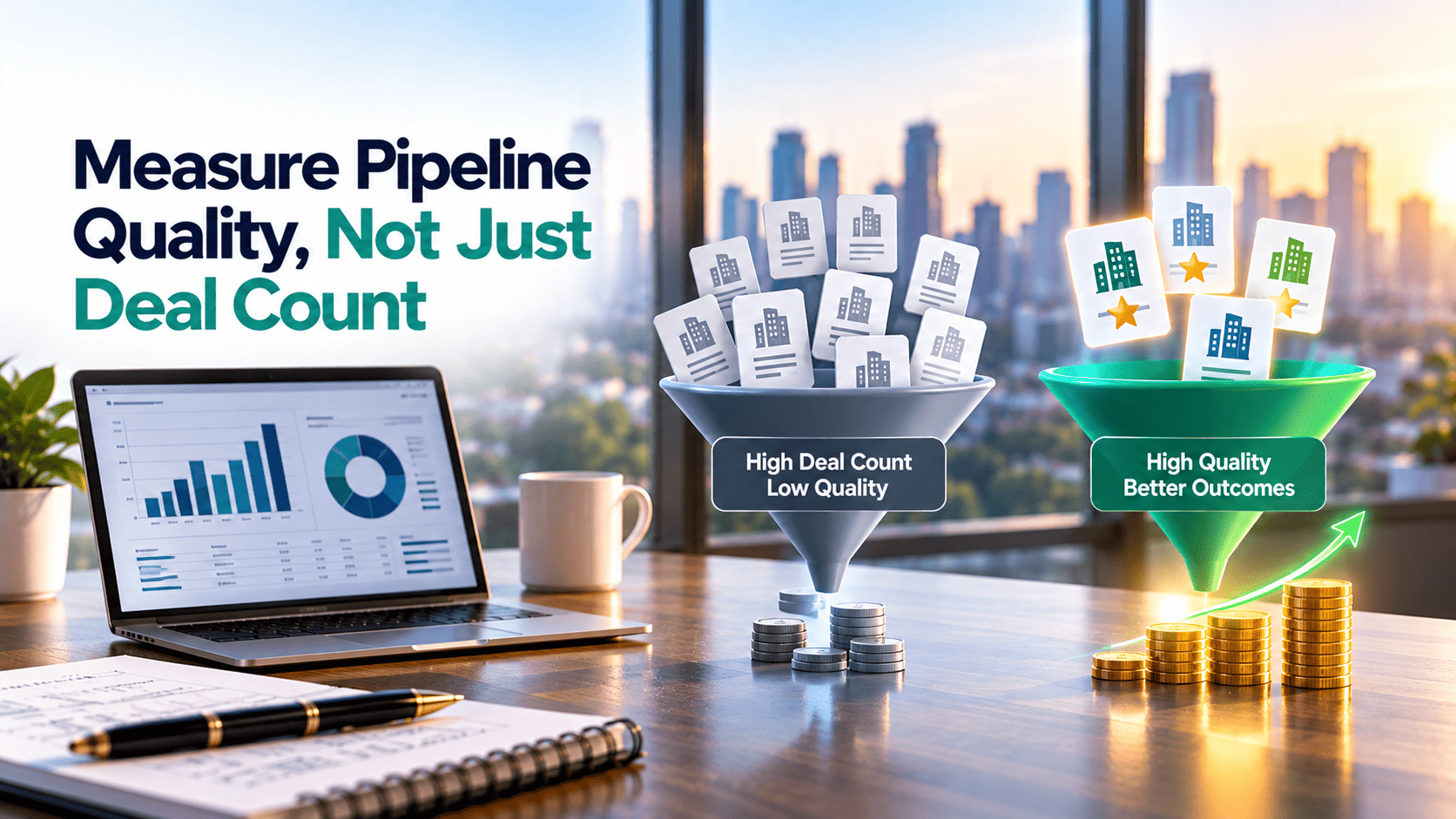
Measure Pipeline Quality, Not Just Deal Count
Deal count is an easy metric to understand, which is why it can become the default measure of pipeline health.
But it can also be misleading.
Suppose an investment team receives 500 opportunities in a quarter. If only 10 meet its core criteria, the headline number tells very little about the quality of the pipeline.
A better approach is to examine conversion throughout the process.
How many opportunities pass initial screening? How many receive partner attention? How many reach diligence? How many reach the investment committee? How many ultimately receive funding?
These conversion rates provide a much clearer picture of pipeline quality.
Deal flow analytics allows teams to see whether a large pipeline is actually producing meaningful investment opportunities or simply increasing the workload of the investment team.
Finding the Sourcing Channels That Actually Work
Every investment team has sourcing channels, but not every channel performs equally well.
One source might deliver a large number of opportunities, but very few that fit the thesis. Another might produce a smaller volume but a much higher percentage of companies that reach serious evaluation.
This distinction matters when deciding where to invest future sourcing efforts.
Teams can compare channels based on qualification rates, progression through the pipeline, investment rates, and potentially long-term portfolio performance.
For example, if opportunities from an accelerator repeatedly progress to diligence, while a much larger inbound channel rarely gets beyond screening, the team has evidence that the two sources should not be treated equally.
The point is not necessarily to eliminate lower-performing channels. Rather, the data provides a basis for deciding how much attention each channel deserves.
Identifying Bottlenecks Before They Cost Good Deals
A pipeline can contain strong opportunities and still perform poorly if the process is too slow.
An opportunity might enter screening quickly but remain there for weeks. A promising founder might have multiple meetings but no clear next step. Due diligence might begin but stall because ownership is unclear.
These delays become important in this context since entrepreneurs are themselves assessing the investors as well. A poorly managed process could cause investment teams to miss out on deals that competing organizations would be interested in.
Deal flow analytics can highlight where these delays occur.
Such teams would be able to gauge the amount of time taken by each opportunity in each phase of the process.
If one stage consistently takes longer than others, the team can investigate the reason. Sometimes the problem is capacity. In other cases, it may be unclear criteria, repeated work, missing information, or a lack of decision ownership.
Learning From Rejected Deals
Rejection is an unavoidable part of investing, but rejected opportunities can still provide valuable information.
When teams consistently document why companies were rejected, patterns begin to emerge.
Perhaps a large percentage of opportunities have insufficient traction. Perhaps valuation becomes a recurring concern late in the process. Perhaps many companies are simply outside the investment thesis.
Without structured records, these patterns are easy to forget.
With deal flow analytics, teams can examine rejection reasons across hundreds of opportunities rather than relying on individual recollections.
This can improve future sourcing and screening. If a particular type of opportunity is almost always rejected for the same reason, the team may be able to identify that issue earlier in the process.
Using Data to Examine Investment Bias
Investment teams make judgment calls, and those decisions can sometimes be influenced by factors that have little to do with a company’s underlying potential.
A warm introduction may result in faster attention than an unfamiliar inbound application. A recognizable founder may receive more benefit of the doubt. Before even conducting an analysis of a firm, a credible network may affect its perception.
However much one tries to conduct analytics; these kinds of influences will not be eradicated; however, they will become more visible.
The group can compare opportunities based on sourcing networks, founder profiles, analysis, and pipeline stage to determine if discrimination is occurring against any firms.
The purpose is not to remove intuition from investing. Experienced investors often notice important signals that cannot be captured neatly in a spreadsheet.
The purpose is to make the decision-making process more transparent and give teams an opportunity to question patterns that may otherwise go unnoticed.
Connecting Pipeline Activity to Investment Outcomes
One of the biggest opportunities in deal flow analytics comes from connecting pipeline decisions with what happens after an investment is made.
A team can examine which characteristics appeared frequently among companies it funded and compare them with later portfolio performance.
Over time, this can help answer important questions.
Were the evaluation criteria actually useful? Did certain sourcing channels produce stronger investments? Did the factors that looked attractive during diligence translate into portfolio performance?
These kinds of questions enable teams to continuously refine their investing process.
It is not necessary to treat each new opportunity in isolation because of the historical data in the pipeline.
How Can Investment Teams Build a Practical Analytics Process?
The best approach is usually to start small.
The team should initially define what are the important criteria and the different pipeline stages before identifying what data to capture consistently for every investment opportunity.
Once the foundation is in place, teams can monitor a focused group of measures, including qualification rates, stage conversion, time spent in each stage, sourcing performance, rejection reasons, and investment outcomes.
The next step is regular review.
Analytics should become part of investment discussions rather than a report that is created occasionally and forgotten. A monthly or quarterly review can help teams identify changes in deal quality, sourcing performance, pipeline speed, and decision patterns.
Over time, the process can become more sophisticated as the team learns which measurements are genuinely useful.
What Should an Investment Pipeline Dashboard Show?
A proper investment dashboard needs to ensure that the pipeline is easy to interpret.
It could include data on the total number of opportunities at each stage, priority status, source breakdown, sector breakdown, conversion rate, average time spent at each stage, and evaluation metrics.
The dashboard should also make it easy to identify opportunities that require action.
For example, a high-priority opportunity that has been sitting without a next step for several days should be visible. So should a growing group of opportunities waiting for the same review stage.
The objective is not to fill a screen with statistics. It is to give investment teams the information they need to make timely decisions.
Common Mistakes to Avoid
The first mistake is tracking too much information.
More data does not automatically produce better decisions. If the team cannot explain why a metric matters, it probably does not belong at the center of the process.
Another mistake is treating a score as a verdict. Investment opportunities are complex, and some important information will always require human assessment.
Teams should also avoid changing their evaluation framework constantly. Uniform criteria will allow comparing past decisions and finding patterns in them.
Lastly, it is crucial to keep the pipeline updated. An outdated pipeline leads to misaligned priorities, incorrect conversions, and follow-ups.
Making Deal Flow Analytics Part of the Investment Culture
Technology and dashboards alone will not improve the investment process.
The real change happens when the team begins using pipeline data during everyday discussions.
Instead of simply saying that deal flow is “strong,” the team can ask what has changed. Are more qualified companies entering the pipeline? Are certain sources producing better opportunities? Are promising deals progressing quickly enough? Are rejection patterns changing?
These questions create a more disciplined conversation around the pipeline.
Over time, deal flow analytics can become less about reporting what happened and more about helping teams decide what to do next.
The Competitive Advantage of a More Focused Pipeline
Investment teams often compete for the same promising companies. In that environment, having more opportunities is not necessarily the deciding advantage.
The ability to recognize the right opportunities quickly can matter just as much.
If a team knows what its pipeline looks like, then it will be able to determine the presence of quality and advance the opportunities while avoiding undue focus on the wrong deals.
This does not mean moving faster at the expense of diligence. It means directing attention more deliberately.
That distinction can be particularly important for smaller investment teams, where every hour spent reviewing a weak opportunity is an hour that cannot be spent evaluating a potentially valuable one.
Conclusion
A strong investment pipeline is more than a long list of companies waiting to be reviewed. It is a constantly changing picture of opportunities, relationships, decisions, and potential outcomes.
Deal flow analytics gives investment teams a way to make sense of that picture.
By understanding where opportunities come from, evaluating them using the same yardstick each time, ranking them based on alignment with strategy, and following their progress through the funnel, teams will be able to optimize their scarce time and attention.
The value goes beyond prioritization. Analytics can reveal sourcing strengths, expose bottlenecks, highlight recurring rejection reasons, identify potential biases, and connect past investment decisions with portfolio outcomes.
Most importantly, it gives investment teams a stronger basis for asking the questions that matter: Which opportunities deserve attention? Why are they worth pursuing? Where should the team spend its time? And what can past pipeline decisions teach us about the next investment?
Used thoughtfully, deal flow analytics does not replace investment judgment. It gives that judgment a better context, helping teams move from managing a crowded pipeline to building a more focused and purposeful investment process.
FAQs
1. How can investment teams tell whether a crowded pipeline reflects strong sourcing or weak filtering?
Big pipelines do not always signify good deal flow. Teams need to analyze the number of deals that get to each stage, where deals are getting rejected, and which deals are receiving serious attention. This ensures the difference between good sourcing and a pipeline with deals that do not qualify for investment.
2. What data points can reveal that an investment team is spending too much time on low-priority deals?
Comparisons can be drawn between the amount of time spent on each opportunity and its corresponding score, level of development, genesis, and outcomes of each opportunity. If the comparisons continuously reveal that the analysts and partners have spent a significant amount of time on underperforming or poorly developed opportunities, the deal flow could use better prioritization criteria.
3. Can deal flow analytics help investment teams identify overlooked opportunities?
Yes. By analyzing pipeline data from the past, one can find opportunities that seemed unimportant at first but gained traction or made significant progress over time. Comparison between such trends and existing opportunities can help determine the features that should receive more attention.
4. How should investment teams balance quantitative scoring with investment judgment?
The scoring process should create structure and not act as a substitute for judgment. Structure will allow the teams to assess opportunities based on criteria such as market opportunity, traction, strength of the team, fit, and risk. The investment experts can then explore the exceptions, test assumptions, and give context where necessary.
5. What does a healthy investment pipeline look like beyond the number of deals it contains?
A robust pipeline has a well-balanced level of opportunities at different stages, smooth transition between screening and evaluation and rationale for moving forward or discarding a potential opportunity. Additionally, a review of the source quality, conversion rates, decision times and outcomes is necessary instead of using number of deals as a single performance indicator.
6. How can historical rejection data improve future investment decisions?
The data on rejections will help to determine whether there are repetitive cases of the team turning down companies on similar grounds and whether such decisions have proven themselves correct in the end. Analyzing rejected ventures will provide information about consistent mistakes in the screening criteria, sources used, or decision making within the organization.
7. How can deal flow analytics expose bottlenecks in an investment process?
By measuring the time that is taken at each stage in the process, teams will be able to understand where decisions slow down. In this case, having many deals awaiting partner approval could mean there is a bottleneck issue in getting approvals, and delays at the due diligence stage could mean that capacity is an issue.
8. Which pipeline metrics should investment teams review regularly?
Deals may be monitored based on metrics like the number of deals per source, stage conversion rates, duration per stage, reason for rejection, scores of opportunities, follow-ups, and investments made. The analysis of these metrics as a whole will offer a bigger insight into the health of the pipeline and relate the deals to investments.

I’m the Co-Founder of Startup Steroid, where I help founders navigate the challenges of building a startup. From connecting with the right investors and talent to guiding marketing, legal, and MVP development, I work alongside entrepreneurs to provide practical support and clarity, helping them grow their ideas into successful, sustainable businesses.