
The nature of family offices has undergone many changes in the last ten years. Wealth preservation is one of the objectives of most family offices but at the same time they are increasingly investing in private businesses, venture capital, private equity, real estate, and alternative assets. Finding such investments is just a part of the game since managing them is another important aspect.
A steady stream of investment opportunities can quickly become overwhelming without the right process in place. Opportunities may come from founders, advisors, co-investors, investment banks, accelerators, or personal networks. Without a structured approach, valuable deals can be delayed, overlooked, or lost entirely.
It is precisely at such times that the need arises to manage business transaction flow in the family office. This means that rather than relying on tools like spreadsheets, e-mails, and personal memories, investors must find ways to track all their leads from inception to fruition.
This guide explains what family office deal flow management is, why it matters, and how modern investment teams can build an organized process that improves decision-making while supporting long-term investment goals.
What Is Family Office Deal Flow?
Family office deal flow is defined as the ongoing flow of investment deals coming into a family office. The investment deals can include startups, mature private businesses, real estate ventures, venture capital funds, private equity funds, or co-investment opportunities.
Nonetheless, deal flow not only encompasses receiving investments but also all subsequent phases, such as information gathering, opportunity review, internal assignment of ownership, initial assessment, due diligence, investment discussion with decision makers, and monitoring until the final decision is reached.
In today’s world, deal flow is not an individual set of deals but a continuous process for investors. Every single deal goes through some stages of development, each one of which requires timely and accurate information and cooperation.
An organized approach helps ensure that promising investments receive the attention they deserve while reducing unnecessary delays and administrative work.
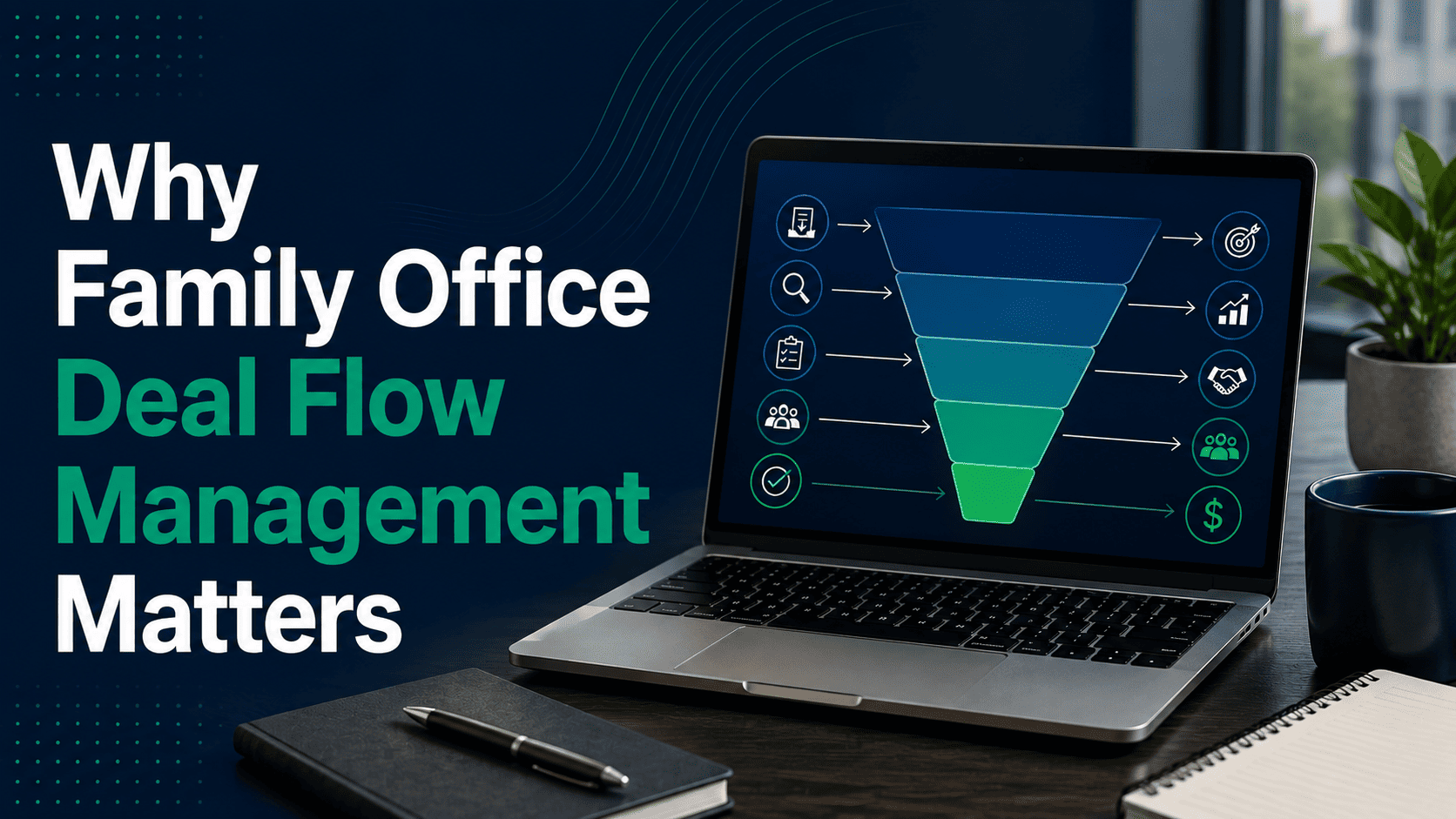
Why Family Office Deal Flow Management Matters
Many family offices rely heavily on trusted relationships and referrals to source investments. While strong networks remain valuable, they are no longer enough on their own.
Current investment dynamics have become quite swift. The founder speaks to several investors at once, and good investment chances get commitments in just a couple of days. If there is no well-managed process inside, even seasoned investment teams find it hard to cope with.
Effective deal flow management creates consistency across the investment lifecycle. There is no need to go through inboxes or ask colleagues about the status of opportunities because each member on the team will have an idea of where things stand and what needs to be done next.
Such organization facilitates communication between investment professionals, analysts, advisors, and families.
Perhaps most importantly, structured processes reduce the likelihood of missing opportunities because of simple administrative issues rather than investment quality.
The Difference Between Deal Sourcing and Deal Flow Management
Although these terms are often used interchangeably, they represent different parts of the investment process.
Deal sourcing deals with generating deal opportunities. This has to do with networking and building relationships with entrepreneurs, venture capital firms, incubators, investment banks, and others from the specific industry who offer investment possibilities.
Deal flow management starts when such investment possibilities come into the pipeline for investments. From here onward, the primary objective becomes one of organizing data, coordinating evaluations, tracking progress, recording decisions, and making sure that each possibility goes through an evaluation process.
Think of deal sourcing as filling the pipeline, while deal flow management keeps the pipeline organized and moving efficiently.
Successful family offices invest in both areas because sourcing alone cannot create successful investments without effective execution afterward.
How Family Office Deal Flow Has Evolved
Not long ago, many family offices managed investment opportunities using spreadsheets, email folders, handwritten notes, and periodic meetings. This approach worked reasonably well when investment volumes were relatively low.
Today, however, investment teams often review hundreds of opportunities each year across multiple industries, asset classes, and geographic regions.
With the increasing complexity of private markets, there has been a need to develop structured workflows.
The investment teams will work in coordination with legal experts, tax experts, consultants, operating partners, and co-investors as part of the evaluation process. Information from all participants needs to be collected.
As a result, modern family office deal flow management emphasizes visibility, collaboration, accountability, and centralized information rather than disconnected tools.
The Typical Stages of Family Office Deal Flow
Although every investment team develops its own workflow, most opportunities move through similar stages before a final investment decision is made.
- A typical process includes:
- Opportunity sourcing and introduction
- Initial screening
- Preliminary review
- Due diligence
- Investment committee review
- Final approval or rejection
- Portfolio monitoring after investment
The purpose of each phase is unique. Instead of trying to reach an investment decision immediately, a process allows information to be gathered systematically, discarding inappropriate choices before too much time or effort is spent.
The intention is not only to finish each phase but to take decisions based on systematic evaluations.
What Makes High-Quality Deal Flow?
Many investment professionals believe that receiving more investment opportunities automatically leads to better results. In reality, quality matters far more than quantity.
Despite the large number of deals a family office considers each quarter, very few of them will be compatible with the firm’s investment strategy.
High-quality deal flow typically shares several characteristics. Opportunities fit the family’s investment thesis, originate from credible sources, include sufficient information for evaluation, and arrive early enough for meaningful participation.
Good flow of opportunities will not only bring diversification across industry sectors, stages of development, and geographic locations but will also be consistent with the family’s approach.
When investment groups concentrate exclusively on boosting their numbers, they waste time screening opportunities which they should have never considered in the first place.
Common Challenges in Managing Deal Flow
Even experienced investment teams encounter operational challenges as their pipelines grow.
One common issue is fragmented information. Investment documents may be stored across email inboxes, cloud storage platforms, messaging applications, and local devices. Finding the latest financial statements or previous meeting notes can become frustrating and time-consuming.
Miscommunication would form another problem area. Individual members of the team might be communicating with the founders separately without informing one another.
Another issue relates to non-standardized evaluation processes. In case there are no standardized evaluation criteria, similar opportunities can be evaluated differently according to the reviewer.
Delayed decision-making is also common. Opportunities remain inactive because responsibilities are unclear, or approvals take longer than expected.
Over time, these small inefficiencies accumulate, making it increasingly difficult for investment teams to manage growing pipelines effectively.
Building the Right Foundation
Effective deal flow management begins long before investment decisions are made.
It is crucial that every family office has an established investment objective, has defined evaluation criteria, delegate tasks, and defines the process by which deals will be reviewed.
Equally important is creating a centralized system where documents, communications, meeting notes, financial information, and investment decisions remain connected to each opportunity.
When everyone follows the same process, collaboration becomes easier, reporting improves, and investment decisions become more consistent.
Instead of responding to the opportunities that arise, the investment professionals of today create repeatable processes that drive growth over time but provide flexibility for unique opportunities to occur.
Building a Scalable Family Office Deal Flow Process
Managing investment opportunities becomes more challenging as a family office grows. More deals, more stakeholders, and more documentation can quickly create confusion without a defined process.
An effective investment deal flow process allows for all investments to be treated in a similar fashion through the entire process from the moment of being introduced until completion. It is not necessary for investment teams to rely on emails or spreadsheets to document their progress.
Having a repeatable process also makes it easier to compare opportunities, identify delays, and maintain consistency across every investment review.
Finding High-Quality Investment Opportunities
Strong investment performance starts with strong deal sourcing. While many family offices receive referrals through trusted relationships, relying on one source alone can limit opportunities.
In order to create opportunities, investment teams should ensure that they have a broad network consisting of founders, venture capitalists, private equity funds, investment banks, wealth managers, attorneys, accountants, accelerators, and co-investors.
The objective is not to review as many deals as possible but to receive opportunities that match the family’s investment goals and risk profile.
Standardizing the Intake Process
Every investment opportunity should enter the pipeline through the same process.
Gathering necessary information right at the start enables the investment team to evaluate the investments faster. Gathering company information, capital needs, financial information, industry, source of referral, and relevant documentation should be done before conducting the evaluation.
A standardized intake process reduces back-and-forth communication and ensures every opportunity is evaluated using consistent information.
This will help build a much firmer platform for further analysis as the investment goes through various phases of assessment.
Screening Opportunities Efficiently
Not every opportunity deserves extensive analysis.
The initial screening phase ensures that the investment team is able to decide if the proposed deal meets the family’s investment requirements before investing more effort.
In this phase, there are usually evaluations made regarding issues like the industry focus, investment amount, business model, growth prospects, and strategic fit.
By adopting a consistent screening process, it becomes possible for the investment teams to eliminate unsuitable deals while concentrating on the best deals.
Disciplined process is crucial for successful family office deal flow management since it helps to increase efficiency without losing quality.
Conducting Thorough Due Diligence
After performing the initial evaluation of the opportunity, the next stage is performing the due diligence exercise.
In this process, consideration is given to assessing the authenticity of the data given by the business and finding out risks and opportunities in the business.
Normally, investment groups will study financial performance, legality issues, market position, management capabilities, customer relations, operations of the business, and growth prospects of the company.
Family offices also usually consult outside experts on law, finance, and business matters prior to investing.
Well-kept documentation during the process makes it easier for decision makers to evaluate their findings.
Improving Team Collaboration
Investment decisions often involve multiple people, including analysts, investment managers, advisors, consultants, and family members.
In the absence of communication, critical information is likely to be spread over emails, meetings, and individual documents.
It would be convenient for all parties involved in the discussion to have all the information in one single place.
When everyone works with the same information, decisions become more consistent, and unnecessary duplication of work is reduced.

Using Technology to Support the Investment Process
Technology has become an important part of modern investment operations.
Software for specific investments will enable investors to handle opportunities, store information, delegate responsibility, track their performance, and even generate reports from a single place.
Such systems will increase visibility in the investment pipeline process and reduce manual labor.
Automations will also be able to help in routine tasks like reviewer assignments, reminder notifications, deadlines, and so forth.
Rather than replacing investment judgment, technology helps teams spend more time evaluating opportunities and less time managing information.
Maintaining Momentum Throughout the Pipeline
One of the biggest challenges in managing investments is keeping opportunities moving.
The most common causes of delay include insufficient documentation, longer-than-expected time to approval, or lack of clarity in responsibilities.
Conducting periodic pipeline reviews makes it easier for the investment team to find out where things have got stuck and what the next step should be.
It is important to establish who should take care of which step along the way.
Maintaining momentum is essential because attractive private market opportunities often move quickly, and extended internal delays can result in missed investments.
Documenting Investment Decisions
Every investment decision should be supported by clear documentation.
The reason for accepting, rejecting, or delaying an investment decision makes for a good institutional memory which helps future investment decisions.
Historical records allow teams to compare similar opportunities, review previous analyses, and understand how investment criteria have evolved over time.
Documentation will also enhance governance to ensure transparency in making decisions in investment, even when there is expansion in the team.
Balancing Speed and Discipline
Investing in the private markets needs speed, but being too fast can be a risky venture.
A good investment team knows how to be both fast and thorough by adhering to certain standard procedures that eliminate unneeded time-wasters but still remain thorough.
This can be achieved through proper organization, well-defined procedures, and clear responsibility allocation for the benefit of family offices.
Finally, efficient deal flow management within a family office comes down to developing a discipline in the process which would help make better decisions. With a combination of good workflow, teamwork, evaluation criteria, and technology, modern day investment teams can handle increasing deal flows.
In the final part of this guide, we’ll look at the key performance metrics every family office should monitor, common deal flow management mistakes to avoid, emerging trends shaping investment operations, and best practices for building a process that supports long-term success.
Measuring the Success of Your Deal Flow Process
An organized process is valuable only if it delivers measurable results. Performance monitoring can assist family offices in determining whether their investment pipeline is working efficiently or requires changes.
It is not about counting the number of leads but tracking the overall performance of the process. Performance of the whole process relies on the number of quality leads that are generated, the time it takes at each stage, the conversion ratio, and the number of deals that move into the due diligence stage.
It is through monitoring such trends that bottlenecks are identified.
Common Mistakes to Avoid
Even experienced investment teams can encounter challenges when managing a growing pipeline.
One error that people make frequently is the reliance on manual methods. As the deals increase, the use of spreadsheets and emails becomes complicated and makes it possible to overlook some essential pieces of information.
Another issue is the absence of standardized evaluation criteria. As each opportunity is assessed independently, there will be inconsistencies in the decision-making process.
In some other cases, decision making can be delayed due to ambiguity of responsibilities and poor communication.
Finally, failing to document investment decisions can create problems later. Without a documented reason for why a transaction was either accepted or declined, it will be hard to measure previous decisions or enhance future processes.
Best Practices for Long-Term Success
Strong family office deal flow management is built on consistency rather than complexity.
Each opportunity needs to go through an identical process starting from its introduction up to the decision-making point.
Investment teams should also review their pipeline regularly instead of waiting until formal investment committee meetings. Regular reviews ensure the identification of stalled initiatives and keep the process going.
Documents should be kept in one place for all participants in the decision-making process to have access to minutes of meetings, financial data, due diligence information, and investment decisions.
Above all, family offices need to revisit their investment approach on a regular basis. With the changing markets and investment approaches, the processes should be adjusted to match the new goals while maintaining consistency.
The Growing Role of Technology
Technology is continuously transforming the way investment teams deal with opportunities.
Sophisticated deal management software systems make it easy to perform many of the administrative functions using only one system.
Investment professionals do not have to waste time looking for files and requesting status reports but instead spend time analyzing opportunities.
Technology also improves transparency by giving authorized team members real-time visibility into the investment pipeline. This makes collaboration easier and reduces the likelihood of duplicate work or missed deadlines.
While software cannot replace investment experience, it can make the overall process more organized, efficient, and scalable.
Preparing for the Future of Family Office Investing
Private markets continue to evolve, creating both opportunities and challenges for family offices.
The competition among investors is fierce; the founders want faster answers from the investors, and investment teams analyze multiple deals from different sectors simultaneously.
As a result, operational efficiency has become just as important as investment expertise.
Family offices that establish structured workflows today will be better prepared to manage larger pipelines tomorrow. This will also help them to cooperate more effectively with other investors, take advantage of new opportunities, and maintain consistency in their decisions as their portfolios expand.
With a well-defined approach, they can be flexible yet maintain governance standards, making sure that they remain responsive to the changing environment and stay true to their objectives.
Conclusion
Successfully managing an investment portfolio entails far more than just spotting lucrative opportunities. An efficient procedure is necessary in order to keep all the opportunities organized, from their initial introduction up to and including the final investment decision made.
Efficiently managed deal flow processes in a family office result in consistent performance, improved collaboration among team members, better due diligence procedures, and decision making based on accurate information.
With the increase in the number of deals that family offices undertake, a formalized process for sourcing deals will prove crucial going forward. Those that are well-placed with systems and processes in place for workflow, analysis, document control, and technology will find themselves in good stead in handling increasing volumes of deals.
Ultimately, successful investing is not simply about finding the right opportunities. The process must also be appropriate to evaluate, manage, and implement them. With a well-designed family office deal flow management system, all this can be achieved, thus ensuring that contemporary investment teams operate efficiently and build their portfolio over time.
FAQs
1. How can a family office tell if its investment pipeline is becoming too difficult to manage?
Delayed decision making, distributed documentation, repeated follow ups, and unclear ownership indicate the need for a more structured process. An organized process enables one to remain on track when dealing with an increasing number of opportunities.
2. Does improving family office deal flow mean evaluating more investment opportunities?
Necessarily not. In the case of strong family offices, deal flow is more about attracting deals that are relevant to their investment strategy and not necessarily about the number of deals. Better opportunities result in good investments than looking at many but irrelevant deals.
3. Why do some promising investments lose momentum during the evaluation process?
Often, the delays are caused by lack of documentation, ambiguity of roles, inconsistencies in communication, or long internal approval processes. A consistent process ensures that the deals move forward while still maintaining due diligence.
4. Can technology improve family office deal flow without replacing human judgment?
Yes. The investment management software assists the family office deal flow through document management, process tracking, task delegation, and collaboration. The investment decision is still based on the experience and know-how of the investment team.
5. How often should a family office review its active investment pipeline?
Rather than waiting for formal investment committee meetings, many investment teams benefit from regular pipeline reviews. Frequent reviews help identify stalled opportunities, prioritize next steps, and improve overall decision-making efficiency.
6. What separates a repeatable investment process from a rigid one?
The key is to have a repeatable process that allows for consistency in evaluating opportunity, while still being flexible enough to deal with exceptional investments. The objective is to ensure that one practices discipline without constraining flexibility.
7. Why is documenting rejected investment opportunities just as important as documenting successful ones?
Writing down the rationale for the decline of investments is very useful in creating institutional knowledge. Eventually, this process will help in improving the criteria used in making decisions.
8. How can family office deal flow support long-term portfolio growth instead of just short-term investment activity?
A well-managed family office deal flow process ensures that every opportunity is evaluated consistently, decisions are based on complete information, and collaboration remains efficient. Over time, this creates a stronger foundation for disciplined investing and sustainable portfolio growth.

I’m the Co-Founder of Startup Steroid, where I help founders navigate the challenges of building a startup. From connecting with the right investors and talent to guiding marketing, legal, and MVP development, I work alongside entrepreneurs to provide practical support and clarity, helping them grow their ideas into successful, sustainable businesses.